Public-domain ebook
What the Blackbird said A story in four chirps
Language: en394 downloads on Project Gutenberg
Subjects
In: Children & Young Adult Reading
Public-domain ebook sourced from Project Gutenberg #29111.
Public-domain ebook
Language: en394 downloads on Project Gutenberg
Subjects
In: Children & Young Adult Reading
Public-domain ebook sourced from Project Gutenberg #29111.
The opening · free to read
Produced by Katherine Ward, Suzanne Shell and the Online Distributed Proofreading Team at http://www.pgdp.net (This file was produced from images generously made available by The Internet Archive/American Libraries.)
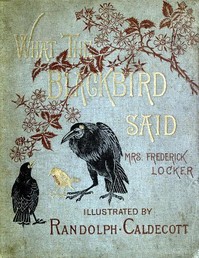
WHAT THE BLACKBIRD SAID.
A Story IN FOUR CHIRPS.
BY MRS. FREDERICK LOCKER.
ILLUSTRATED BY RANDOLPH CALDECOTT.
LONDON GEORGE ROUTLEDGE AND SONS BROADWAY, LUDGATE HILL NEW YORK: 416 BROOME STREET 1881
LONDON: R. CLAY, SONS, AND TAYLOR, BREAD STREET HILL, E.C.
TO MY DEAR CHILDREN, GODFREY AND DOROTHY, THIS LITTLE STORY IS AFFECTIONATELY DEDICATED BY THEIR MOTHER.
CONTENTS. PAGE CHIRP THE FIRST--WINTER 1 CHIRP THE SECOND--SPRING 22 CHIRP THE THIRD--SUMMER 47 CHIRP THE FOURTH--AUTUMN 69
LIST OF ILLUSTRATIONS. PAGE THE BLACKBIRD ON A SMALL WHITE HILLOCK. 4 THE ROBIN'S NEST. 38 THE ROOK. 62 THE THREE FRIENDS--THE ROBIN, THE ROOK, AND THE BLACKBIRD. 84
CHIRP THE FIRST.
The winter of 1878 was certainly an unusually dreary one, and so thought a remarkably fine young Blackbird, as he perched one morning on the bare bough of a spreading lime-tree, whose last brown leaf had fallen to the ground some weeks before.
With the exception of the Scotch firs and other fortunate evergreens, there was nothing to be seen on all sides but leafless branches standing out sharply against the cold, grey sky. The ground was frozen, and entirely covered with snow, for there had been a heavy fall during the night. The way-marks of field and road were obliterated, all was one sheet of dazzling whiteness. Here and there a little mound marked the spot where a flower-bed lay buried, and there was one narrow path where the snow was thickly piled on either side, for it had been partially swept from the centre, which showed traces of the bright brown gravel below.
The Blackbird was contemplating this landscape in a discontented and unhappy frame of mind. He was, as we have just said, a remarkably fine young bird. His plumage was of a glossy blackness, with which not even a raven's could vie; his bright eyes looked even brighter as they gleamed from the deep yellow rims which surrounded them, and his bill resembled the polished shaft of an early crocus.
At the time at which my story begins, this Blackbird was about eight months old, and usually he was not a little vain of his appearance. On this particular morning, however, he did not feel at all so proud of himself, or especially pleased with any one or anything. He had passed the long night in a wood hard by, and had been benumbed with cold.
He had tucked his head first under one wing, and then under the other, but it had been of no use, the cutting wind had penetrated even his thick warm feathers, and had ruffled them in a way which had sorely discomposed him, in body as well as in mind.
Then again, all through the night he had been exceedingly put out by little cold wet dabs which kept continually falling on his back. The Blackbird had changed his position--he had done it several times: he had moved from a birch to an elm, and then to a beech-tree. But it was of no avail, the little cold droppings seemed to pursue him wherever he went, and it was not till quite late in the night that he found real shelter, and got a little rest in a thick mantle of ivy which completely covered a wall near the stables.
What were these cold droppings? He could not imagine. He knew well enough they were not rain; rain always made a sharp pelting noise as it struck against the trees. But there had been no such sound, for, with the exception of the occasional sighing of the wind, the night had been a singularly noiseless one. What then could this cold, soft moisture be?
The Blackbird could not at all understand it, but as he was well sheltered, and soon got warm in the ivy, he fell asleep and forgot all about it.
The next morning, however, when he woke up and peeped forth from his green canopy, he was much astonished by the sight which met his eyes. Everything was white! The green fields were gone, the lawn where he found his worms, the flower-beds where he caught his insects,--all had disappeared, and a broad, white, sparkling covering lay over everything. What was it? what could it mean?
The Blackbird had no one to explain it all to him, so he thought he would just take a short flight and find out for himself. He stretched his wings and skimmed away over the white ground, and then he thought he would rest for a while on a small white hillock.
No sooner, however, had his little dusky brown feet touched the surface of the snow, than he found he was gradually sinking down, down into a soft, but very cold white bed. With a shrill cry of alarm he flew up again, and did not stop until he alighted on the bough of the lime-tree where we were first introduced to him. What was it? What wonderful and terrible new thing was this? and where was he to go for his breakfast?
He was sitting in a very melancholy frame of mind, stretching out first one foot and then the other, when his attention was arrested by a flood of joyous song poured forth from above, and looking up, he saw a bright-breasted Robin on the bough immediately over his head.
The little bird in his scarlet and brown plumage looked more richly coloured and even more beautiful than usual, as, supported by his slender legs, with his head thrown back and his feathers puffed out, he poured forth his light-hearted carol to the leafless woods.
"How can you sing on this miserable morning?" said the Blackbird, gloomily, and indeed half contemptuously.
"Miserable morning!" replied the Robin in a tone of surprise; "why I don't think it's at all a miserable morning,--just look at the beautiful snow."
"Oh, that's what you call that white stuff down there, is it?" said the Blackbird, disdainfully gazing at the white world beneath him.
"Yes, to be sure," said the Robin; "have you never seen snow before?"
"No," replied the Blackbird, "I've not, and I shan't break my heart if I never see it again. All last night it was dropping on my back till I was wet through and through; and just now, when I flew down to look about for my breakfast, why it all gave way under my feet, and I might have been smothered."
"Ah," said the Robin, shaking his head, "you won't mind it when you get more used to it. You see you're a young bird; this is only your first winter. Now I saw it all last winter. I'm nearly two years old."
The Robin said this with a certain pride of seniority, and stretched himself to his full height as he looked at his younger, but much more bulky, neighbour.
"I don't see any great advantage in being old," said the Blackbird, sarcastically; "but since you are so experienced, perhaps you can tell me what it all means?"
"Yes, I can," said the Robin, hopping a little nearer. "Rain, you know, comes down from the clouds up there. Well, when it gets very cold indeed, as it is just now" (here the Blackbird shivered visibly), "why, then the clouds get frozen, and instead of falling in soft, warm little drops, they come down in these white flakes, which we call snow. I am not very learned myself," said the Robin, humbly, "but a very wise friend of mine, an old Rook, told me all this, and he also said that if I examined a flake of snow, I should find it was made of beautiful crystals, each shaped like a little star."
"Indeed," said the Blackbird, "that is very curious, but, in the meantime, I should very much like to know what I am to do for something to eat. The fruit is all gone from the garden, and I can't find any insects in the snow. Ivy-berries will be poorish eating day after day."
"What do all your friends do?" asked the Robin.
"I don't see much of my friends," replied the Blackbird; "we Blackbirds are not so mighty fond of each other's company, we like to live alone, we never," he said this rather loftily, "talk much to strangers; in fact, during this cold weather, we don't care to talk to each other."
"Every one must judge for himself," quoth the Robin, "but methinks it would be rather a dull world if none of us spoke to each other when it was cold. You see it's very often cold here in old England, and the winters are very long and dark. I should like to know what we should all do without a little cheerful talk, and an occasional snatch of song?"
"As to singing," struck in the Blackbird, "I've been so hoarse these last two months, that it's only when the sun is very bright indeed that I can sing at all, and all my friends are in the same plight. There are no leaves on the trees, there is no music in the woods, there is no sunshine to speak of, and it's altogether exceedingly dull."
The Robin did not exactly know how to reply to this wail of discontent, so he gathered himself together and poured forth a bright little song.
"How is it," said the Blackbird suddenly, "that you have all at once become such a great songster? I never remember hearing your voice in the summer."
The book keeps going
Reading is free forever. Sign up and watch scenes appear while you read.



Scenes Storieta drew for other classics.
New illustrated classics
Once or twice a month: the latest books to get full character casts, scene art, and free comic editions. No account needed.