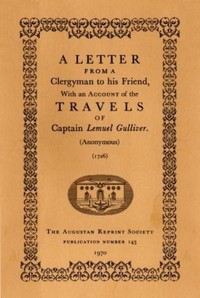
As Gay's letter suggests, details concerning the contemporary reception of Gulliver's Travels exhibit two sides of Jonathan Swift's character--the pleasant (that is, merry, witty, amusing) and the unpleasant (that is, sarcastic, envious, disaffected). A person with a powerful ego and astringent sense of humor, Swift must have been a delightful friend, if somewhat difficult, but also a dangerous enemy. A Letter from a Clergyman (1726), here reproduced in a facsimile of its first and only edition, is a reaction typical of those who regard Swift and the sharp edge of his satire with great suspicion and revulsion. It displays the dangerously Satanic aspect of Swift--that side of his character which for some people represented the whole man since the allegedly blasphemous satire in A Tale of a Tub, published and misunderstood early in his career, critically affected, even by his own admission, his employment in the Church. It is this evil character of the author, the priest with an indecorous and politically suspect humor, that offended some contemporary readers. To them, the engraved frontispiece of Jonathan Smedley's scurrilous Gulliveriana (1728) is the proper image of the author of the Travels. It portrays Swift in a priest's vestments that barely conceal a cloven hoof.
In the following pages, we shall define the historical context of the clergyman's Letter and illuminate the nature of the literary warfare in which Swift was an energetic if not particularly cheerful antagonist when Gulliver's Travels was published late in 1726.
In another letter, Gay remarked to Swift (17 November 1726) that "The Politicians to a man agree, that it [the _Travels_] is free from particular reflections"; nevertheless some "people of greater perspicuity" would "search for particular applications in every leaf." He also predicted that "we shall have keys publish'd to give light into Gulliver's design." His prediction was correct, for it was not long before four Keys, the earliest commentary in pamphlet form on the Travels, were published by a Signor Corolini, undoubtedly a pseudonym for Edmund Curll, the London printer and bookseller. But surprisingly, the observations do not exhibit Swift in a harsh factional light. As a matter of fact, in his introduction to the Keys, which are entitled Lemuel Gulliver's Travels into Several Remote Nations of the World. Compendiously Methodized, For Publick Benefit: With Observations and Explanatory Notes Throughout (1726), Curll flatters Swift as possessing "the true Vein of Humour and polite Conversation" (I, 4). Regarding the Travels, he observes, "The Town are infinitely more eager after them than they were after Robinson Crusoe" (I, 5).
In general, the Keys are pleasantly written, including no nasty innuendoes critical of Swift's high-church sectarian zeal or his high-flying Tory political sympathies. They may be considered a frankly commercial venture meant to exploit the popularity of the Travels. Curll merely summarizes the narratives, occasionally providing substantial extracts or sprinkling explanatory comments on some allusions that attract him. Some of the annotations are ridiculous, or curious, like the equations of Blefuscu with Scotland, of the storm Gulliver passes through before reaching Brobdingnag with "the South-Sea and Mississippi Confusion," and of the giants with inflated South Sea stock (II, 4). Some remarks, however, appear convincing, such as his belief that "the trifling Transactions of the present English Royal Society" on insects and fossils are "finely rallied" (II, 11-12). Curll also notes about the third voyage that "besides the political Allegory, Mr. Gulliver has many shrewd Remarks upon Men and Books, Sects, Parties, and Opinions" (III, 10-11). Concerning the fourth, he equates the good Portuguese Captain Don Pedro with the Dean's "good Friend the Earl of P[eterboroug]h" (IV, 26). The Roman Catholic Peterborough, we recall, fought in Spain and was also Pope's good friend.
Other more suggestive comments on Swift's political meaning may be cited. For example, the "_ancient Temple_" in which Gulliver is housed in Lilliput, a structure "_polluted ... by an unnatural Murder_," he identifies as "the Banquetting-House at White-Hall, before which Structure, King CHARLES I was Beheaded" (I, 7-8). This allusion to "the Royal-Martyr" (III, 32) may be considered a modest clue to Swift's Toryism, and it is associated with the Jacobitism of which his Whiggish enemies accused him. Yet an unusual reading of the Struldbruggs in the third voyage (particularly the controls imposed on the senile creatures in order to prevent their engrossing the civil power) as an attack on the religious dissenters demonstrates that Curll and Swift agreed on the issue of an established church. The clergy who wished to separate state from church, or as Curll describes the situation,
that implacable Spirit and Rancour ... [of] those English Ecclesiasticks, who have asserted the Independency of the Church upon the State ... ought to the latest Posterity in England, to be called Struldbruggs. For it will be found ... that, whenever they assume the Civil Power, their want of Abilities to manage, must end in the Ruin of the Publick. (III, 32)
Indeed, among the most interesting of Currl's annotations are those which suggest that a religious reading of the Travels was by no means unappreciated by Swift's contemporaries. Thus, again, besides his unusual politico-religious comment on the Struldbruggs, Curll is fairly sharp in his annotation of the passage on religious differences in Chapter V of the fourth voyage, concerning "_Transubstantiation_ as believed by the Papists," "Cathedral-worship," kissing the Crucifix, vestments,--and resulting furious religious wars (IV, 12-13). All in all, however, the Keys are singularly shallow and agreeably bland. Curll simply agrees with Gulliver-Swift, and reinforces the meaning by practically repeating the text, as he does at this point when deploring inessential differences in ritual as needless causes of cruel conflict. Although Curll was aware of the presence of politics and religion in Swift's allegories, his annotations do not reflect unfavorably on Swift's character.
But it was not long before an attack on Swift was mounted. It began with A Letter from a Clergyman to His Friend, With an Account of the Travels of Capt. Lemuel Gulliver: And a Character of the Author. To Which is Added, The True Reasons Why a Certain Doctor Was Made a Dean (1726)--the first substantial attack on Swift resulting from the publication of his most celebrated work. The identity of the author is unknown. Steele, Swift's implacable political enemy, had retired to the country at this time and was soon to die. Because of the numerous references to Swift's treacherous disloyalty to Steele's friendship, we could speculate on a connection between the anonymous author and Steele and infer that it was a friendly relationship.
The long and breathless title underlines the malicious content of this polemical pamphlet, a pungent libel on Swift's character that includes cutting observations on Swift's chief fiction as well. Obviously, the author's intent is to vilify Swift in retaliation for attacks on the writer's friends. Inspired by the publication of the Travels, he presents a crudely defamatory "Character of the Author." He claims an acquaintance with Swift "in publick and private Life" (p. 4) but offers no evidence to substantiate this claim. Drawing from common knowledge, he simply cites the well-known negative evidence of A Tale of a Tub, in which Swift, he indignantly asserts like Swift's former enemy William Wotton, "levelled his Jests at Almighty God; banter'd and ridiculed Religion," thereby offending Queen Anne and blocking his own church preferment (p. 19). Except for "some gross Words, and lewd Descriptions, and had the Inventor's Intention been innocent" (p. 6 [note the suspicion of Swift's political and religious bias]), the author is mildly pleased with the first three voyages. But he finds intolerable the satire on human nature in the last, here echoing Addison's criticism of the demoralizing effect of a satire on mankind (Spectator 249, 5 December 1711).
However, Swift's "Intention" in the first three voyages is, he angrily declares, tinctured by his poisonous malice and envy, the result of twelve years of exile. He is positive of the identity of the vicious person behind the mask of the imaginary memoirist:
Here, Sir, you may see a reverend Divine, a dignify'd Member of the Church unbosoming himself, unloading his Breast, discovering the true Temper of his Soul, drawing his own Picture to the Life; here's no Disguise, none could have done it so well as himself.... (p. 8)
He detects envy in what he believes is the incendiary narrator of the Travels, and insists that by siding with the enemies of the nation, meaning France, Swift was "endeavouring to ruin the British Constitution, set aside the Hanover Succession, and bring in a [tyrannical] Popish Pretender," and, of course, "destroy our Church Establishment" (pp. 14, 8-9). Thereupon, he furiously threatens Swift with punishment for his pernicious attack on the government, that is, the present political administration. Clearly motivated by politico-religious fears, this Whig militantly defends not only the Protestant succession but also the ministry of Sir Robert Walpole--which the numerous allusions to the "_Great Man_" and "the greatest Man this Nation ever produced" (p. 15) confirm. Swift's mean character of Flimnap, the Lilliputian Prime Minister, stung badly: "With what Indignation must every one that has had the Honour to be admitted to this Great Man, review the Doctor's charging him with being morose" (p. 15). He counters Swift's insulting reduction of the Great Man to a petty little man with an egregiously fulsome panegyric that magnifies the virtues of Sir Robert's public and private character, and concludes with abuse of Swift's character as an Irish dean disaffected from the government--hence deserving of permanent exile in Ireland.[1]
The author of the fiery Letter focuses on Swift's impiety--pointing to his wickedness, the sneering tone of his sacrilegious satire, his indiscreet joking about religion, all of which Swift's enemies were quick to emphasize as the outstanding features of A Tale of a Tub, as well as portions of the Travels. For example, even Gay, in the letter to Swift quoted above (17 November 1726) also noted that those "who frequent the Church, say his [Gulliver's] design is impious, and that it is an insult on Providence, by depreciating the works of the Creator,"--a line of attack soon to be pursued by Edward Young, James Beattie, and others who were not in the least charmed by Swift's satire. But Swift's friends were not idle; for it was precisely this bitter onslaught on Swift's religion in the Letter that brought another writer to the defense in the ironically entitled Gulliver Decypher'd: or Remarks on a Late Book, Intitled, Travels Into Several Remote Nations of the World, Vindicating the Reverend Dean on Whom it is Maliciously Father'd, With Some Conjectures Concerning the Real Author (1726).[2]