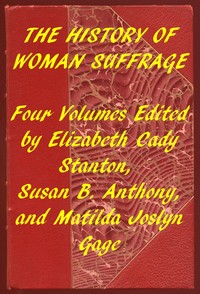
After the movement for woman suffrage, which commenced about the middle of the nineteenth century, had continued for twenty-five years, the feeling became strongly impressed upon its active promoters, Miss Susan B. Anthony and Mrs. Elizabeth Cady Stanton, that the records connected with it should be secured to posterity. With Miss Anthony, indeed, the idea had been ever present, and from the beginning she had carefully preserved as far as possible the letters, speeches and newspaper clippings, accounts of conventions and legislative and congressional reports. By 1876 they were convinced through various circumstances that the time had come for writing the history. So little did they foresee the magnitude which this labor would assume that they made a mutual agreement to accept no engagements for four months, expecting to finish it within that time, as they contemplated nothing more than a small volume, probably a pamphlet of a few hundred pages. Miss Anthony packed in trunks and boxes the accumulations of the years and shipped them to Mrs. Stanton's home in Tenafly, N. J., where the two women went cheerfully to work.
Mrs. Stanton was the matchless writer, Miss Anthony the collector of material, the searcher of statistics, the business manager, the keen critic, the detector of omissions, chronological flaws and discrepancies in statement such as are unavoidable even with the most careful historian. On many occasions they called to their aid for historical facts Mrs. Matilda Joslyn Gage, one of the most logical, scientific and fearless writers of her day. To Mrs. Gage Vol. I of the History of Woman Suffrage is wholly indebted for the first two chapters--Preceding Causes and Woman in Newspapers, and for the last chapter--Woman, Church and State, which she later amplified in a book; and Vol. II for the first chapter--Woman's Patriotism in the Civil War.
When the allotted time had expired the work had far exceeded its original limits and yet seemed hardly begun. Its authors were amazed at the amount of history which already had been made and still more deeply impressed with the desirability of preserving the story of the early struggle, but both were in the regular employ of lecture bureaus and henceforth could give only vacations to the task. They were entirely without the assistance of stenographers and typewriters, who at the present day relieve brain workers of so large a part of the physical strain. A labor which was to consume four months eventually extended through ten years and was not completed until the closing days of 1885. The pamphlet of a few hundred pages had expanded into three great volumes of 1,000 pages each, and enough material remained unused to fill another.[1]
It was almost wholly due to Miss Anthony's clear foresight and painstaking habits that the materials were gathered and preserved during all the years, and it was entirely owing to her unequaled determination and persistence that the History was written. The demand for Mrs. Stanton on the platform and the cares of a large family made this vast amount of writing a most heroic effort, and one which doubtless she would have been tempted to evade had it not been for the relentless mentor at her side, helping to bear her burdens and overcome the obstacles, and continually pointing out the necessity that the history of this movement for the emancipation of women should be recorded, in justice to those who carried it forward and as an inspiration to the workers of the future. And so together, for a long decade, these two great souls toiled in the solitude of home just as together they fought in the open field, not for personal gain or glory, but for the sake of a cause to which they had consecrated their lives. Had it not been for their patient and unselfish labor the story of the hard conditions under which the pioneers struggled to lift woman out of her subjection, the bitterness of the prejudice, the cruelty of the persecution, never would have been told. In all the years that have passed no one else has attempted to tell it, and should any one desire to do so it is doubtful if, even at this early date, enough of the records could be found for the most superficial account. In not a library can the student who wishes to trace this movement to its beginning obtain the necessary data except in these three volumes, which will become still more valuable as the years go by and it nears success.
Miss Anthony began this work in 1876 without a dollar in hand for its publication. She never had the money in advance for any of her undertakings, but she went forward and accomplished them, and when the people saw that they were good they usually repaid the amount she had advanced from her own small store. In this case she resolved to use the whole of it and all she could earn in the future rather than not publish the History. Mrs. Elizabeth Thompson, of New York, a generous patron of good works, gave her the first $1,000 in 1880, but this did not cover the expenses that had been actually incurred thus far in its preparation. She was in nowise discouraged, however, but kept steadily on during every moment which could be spared by Mrs. Stanton and herself, absolutely confident that in some way the necessary funds would be obtained. Her strong faith was justified, for the first week of 1882 came a notice from Wendell Phillips that Mrs. Eliza Jackson Eddy, of Boston, had left her a large legacy to be used according to her own judgment "for the advancement of woman's cause." Litigation by an indirect heir deprived her of this money for over three years, but in April, 1885, she received $24,125.
The first volume of the History had been issued in May, 1881, and the second in April, 1882. In June, 1885, Mrs. Stanton and Miss Anthony set resolutely to work and labored without ceasing until the next November, when the third volume was sent to the publishers. With the bequest Miss Anthony paid the debts that had been incurred, replaced her own fund, of which every dollar had been used, and brought out this last volume. All were published at a time when paper and other materials were at a high price. The fine steel engravings alone cost $5,000. On account of the engagements of the editors it was necessary to employ proofreaders and indexers, and because of the many years over which the work had stretched an immense number of changes had to be made in composition, so that a large part of the legacy was consumed.
The money which Miss Anthony now had enabled her to carry out her long-cherished project to put this History free of charge in the public libraries. It was thus placed in twelve hundred in the United States and Europe. Mrs. Stanton and Mrs. Gage, who had contributed their services without price, naturally felt that it should be sold instead of given away, and in order to have a perfectly free hand she purchased their rights. In addition to the libraries, she has given it to hundreds of schools and to countless individuals, writers, speakers, etc., whom she thought it would enable to do better work for the franchise. For seventeen years she has paid storage on the volumes and the stereotype plates. During this time there has been some demand for the books from those who were able and willing to pay, but much the largest part of the labor and money expended were a direct donation to the cause of woman suffrage.
From the time the last volume was finished it was Miss Anthony's intention, if she should live twenty years longer, to issue a fourth containing the history which would be made during that period, and for this purpose she still preserved the records. As the century drew near a close, bringing with it the end of her four-score years, the desire grew still stronger to put into permanent shape the continued story of a contest which already had extended far beyond the extreme limits imagined when she dedicated to it the full power of her young womanhood with its wealth of dauntless courage and unfailing hope. She resigned the presidency of the National Association in February, 1900, which marked her eightieth birthday, in order that she might carry out this project and one or two others of especial importance. Among her birthday gifts she received $1,000 from friends in all parts of the country, and this sum she resolved to apply to the contemplated volume. One of the other objects which she had in view was the collecting of a large fund to be invested and the income used in work for the enfranchisement of women. Already about $3,000 had been subscribed.
By the time the first half year had passed, nature exacted tribute for six decades of unceasing and unparalleled toil, and it became evident that the idea of gathering a reserve fund would have to be abandoned. The donors of the $3,000 were consulted and all gave cordial assent to have their portion applied to the publication of the fourth volume of the History. The largest amount, $1,000, had been contributed by Mrs. Pauline Agassiz Shaw, of Boston. Dr. Cordelia A. Greene, of Castile, N. Y., had given $500 and Mrs. Emma J. Bartol, of Philadelphia, $200. The other contributions ranged all the way down to a few dollars, which in many cases represented genuine sacrifice on the part of the givers. It is not practicable to publish the list of the women in full. They will be sufficiently rewarded in the consciousness of having helped to realize Miss Anthony's dream of finishing the story, to the end of her own part in it, of a great progressive movement in which they were her fellow-workers and loyal friends.
Mrs. Gage passed away in 1898. Although Mrs. Stanton is still living as this volume goes to the publishers in 1902, and evinces her mental vigor at the age of eighty-seven in frequent magazine and newspaper articles, she could not be called upon for this heavy and exacting task. It seemed to Miss Anthony that the one who had recently completed her Biography, in its preparation arranging and classifying her papers of the past sixty years, and who necessarily had made a thorough study of the suffrage movement from its beginning, should share with her this arduous undertaking. The invitation was accepted with much reluctance because of a full knowledge of the great labor and responsibility involved. It must be confessed that even a strong sense of obligation to further the cause of woman's enfranchisement would not have been a sufficient incentive, but personal devotion to a beloved and honored leader outweighed all selfish considerations. It is to Miss Anthony, however, that the world is indebted for this as well as the other volumes. It was she who conceived the idea; through her came the money for its publication; for several years her own home has been given up to the mass of material, the typewriters, the coming and going of countless packages, the indescribable annoyances and burdens connected with a matter of this kind. In addition she has borne from her private means a considerable portion of the expenses, and has endured the physical weariness and mental anxiety at a time when she has earned the right to complete rest and freedom from care. There is not a chapter which has not had the inestimable benefit of her acute criticism and matured judgment.