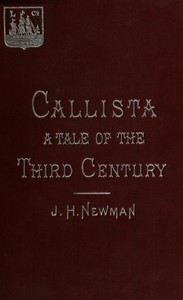
HENRY WILLIAM WILBERFORCE.
To you alone, who have known me so long, and who love me so well, could I venture to offer a trifle like this. But you will recognise the author in his work, and take pleasure in the recognition.
J. H. N.
ADVERTISEMENT.
It is hardly necessary to say that the following Tale is a simple fiction from beginning to end. It has little in it of actual history, and not much claim to antiquarian research; yet it has required more reading than may appear at first sight.
It is an attempt to imagine and express, from a Catholic point of view, the feelings and mutual relations of Christians and heathens at the period to which it belongs, and it has been undertaken as the nearest approach which the Author could make to a more important work suggested to him from a high ecclesiastical quarter.
September 13, 1855.
POSTSCRIPTS TO LATER EDITIONS.
_February 8, 1856._—Since the volume has been in print, the Author finds that his name has got abroad. This gives him reason to add, that he wrote great part of Chapters I., IV., and V., and sketched the character and fortunes of Juba, in the early spring of 1848. He did no more till the end of last July, when he suddenly resumed the thread of his tale, and has been successful so far as this, that he has brought it to an end.
Without being able to lay his finger upon instances in point, he has some misgiving lest, from a confusion between ancient histories and modern travels, there should be inaccuracies, antiquarian or geographical, in certain of his minor statements, which carry with them authority when they cease to be anonymous.
_February 2, 1881.—October, 1888._—In a tale such as this, which professes in the very first sentence of its Advertisement to be simple fiction from beginning to end, details may be allowably filled up by the writer’s imagination and coloured by his personal opinions and beliefs, the only rule binding on him being this—that he has no right to contravene acknowledged historical facts. Thus it is that Walter Scott exercises a poet’s licence in drawing his Queen Elizabeth and his Claverhouse, and the author of “Romola” has no misgivings in even imputing hypothetical motives and intentions to Savonarola. Who, again, would quarrel with Mr. Lockhart, writing in Scotland, for excluding Pope, or Bishops, or sacrificial rites from his interesting Tale of Valerius?
Such was the understanding, as to what I might do and what I might not, with which I wrote this story; and to make it clearer, I added in the later editions of this Advertisement, that it was written “from a Catholic point of view;” while in the earlier, bearing in mind the interests of historical truth, and the anachronism which I had ventured on at page 82 in the date of Arnobius and Lactantius, I said that I had not “admitted any actual interference with known facts without notice,” questions of religious controversy, when I said it, not even coming into my thoughts. I did not consider my Tale to be in any sense controversial, but to be specially addressed to Catholic readers, and for their edification.
This being so, it was with no little surprise I found myself lately accused of want of truth, because I have followed great authorities in attributing to Christians of the middle of the third century what is certainly to be found in the fourth,—devotions, representations, and doctrines, declaratory of the high dignity of the Blessed Virgin. If I had left out all mention of these, I should have been simply untrue to my idea and apprehension of Primitive Christianity. To what positive and certain facts do I run counter in so doing, even granting that I am indulging my imagination? But I have allowed myself no such indulgence; I gave good reasons long ago, in my “Letter to Dr. Pusey” (pp. 53–76), for what I believe on this matter and for what I have in “Callista” described.
CONTENTS.
CHAP. PAGE I. SICCA VENERIA 1 II. CHRISTIANITY IN SICCA 14 III. AGELLIUS IN HIS COTTAGE 25 IV. JUBA 30 V. JUCUNDUS AT SUPPER 39 VI. GOTHS AND CHRISTIANS 51 VII. PERSECUTION IN THE OFFING 64 VIII. THE NEW GENERATION 80 IX. JUCUNDUS BAITS HIS TRAP 92 X. THE DIVINE CALLISTA 111 XI. CALLISTA’S PREACHING, AND WHAT CAME OF IT 122 XII. A DEATH 135 XIII. AND RESURRECTION 145 XIV. A SMALL CLOUD 159 XV. A VISITATION 168 XVI. WORSE AND WORSE 178 XVII. CHRISTIANOS AD LEONES 189 XVIII. AGELLIUS FLITS 199 XIX. A PASSAGE OF ARMS 212 XX. HE SHALL NOT LOSE HIS REWARD 226 XXI. STARTLING RUMOURS 235 XXII. JUCUNDUS PROPOUNDS HIS VIEW OF THE SITUATION 239 XXIII. GURTA 256 XXIV. A MOTHER’S BLESSING 266 XXV. CALLISTA IN DURANCE 274 XXVI. WHAT CAN IT ALL MEAN? 281 XXVII. AM I A CHRISTIAN? 291 XXVIII. A SICK CALL 305 XXIX. CONVERSION 317 XXX. TORRES VEDRAS 329 XXXI. THE BAPTISM 343 XXXII. THE IMPERIAL RESCRIPT 352 XXXIII. A GOOD CONFESSION 357 XXXIV. THE MARTYRDOM 366 XXXV. THE CORPO SANTO 371 XXXVI. LUX PERPETUA SANCTIS TUIS, DOMINE 377
In no province of the vast Roman empire, as it existed in the middle of the third century, did Nature wear a richer or a more joyous garb than she displayed in Proconsular Africa, a territory of which Carthage was the metropolis, and Sicca might be considered the centre. The latter city, which was the seat of a Roman colony, lay upon a precipitous or steep bank, which led up along a chain of hills to a mountainous track in the direction of the north and east. In striking contrast with this wild and barren region was the view presented by the west and south, where for many miles stretched a smiling champaign, exuberantly wooded, and varied with a thousand hues, till it was terminated at length by the successive tiers of the Atlas, and the dim and fantastic forms of the Numidian mountains. The immediate neighbourhood of the city was occupied by gardens, vineyards, corn-fields, and meadows, crossed or encircled here by noble avenues of trees or the remains of primeval forests, there by the clustering groves which wealth and luxury had created. This spacious plain, though level when compared with the northern heights by which the city was backed, and the peaks and crags which skirted the southern and western horizon, was discovered, as light and shadow travelled with the sun, to be diversified with hill and dale, upland and hollow; while orange gardens, orchards, olive and palm plantations held their appropriate sites on the slopes or the bottoms. Through the mass of green, which extended still more thickly from the west round to the north, might be seen at intervals two solid causeways tracking their persevering course to the Mediterranean coast, the one to the ancient rival of Rome, the other to Hippo Regius in Numidia. Tourists might have complained of the absence of water from the scene; but the native peasant would have explained to them that the eye alone had reason to be discontented, and that the thick foliage and the uneven surface did but conceal what mother earth with no niggard bounty supplied. The Bagradas, issuing from the spurs of the Atlas, made up in depth what it wanted in breadth of bed, and ploughed the rich and yielding mould with its rapid stream, till, after passing Sicca in its way, it fell into the sea near Carthage. It was but the largest of a multitude of others, most of them tributaries to it, deepening as much as they increased it. While channels had been cut from the larger rills for the irrigation of the open land, brooks, which sprang up in the gravel which lay against the hills, had been artificially banked with cut stones or paved with pebbles; and where neither springs nor rivulets were to be found, wells had been dug, sometimes to the vast depth of as much as 200 fathoms, with such effect that the spurting column of water had in some instances drowned the zealous workmen who had been the first to reach it. And, while such were the resources of less favoured localities or seasons, profuse rains descended over the whole region for one half of the year, and the thick summer dews compensated by night for the daily tribute extorted by an African sun.
At various distances over the undulating surface, and through the woods, were seen the villas and the hamlets of that happy land. It was an age when the pride of architecture had been indulged to the full; edifices, public and private, mansions and temples, ran off far away from each market-town or borough, as from a centre, some of stone or marble, but most of them of that composite of fine earth, rammed tight by means of frames, for which the Saracens were afterwards famous, and of which specimens remain to this day, as hard in surface, as sharp at the angles, as when they first were finished. Every here and there, on hill or crag, crowned with basilicas and temples, radiant in the sun, might be seen the cities of the province or of its neighbourhood, Thibursicumber, Thugga, Laribus, Siguessa, Sufetula, and many others; while in the far distance, on an elevated table-land under the Atlas, might be discerned the Colonia Scillitana, famous about fifty years before the date of which we write for the martyrdom of Speratus and his companions, who were beheaded at the order of the proconsul for refusing to swear by the genius of Rome and the emperor.
If the spectator now takes his stand, not in Sicca itself, but about a quarter of a mile to the south-east, on the hill or knoll on which was placed the cottage of Agellius, the city itself will enter into the picture. Its name, Sicca Veneria, if it be derived (as some suppose) from the Succoth benoth, or “tents of the daughters,” mentioned by the inspired writer as an object of pagan worship in Samaria, shows that it owed its foundation to the Phœnician colonists of the country. At any rate, the Punic deities retained their hold upon the place; the temples of the Tyrian Hercules and of Saturn, the scene of annual human sacrifices, were conspicuous in its outline, though these and all other religious buildings in it looked small beside the mysterious antique shrine devoted to the sensual rites of the Syrian Astarte. Public baths and a theatre, a capitol, imitative of Rome, a gymnasium, the long outline of a portico, an equestrian statue in brass of the Emperor Severus, were grouped together above the streets of a city, which, narrow and winding, ran up and down across the hill. In its centre an extraordinary spring threw up incessantly several tons of water every minute, and was inclosed by the superstitious gratitude of the inhabitants with the peristylium of a sacred place. At the extreme back, towards the north, which could not be seen from the point of view where we last stationed ourselves, there was a sheer descent of rock, bestowing on the city, when it was seen at a distance on the Mediterranean side, the same bold and striking appearance which attaches to Castro Giovanni, the ancient Enna, in the heart of Sicily.
And now, withdrawing our eyes from the panorama, whether in its distant or nearer objects, if we would at length contemplate the spot itself from which we have been last surveying it, we shall find almost as much to repay attention, and to elicit admiration. We stand in the midst of a farm of some wealthy proprietor, consisting of a number of fields and gardens, separated from each other by hedges of cactus or the aloe. At the foot of the hill, which sloped down on the side furthest from Sicca to one of the tributaries of the rich and turbid river of which we have spoken, a large yard or garden, intersected with a hundred artificial rills, was devoted to the cultivation of the beautiful and odoriferous khennah. A thick grove of palms seemed to triumph in the refreshment of the water’s side, and lifted up their thankful boughs towards heaven. The barley harvest in the fields which lay higher up the hill was over, or at least was finishing; and all that remained of the crop was the incessant and importunate chirping of the cicadæ, and the rude booths of reeds and bulrushes, now left to wither, in which the peasant boys found shelter from the sun, while in an earlier month they frightened from the grain the myriads of linnets, goldfinches, and other small birds who, as in other countries, contested with the human proprietor the possession of it. On the south-western slope lies a neat and carefully dressed vineyard, the vine-stakes of which, dwarfish as they are, already cast long shadows on the eastern side. Slaves are scattered over it, testifying to the scorching power of the sun by their broad petasus, and to its oppressive heat by the scanty subligarium, which reached from the belt or girdle to the knees. They are engaged in cutting off useless twigs to which the last showers of spring have given birth, and are twisting those which promise fruit into positions where they will be safe both from the breeze and from the sun. Everything gives token of that gracious and happy season which the great Latin poets have hymned in their beautiful but heathen strains; when, after the heavy rains, and raw mists, and piercing winds, and fitful sun-gleams of a long six months, the mighty mother manifests herself anew, and pours out the resources of her innermost being for the life and enjoyment of every portion of the vast whole;—or, to apply the lines of a modern bard—