Public-domain ebook
Doctor Bolus and His Patients
by Unknown
Language: en347 downloads on Project Gutenberg
Subjects
In: Children & Young Adult Reading
Public-domain ebook sourced from Project Gutenberg #31909.
Public-domain ebook
by Unknown
Language: en347 downloads on Project Gutenberg
Subjects
In: Children & Young Adult Reading
Public-domain ebook sourced from Project Gutenberg #31909.
The opening · free to read
HIS PATIENTS.
TROY, N. Y. MERRIAM, MOORE & CO.
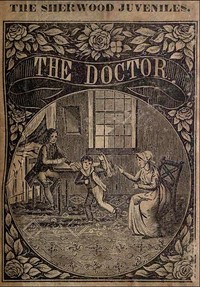
DOCTOR BOLUS AND HIS PATIENTS.
Old Doctor Bolus was an old fashioned Doctor, and every morning started out with his cane, to visit his patients, sometimes taking with him his student, a man who had taken to studying medicine at thirty years old, in the hope of being the successor of Doctor Bolus.
We will follow the Doctor's rounds for one morning. First he called at the Squire's, whose father was sick. The Doctor examined his tongue, felt his pulse, and mixed a white powder and a gray powder, giving directions for him to take a little every two hours. Then, after talking over the state of the crops with the Squire, he went on to his next patient, old black John, the colored man. John was very poor, but a good Quaker had relieved his wants and the Doctor gave him a dose of calomel, telling him he would soon be at work again.
The Doctor's next call was to see little Kitty Green, the merchant's daughter; Kitty had meddled with a sharp knife, and cut her finger pretty severely; if she had been a poor man's daughter it would have got well without the doctor, but rich people can afford to call the doctor for little things, so Doctor Bolus applied some salve to Kitty's finger, and she was soon playing again.
The next patient was Mrs. Droley, who always imagined she was sick, and had been one of the Doctor's regular patients for several years; and if a few days passed without his calling on her, he was sure to be sent for. Mrs. Droley kept her room and her bed much of the time, thinking she had only strength to feed her cat. The doctor could not do her much good, but gave her a little harmless medicine.
The last call the Doctor made before his dinner, was at Mrs. Smith's. She had been sick for a long time, and a few months before this her husband had been drawn in to commit a robbery, for which he was sentenced to imprisonment for life. She was rapidly failing, and would soon die. She had mourned only that she must leave her little daughter destitute, but was now assured that a good home was provided for Mary by her friends; and she felt that she could die happy.
DOCTOR BOLUS AFTER DINNER.
After dinner Doctor Bolus went to visit a very poor woman, who was sick with a lung fever, and all alone, only when a colored girl came in to help her, or to read to her. The Doctor knew he could not cure her, and only gave her a little medicine to soothe her pain.
His next visit was to Susan Blake, a little girl of ten years old, who was very sick, and could not recover. She had one sister, and they were orphans. It was hard indeed for them to part, but they both knew that death would soon separate them.
Doctor Bolus was next called to pull a tooth for a little girl, (see frontispiece,) and then went to see Joe Glutton as he was called. Joe well deserved the name for his greediness; a day or two before he had slily climbed up to a dish of sweetmeats, and eaten very freely of them; that night he was taken severely sick, and was obliged to take much bitter medicine. This was not the first time he had suffered for his greediness. The Doctor had a fine pear tree which was often robbed; when the pears were ripe, he had inserted emetics in several of the finest of them, and soon after was called to visit Joe, who had been suddenly taken with vomiting; the Doctor soon relieved him, but found he had been eating his pears.
The next place was at the carpenter's, where the baby and the grandfather were both sick. The grandfather was a very old man, and loved to tell over the story of his settling in the wilderness, when a young man. The Doctor left medicine for them, and then went on to Mrs. Thorn's whose daughter was sick. He found the mother spinning, and the daughter trying to sew as she lay on the bed. Mrs. Thorn's husband and six children had died with consumption, and now the last, and youngest, on whom the mother had depended for aid, was wasting away with the same disease. The mother grieved deeply, but was cheerful, and said she hoped to meet them in heaven.
Next he called to see a little girl who had been sick for several days with a violent fever; he had been afraid she would die, but now found her better, and the danger past. Her brother was standing by her, trying to draw her attention to a brood of chickens which had been hatched since she was shut up by sickness.
The Doctor had now finished his calls; but as he was walking home he was called to a young lady who had been with a party of young people, sailing on the pond, and in reaching over too far had fallen into the water. The party were frightened, and it was sometime before she was taken out. The Doctor tried for several hours to restore her, but it was in vain; she was dead, and the whole village mourned over the sudden and sad death.
DANGEROUS LEAP.
The above is a correct sketch of a young man on horseback leaping from a bridge, at Egremont. The bridge was twenty feet high, but neither horse nor rider sustained serious injury. Men after escaping great dangers are often killed by slight causes.
"An earthquake may be bid to spare The man that's strangled by a hair."
JOHN AND JANE, THE TWO ORPHANS.
John and Jane were the children of an Englishman. When they lived in England they were well off, and were well taught by their mother, who took much pains to lead them in the right way, and to teach them how they might be happy here and hereafter. They lived in a pretty cottage near the sea shore, where they could sometimes hear the waves dash against the rocks in a storm. They played together, ate their meals together, sometimes sharing them with the cat; they often walked together, and frequently rode out with their father and mother.
When Jane was ten years old and John eight, their father lost most of his property, and decided to go to America with his family. They crossed the ocean safely, but soon after they arrived in America their father and mother were both taken sick, and after being sick, the father for a few days, and the mother for several weeks, both died; the little property they left was seized by their landlord, and John and Jane were left entirely destitute and alone.
Jane knew they had an uncle in a town in Ohio, and they had no other way but to beg their way to him. They traveled several hundred miles on foot to Ohio, begging their way; at first, in the city and until they had traveled to a distance from it, people were often unkind to them; they went ragged, frequently hungry, and sometimes found it very difficult to learn their way; but after they got into the country towns many pitied them, and not only gave them food, but supplied them with clothes, and took pains to direct them on their way to the place where their uncle lived.
At last they reached their uncle's; they were kindly received, and their uncle adopted them as his own children. Their sufferings were then at an end; but they never forgot their sorrowful journey, nor the good things their mother had taught them in their pleasant home in England, and tried not only to remember but to obey her teachings.
THE WELCH MOUNTAIN BOY.
"He fixed his crow-bar, attached his cord to it and descended the face of the rock. Busily employed in gathering samphire, the rope suddenly dropped from his hand." The above is a description of a boy in a most dangerous situation, his only chance of escape being to dart out at the rope and catch it in his hand.
GEORGE DENTON, THE TRUANT.
George Denton was a bad boy, and was constantly getting himself or others into trouble. One afternoon, when sent to school, he played truant, and started for a walk, ready for any mischief that might come to his hand.
He first went into a grove not far from the school house, where one of the school boys had showed him a bird's nest, which George promised him he would not disturb. Not regarding his promise, he now climbed the tree and got the nest, which contained several young birds; then, not knowing what to do with the nest, he sat under a tree and held it for a little while, but getting tired of this, and not knowing what to do with it, he left it in the bushes where the young birds would perish. He then went to find James, another bad boy with whom he often played, and with whom he had many times planned mischief.
On his way he passed a field where a number of reapers were engaged in cutting the grain; coming to a spot where they had left their jackets, he removed one of them and hid it under a bush thus obliging the owner to make a long search for it after he had finished his day's work. He found James, and with him two other boys; they were just starting to rob an orchard, and James went with them; they got their pockets full of fruit, and the other boys then left them. George and James sat under a tree by the brook, eating their fruit, till they saw an old crazy man near them, trying to cross the brook on a tree that had been laid across it. The boys jumped on the tree and shook it to frighten him; but James willing to frighten George as well as the old man, slily tripped him into the water, and then ran away.
George was frightened and very angry, but scrambled out of the water, and wandered about for an hour or two in his wet clothes, fearing to go home, and wishing he had gone to school. At last he started for home; a carriage passing him, he jumped up behind it for a ride, but soon received a severe blow from the driver's whip. He then hurt himself in jumping off the carriage, but soon reached home, wet, tired, lame and dirty, and received a severe punishment from his father.
THE LOTTERY.
Above you have a picture of the drawing of a lottery. The wheels are turned to mix up the numbers; a boy then draws a number from one wheel, and then another boy draws from another wheel a blank or prize as it may be. This is a sort of gambling, and many lads have begun with buying a ticket in some little lottery, and from that been led on to shame, disgrace and ruin.
LONG JAKE, THE ENGLISH BEGGAR.
Jacob Longley, or 'long Jake,' as he was afterwards called, was born in London. His parents were beggars, and they trained Jacob to their business. When very small he was sent out with an older sister that he might learn how to beg. When a little older, he was sent alone; sometimes in rags, to get charity by his raggedness, at other times well dressed, to tell a story of sickness and suffering at home. If not successful in getting money, he was made to go without his supper, and sometimes beaten.
Poor Jake was never taught that lying was wrong, but was praised if he could get money by an artful story, and did not know that begging was any more dishonorable than working. How thankful ought those children to be who are taught what is right, while so many others are taught to do wrong.
When Jake grew older, he became very expert in learning how to frame and tell a tale of wo, and how to assume an appearance of want. In this country we see little of the deception practised by beggars in other countries. The appearance of feebleness or lameness is put on, a leg is sometimes doubled up and a wooden leg substituted for it, deafness and blindness are assumed, and many other arts are resorted to, to move the charitable feelings of the benevolent.
The book keeps going
Reading is free forever. Sign up and watch scenes appear while you read.



Scenes Storieta drew for other classics.
New illustrated classics
Once or twice a month: the latest books to get full character casts, scene art, and free comic editions. No account needed.