Public-domain ebook
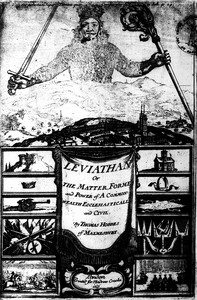
Leviathan
Language: en27,496 downloads on Project Gutenberg
Subjects
In: Politics·Harvard Classics·History - Early Modern (c. 1450-1750)
Public-domain ebook sourced from Project Gutenberg #3207.
Public-domain ebook
Language: en27,496 downloads on Project Gutenberg
Subjects
In: Politics·Harvard Classics·History - Early Modern (c. 1450-1750)
Public-domain ebook sourced from Project Gutenberg #3207.
Thomas Hobbes’s Leviathan is a foundational treatise of political science that opens with a personal dedication to Francis Godolphin, written in the ornate prose of the mid‑seventeenth century. Hobbes frames his discourse as a humble offering to his patron, while simultaneously warning that his arguments will tread a narrow line between excessive liberty and oppressive authority. The opening passage introduces the work’s central concern, the nature and limits of civil power, by invoking abstract notions of “the Seat of Power” and hinting at a critique of certain scriptural texts that he sees as threats to civil authority. From this point the book proceeds systematically through a series of chapters that examine human faculties, the laws of nature, and the structures of commonwealth, building a comprehensive theory of governance grounded in reason and the social contract.
The voice is unmistakably that of a learned 17th‑century philosopher: dense, formal, and rich with classical references, yet driven by a clear, argumentative logic. Hobbes’s style blends meticulous definition with sweeping speculation, making the text both a rigorous philosophical system and a vivid portrait of early modern thought. Readers who enjoy deep, systematic explorations of political theory, the origins of the state, and the interplay between natural law and sovereign power will find Leviathan rewarding. It especially appeals to scholars of philosophy, history, and law, as well as anyone interested in the intellectual roots of modern governance.
Mr. FRANCIS GODOLPHIN of GODOLPHIN HONOR’D SIR. Your most worthy Brother Mr SIDNEY GODOLPHIN, when he lived, was pleas’d to think my studies something, and otherwise to oblige me, as you know, with reall testimonies of his good opinion, great in themselves, and the greater for the worthinesse of his person. For there is not any vertue that disposeth a man, either to the service of God, or to the service of his Country, to Civill Society, or private Friendship, that did not manifestly appear in his conversation, not as acquired by necessity, or affected upon occasion, but inhaerent, and shining in a generous constitution of his nature. Therefore in honour and gratitude to him, and with devotion to your selfe, I humbly Dedicate unto you this my discourse of Common-wealth. I know not how the world will receive it, nor how it may reflect on those that shall seem to favour it. …
Keep reading free · start reading with no account
New illustrated classics
Once or twice a month: the latest books to get full character casts, scene art, and free comic editions. No account needed.