Public-domain ebook
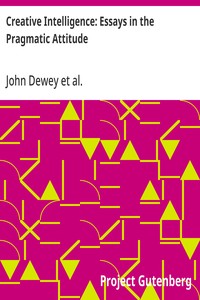
Creative Intelligence: Essays in the Pragmatic Attitude
Language: en1,277 downloads on Project Gutenberg
Subjects
In: Essays, Letters & Speeches·Philosophy & Ethics
Public-domain ebook sourced from Project Gutenberg #33727.
Public-domain ebook
Language: en1,277 downloads on Project Gutenberg
Subjects
In: Essays, Letters & Speeches·Philosophy & Ethics
Public-domain ebook sourced from Project Gutenberg #33727.
The volume is a collaborative collection of essays by seven leading American philosophers, each offering a distinct treatment of what they call “creative intelligence.” The opening pages set the tone: the contributors stress a shared pragmatic attitude rather than doctrinal agreement, and they promise to apply this outlook to a range of fields, logic, mathematics, the natural sciences, psychology, ethics, economics, and finally aesthetics and religion. The first essay, John Dewey’s “The Need for a Recovery of Philosophy,” launches the project with a critique of philosophy’s institutional conservatism and an appeal to reshape experience in light of modern science and social change. Subsequent pieces follow the same pattern, each author responsible for his own contribution, while the whole aims to demonstrate how a forward‑looking, inventive mind can shape a “genuine” future.
The style is scholarly yet conversational, reflecting the early‑20th‑century American pragmatist tradition. The prose is dense with argument, peppered with occasional rhetorical flourishes, and assumes familiarity with the major philosophical debates of the period. Readers who enjoy systematic yet accessible explorations of how philosophy intersects with other disciplines, especially those interested in the historical development of pragmatism, the philosophy of science, and the ethical implications of a dynamic view of experience, will find this work rewarding.
The opening · free to read
The Essays which follow represent an attempt at intellectual cooeperation. No effort has been made, however, to attain unanimity of belief nor to proffer a platform of "planks" on which there is agreement. The consensus represented lies primarily in outlook, in conviction of what is most likely to be fruitful in method of approach. As the title page suggests, the volume presents a unity in attitude rather than a uniformity in results. Consequently each writer is definitively responsible only for his own essay. The reader will note that the Essays endeavor to embody the common attitude in application to specific fields of inquiry which have been historically associated with philosophy rather than as a thing by itself. Beginning with philosophy itself, subsequent contributions discuss its application to logic, to mathematics, to physical science, to psychology, to ethics, to economics, and then again to philosophy itself in conjunction with esthetics and religion. The reader will probably find that the significant points of agreement have to do with the ideas of the genuineness of the future, of intelligence as the organ for determining the quality of that future so far as it can come within human control, and of a courageously inventive individual as the bearer of a creatively employed mind. While all the essays are new in the form in which they are now published, various contributors make their acknowledgments to the editors of the Philosophical Review, the Psychological Review, and the Journal of Philosophy, Psychology and Scientific Methods for use of material which first made its appearance in the pages of these journals.
The book keeps going
Reading is free forever. Sign up and watch scenes appear while you read.



Scenes Storieta drew for other classics.
New illustrated classics
Once or twice a month: the latest books to get full character casts, scene art, and free comic editions. No account needed.