
Public-domain ebook
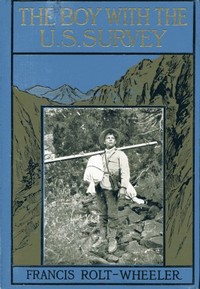
The Boy With the U. S. Survey
Language: en361 downloads on Project Gutenberg
Subjects
In: Children & Young Adult Reading·Adventure·Novels
Public-domain ebook sourced from Project Gutenberg #34497.
Public-domain ebook
Language: en361 downloads on Project Gutenberg
Subjects
In: Children & Young Adult Reading·Adventure·Novels
Public-domain ebook sourced from Project Gutenberg #34497.
The opening · free to read
"Mr. Rivers?"
The Alaskan explorer and geologist looked up from his desk and took in with a quick glance the boy, standing hat in hand beside the door, noting with quiet approval the steady gray eye and firm chin of his visitor.
"Yes?" he replied.
"I'm Roger Doughty," explained the lad sturdily, "and Mr. Herold told me that I should find you here."
"And what can I do for you?"
The boy seemed somewhat taken aback by the direct question, as though he had expected the purpose of his visit to be known, but he answered without hesitation.
"I understood from Mr. Herold that he had spoken to you about me. I want to go to Alaska."
"You mean on the Survey?"
"Yes, sir."
"Your father wrote to me some time ago that you would be coming. He said, if I remember, that you had been nominated one of the new field men under that college scholarship plan."
"I think I am the first, Mr. Rivers," answered Roger with a smile.
"Sit down," said the elder man; then, as the boy hesitated, "just put those books on the table."
The table in question was covered with an immense map showing the vast unexplored and unsurveyed regions of Alaska, that far northern portion of the United States which is equal in size to all the States west of the Mississippi and north of Mason and Dixon's line.
"Mr. Herold spoke of the plan to me," continued the explorer, "but he gave me few of the details. Tell me, if you can, just how the project is to be worked."
"I don't know for certain, Mr. Rivers," replied the boy, "but so far as I can make out, it is this way. You see, Mr. Carneller gave a large fund to get some special boys into the government bureaus to give a chance for the upbuilding of the personnel while still young, and this plan was indorsed in Washington. The scholarship paid everything for two years and gave the usual two months' vacation beside, giving also a liberal allowance for personal expenses."
"And you say this plan is now proceeding?"
"I heard that it was to be tried this first year only in two or three schools. I guess I was lucky, because they started out with us."
"But how does your father like the idea of your roughing it? In the days when I knew him, he believed in keeping his boys near home."
"He wants me to stay, but, you see, Mr. Rivers, I always wanted to get out and do something, and city life isn't what it's cracked up to be. I want to be doing things worth while, things that will tell in the long run, and this poking over columns of figures in a stuffy office doesn't suit me worth a cent when I'm just aching to get out of doors."
The explorer's grave expression relaxed into a half-smile at the boyish but earnest way of describing the feeling he himself knew so well; but he felt it his duty to put bounds to that enthusiasm. Before he could speak in protest, however, Roger continued:
"I know what you're going to say, all right, Mr. Rivers. I know there's just as good work done nearer home as there is far away in Alaska or the Bad Lands or any of those places, but why can't that work be done by the fellows who like to hang around towns? I don't, that's all, and the whole reason I went in for that scholarship and won it"--these last words with an air of conscious pride--"was just so that I could get into real and exciting work."
"If it's work you're after, you've come to the right place, Doughty," was the prompt reply, "but it's more laborious than exciting."
"Why, I thought it was full of excitement!" exclaimed Roger.
"Not especially. The work follows a regular routine on the trail, just as it does anywhere else. It isn't so much the ability to face danger that counts in the Survey, as it is the willingness to do conscientiously the drudgery and hard work which bring in the real results."
"No getting lost and wandering over frozen tundra until nearly at the point of death, and then being rescued just in time?" asked the boy breathlessly, his mind running on an exciting book which had occupied his thoughts a few hours before.
"No!" The negative was emphatic. "The Alaskan parties are composed of picked men, all of whom have had considerable experience and who don't get lost. And if, by any chance, they are late in getting into camp, they know how to shift for themselves. Besides, the chief of the party is ever on the alert for the welfare of his men."
"But aren't there really any snowslides, or rapids, or forest fires, or bears, or anything of that sort?" cried the boy in a disappointed tone. "Surely it isn't as tame as all that?"
"I wouldn't go so far as to call it tame," responded the head of the Alaskan work; "no, it's not tame, but you can't expect a different adventure three times a day, like meals. We don't go out to find adventures, but to do surveying, and are only too thankful when the work goes ahead without any interruption. But of course little incidents do occur. I was considerably delayed in scaling a glacier once, and you're bound to strike a forest fire occasionally, but things like that don't worry us. Rapids are a daily story, too, and of course there are lots of bears."
"Lots of bears!" exclaimed Roger, his eyes lighting up in the discovery that the days of adventure had not yet all passed by, "have you ever been chased by a grizzly bear?"
"Worse than that!" The old-timer was smiling broadly at his would-be follower's interest, being roused from his customary semi-taciturnity by the boy's impetuous enthusiasm. "I thought a Kodiak bear had me one time."
"Worse?" The boy leaned forward almost out of his chair in excitement. "Is a Kodiak bear fiercer than a grizzly? Do tell me about it, Mr. Rivers!"
"Oh, there wasn't much to it, I got away all right." Then, with intent to change the subject, he continued, "but about this desire of yours to go to the field----"
"Please, Mr. Rivers," interrupted Roger, his curiosity overcoming his sense of politeness, "won't you tell me about the bear?"
The bushy brown eyebrows of the explorer lowered at the interruption, but the boy went on hastily:
"I've never met any one before who had even seen a real bear loose, much less had a fight with one. I don't want to seem rude, but I do want to hear it so much."
"You are persistent, at least, Doughty," answered the other, with a suspicion of annoyance in his manner, "but sometimes that's not such a bad thing. Well, if you want to hear the story so much I'll tell it to you, and perhaps it may show the sort of thing that sometimes does come about on the trail. It was this way:
"Some four years ago, the Survey sent me on a trip which included the mapping of a portion of the foothills of the Mt. St. Elias Range. It is a rugged and barren part of the country, but although rough in the extreme, no obstacles had been encountered that hard labor and long hours could not overcome. It was a packing trip and everything had progressed favorably, there was plenty of forage, the streams had been fairly passable, and we feasted twice a day on moose or mountain sheep. For days and weeks together we had hardly been out of sight of caribou. They had a curious way of approaching, either one at a time or else in quite large bands, coming close to the pack-train, then breaking away suddenly at full gallop and returning in large circles. Even the crack of a rifle could not scare them out of their curiosity, and we never shot any except when we needed meat.
"One day I got back to camp with the boys a good deal earlier than usual, somewhere about four o'clock. We had started very early that morning, I remember, trying to gain a peak somewhat hard of access. It was difficult enough, so difficult in fact, that the trial had to be abandoned that day, as we found it could only be approached from the other side. Of course our arrival sent George, the camp cook, into the most violent kind of a hurry. He mentioned to me, as I remembered later, that he had shot at a Kodiak bear somewhere about noon, and though he had found tracks with blood in them, he did not believe that he had wounded the bear sufficiently to make it worth while to track him. But George was hustling at top speed to get dinner, and no one paid much attention to him, I least of all, for I was trying to figure out the best way to climb that peak next day.
"After dinner, it was still early, and as I was anxious to get a line on the geology of the section, in order to determine how far the volcanic formation of the Wrangell mountains intrudes upon the St. Elias Range, I thought an hour would be well spent in investigating. I was not going far from camp, so, as it chanced, I took nothing with me but my geological hammer. About a mile from camp I found a sharp ravine, and I wanted to see whether the granodiorite, which I could see in the walls of the ravine, extended its whole depth. I scrambled down into the ravine, making observations as I went, until the cleft ended in a sort of dry lake bed, shaped like a deep oval saucer. Steep declivities ran upward from the rim of this depression in every way but two, the ravine down which I had come and a creek bed running to the south. Being desirous of tracing the origin of this unusual configuration, I scrambled to the edge, breaking through a clump of bushes on my way.
The pack-train on its way to the camp, where chief of party narrowly escaped death.
The book keeps going
Reading is free forever. Sign up and watch scenes appear while you read.



Scenes Storieta drew for other classics.
New illustrated classics
Once or twice a month: the latest books to get full character casts, scene art, and free comic editions. No account needed.


![Cover of Peter Pan: [Peter and Wendy]](/covers/16.jpg)