
Public-domain ebook
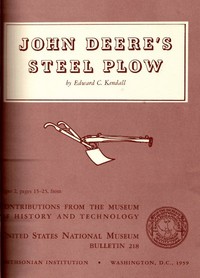
John Deere's Steel Plow
Language: en3,159 downloads on Project Gutenberg
Subjects
In: Technology·History - American·History - Modern (1750+)
Public-domain ebook sourced from Project Gutenberg #34562.
Public-domain ebook
Language: en3,159 downloads on Project Gutenberg
Subjects
In: Technology·History - American·History - Modern (1750+)
Public-domain ebook sourced from Project Gutenberg #34562.
Edward C. Kendall’s work is a scholarly study of the invention and early development of John Deere’s steel plow, framed by a detailed examination of the agricultural challenges of the early nineteenth‑century American prairie. The opening pages lay out the problem of sticky, root‑filled soils that clogged conventional wooden moldboards, then trace how Deere’s 1837 design, featuring a steel share and a smoothly ground wrought‑iron moldboard, proved uniquely effective. Kendall weaves together contemporary accounts, such as John Muir’s description of prairie‑breaking plows, with meticulous documentation of early patents, museum photographs, and partnership agreements, offering a nuanced picture of the technical and commercial forces that shaped the plow’s evolution.
Written in the measured, citation‑heavy style of a museum curator, the text reflects the academic tone of early‑twentieth‑century agricultural history. Its dense factual narrative, abundant footnotes, and reliance on primary sources will appeal to readers who enjoy rigorous historical research, particularly those interested in the intersection of technology, frontier settlement, and the origins of American industry.
The opening · free to read
John Deere in 1837 invented a plow that could be used successfully in the sticky, root-filled soil of the prairie. It was called a steel plow. Actually, it appears that only the cutting edge, the share, on the first Deere plows was steel. The moldboard was smoothly ground wrought iron.
Deere's invention succeeded because, as the durable steel share of the plow cut through the heavy earth, the sticky soil could find no place to cling on its polished surfaces.
Americans moving westward in the beginning of the 19th century soon encountered the prairie lands of what we now call the Middle West. The dark fertile soils promised great rewards to the farmers settling in these regions, but also posed certain problems. First was the breaking of the tough prairie sod. The naturalist John Muir describes the conditions facing prairie farmers when he was a boy in the early 1850's as he tells of the use of the big prairie-breaking plows in the following words:[1]
They were used only for the first ploughing, in breaking up the wild sod woven into a tough mass, chiefly by the cord-like roots of perennial grasses, reinforced by the tap roots of oak and hickory bushes, called "grubs," some of which were more than a century old and four or five inches in diameter.... If in good trim, the plough cut through and turned over these grubs as if the century-old wood were soft like the flesh of carrots and turnips; but if not in good trim the grubs promptly tossed the plough out of the ground.
The second and greater problem was that the richer lands of the prairie bottoms, after a few years of continuous cultivation, became so sticky that they clogged the moldboards of the plows. Clogging was such a factor in prairie plowing that farmers in these regions carried a wooden paddle solely for cleaning off the moldboard, a task which had to be repeated so frequently that it seriously interfered with plowing efficiency. It seems probable that by the 1830's blacksmiths in the prairie country were beginning to solve the problem of continuous cultivation of sticky prairie soil by nailing strips of saw steel to the face of wooden moldboard of the traditional plows. Figure 1 is a photograph of an 18th century New England plow in the collection of the U. S. National Museum. This is one type of plow which was brought west by the settlers. It contributed to the development of the prairie breaker shown in figure 2. The first plow on record with strips of steel on the moldboard is attributed to John Lane in Chicago in 1833.[2] Steel presented a smoother surface which shed the sticky loam better than the conventional wooden moldboards covered with wrought iron, or the cast iron moldboards of the newer factory-made plows then coming into use.
It is generally accepted as historical fact that John Deere made his first steel plow in 1837 at Grand Detour, Illinois. The details of the construction of this plow have been variously given by different writers. Ardrey[3] and Davidson[4] describe Deere's original plow as having a wooden moldboard covered with strips of steel cut from a saw, in the manner of the John Lane plow.
Writers of the 20th century describing the making of the first John Deere steel plow have in mind the 1838 plow. One[7] has John Deere pondering the local plowing problem and getting an idea from the polished surface of a broken steel mill saw. Another[8] claims that Leonard Andrus, the founder and leading figure of Grand Detour and part owner of the sawmill, conceived the design of the plow and employed Deere, the blacksmith newly arrived from Vermont, to build it. This idea may have originated with and was certainly promoted by the late Fred A. Wirt, as advertising manager of the J. I. Case Company. It is difficult, at this distance, to determine the parts played at the beginning by Deere and Andrus.
The earliest existing partnership agreement involving Andrus and Deere is dated March 20, 1843.[9] The existing copy is unsigned, but its conditions are the same as those in the agreements executed during the next few years. It began by stating that Deere and Andrus had agreed "to become copartners together in the art and trade of Blacksmithing, ploughmaking and all things thereto belonging at the said Grand Detour, and all other business that the said parties may hereafter deem necessary for their mutual interest and benefit ..." One of the terms was that the copartnership should continue from the date of the agreement "under the name and firm of Leonard Andrus."
A second agreement dated October 26, 1844,[10] which brought in a third partner, Horace Paine, described the business as "the art and trade of Blacksmithing Plough Making Iron Castings and all things thereto belonging ..." and stated that the copartnership should be conducted "under the name and firm of L. Andrus and Co." The third agreement, dated October 20, 1846, in which another man appeared in place of Paine, gave the name of the firm as Andrus, Deere, and Lathrop.[11] This carried an addendum dated June 22, 1847, in which Andrus and Deere bought out Lathrop's interest in the business and agreed to continue under the name of Andrus and Deere. This is the only mention of the firm of Andrus and Deere. It could only have lasted a few months because it was in 1847 that Deere moved to Moline and established his plow factory there.
These agreements suggest that Leonard Andrus was the capitalist of the young community of Grand Detour, as well as its founder. The dominance of the name Andrus tends to back up the opinion which holds that Andrus was the leading figure in the development of the successful prairie plow. On the other hand, the general tone of the agreements suggests that two or more people were participating in an enterprise in which each contributed to the business and shared in the results. Deere contributed his plow and his blacksmith shop, tools, and outbuildings; Andrus contributed money and business experience. There is no indication that they were formally associated prior to the agreement of March 20, 1843. An advertisement (it is quoted later) dated February 3, 1843, and appearing in the March 10, 1843, issue of the Rock River Register, carries an announcement by John Deere that he is ready to fill orders for plows, which he then describes. There is no mention of Andrus or of an Andrus and Deere firm. I am inclined by the evidence to the view that Deere worked out his plow by himself, began to manufacture it in small numbers, needed money to enlarge and expand his operations, and went to the logical source of capital in the community, Leonard Andrus.
In support of this view I quote a statement by Mr. Burton F. Peek[12] who has spent most of his life in Deere & Company and who may now be the only person living who knew John Deere:
Andrus removed to Grand de Tour from some place in New York [Rochester, though originally from Vermont]. Some years later John Deere came along from Rutland, Vermont leaving his family behind him. Whether Deere ever heard of Andrus or Andrus of Deere no one knows.
Having decided to remain in Grand de Tour, Deere sent for his family asking my paternal grandfather, William Peek, to bring them and also the Peek family out to Grand de Tour. This was done via covered wagon the journey occupying some six weeks. My father, Henry C. Peek, was then an infant age six weeks and Charles Deere, the son of John, an infant of about the same age. Of course these infants came along sleeping in the feed box of the wagon. My grandfather "took up land" adjacent to Grand de Tour and John Deere continued in the manufacturing business.
Incidentally, John Deere and William Peek were brothers-in-law having married sisters and what I have said, and much more that I might say to you, is based upon what I have been told by my grandfather, by John Deere and by others who had a part in the early history of the company. So far as I know, I am the only living person who ever knew or saw John Deere....
... I joined the Deere Company on October 1, 1888, at the age of 16 and retired on the 28th of April, 1956--nearly 68 years. C. H. Deere was my great friend and benefactor. I was educated at his expense as a lawyer and practiced for thirteen years. During this time I was his personal attorney, I drew his will, was made trustee thereunder, and probably was more intimate with him than any living person. I have seen and read the manuscript of an early history of the company which he wrote, but never published and there was nothing in it to indicate that Andrus had any part in the manufacture of the first successful steel plow and it is my firm belief that he had no part other than perhaps a friendly interest in it.
In a small, new, pioneering community it seems unlikely that the local sawmill would have been equipped with the newer circular saw rather than the familiar up and down saw which remained in use throughout the 19th century and, in places, well into the 20th century. The up and down saw was a broad strip of iron or steel with large teeth in one edge. Driven by water power it slowly cut large logs into boards. It is doubtful that the circular saws of that period were large enough for this kind of mill work. The second argument is the shape of the moldboard itself. The photograph of the 1838 plow in figure 7 shows that the shape of the moldboard is unconventional. It is essentially a parallelogram curved to present a concave surface to the furrow slice and thus to make a simple, small but workable plow. A parallelogram or diamond would be an easy shape to cut out of a mill saw with the teeth removed. The moldboard on the 1838 plow is from .228 to .238 inches thick and its width is 12 inches. These dimensions approximate those given in an 1897 Disston catalog[15] which describes mulay saws, a type of mill saw, from 10 to 12 inches wide and from 4 to 9 gauge. Gauge number 4 is the thickest and is .238 inches.
Examination of the 1838 plow suggests that Deere cut the moldboard and landside as one piece, which was then heated and bent to the desired form. The pattern of this piece is shown in figure 4. Some additional metal appears to be forged into the sharp bend at the junction of the moldboard and the landside apparently to strengthen this part, which may have begun to open during the bending. If, however, Deere had used a large circular saw with plenty of room for cutting out a moldboard of the usual shape and size, it seems likely that he would have made a plow of more conventional appearance. In any event his moldboard of one jointless piece of polished metal would scour better than one of wood covered with strips of steel since the nailheads and the joints between the strips would provide places for the earth to stick.
A very great majority of writers describing John Deere and his plow attribute his fame to his development of a successful steel plow which made cultivation of rich prairie soil practical. The emphasis is always on the development of a steel moldboard and the assumption is that from the 1837 plow onward stretched an unbroken line of steel moldboard plows. An advertisement for John Deere plows in the March 10, 1843, issue of the Rock River Register, published weekly in Grand Detour, Illinois, gives a detailed description, here presented in full:
The book keeps going
Reading is free forever. Sign up and watch scenes appear while you read.



Scenes Storieta drew for other classics.

New illustrated classics
Once or twice a month: the latest books to get full character casts, scene art, and free comic editions. No account needed.