Public-domain ebook
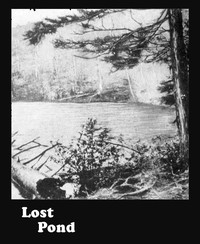
Lost Pond
by Henry Abbott
Language: en344 downloads on Project Gutenberg
Subjects
In: Adventure·Nature/Gardening/Animals
Public-domain ebook sourced from Project Gutenberg #34669.
Public-domain ebook
by Henry Abbott
Language: en344 downloads on Project Gutenberg
Subjects
In: Adventure·Nature/Gardening/Animals
Public-domain ebook sourced from Project Gutenberg #34669.
The opening · free to read
"Lost Pond" was a tradition, a myth. It had never been seen by any living person. Two dead men, it was alleged, had visited it on several occasions while they were yet living.
Wonderful tales were told about that pond for which many persons had hunted, but which no one of the present generation had ever been able to find.
Every guide in Long Lake township talked about Lost Pond and repeated the legends, which through the passing years had probably lost none of their original enticements. Many of these guides had even got the stories at first hand from Captain Parker and Mitchel Sabattis.
Captain Parker, a famous hunter and trapper, had died about ten years ago at the good old age of ninety-four years. Mitchel Sabattis, an Indian, who had married a white woman and had brought up a family of husky half-breeds, was the first settler in the Long Lake country. He was a highly respected citizen, and a mountain and a United States post office had been named after him. Sabattis lived to be a very old man. Many believed him to be past a hundred years when he died, but the family Bible was not available to prove the date of his birth.
Now, all of the natives knew that Lost Pond was somewhere on Seward Mountain, and they apparently believed that the best fishing place in the State was right in that pond. "By Mighty! that pond was just alive with speckled trout--big ones. You could catch all you wanted there in a few minutes. The water fairly boiled with the jumping fish. Now, if we could only find it," etc.
To the layman it would seem, possibly a difficult, but certainly not an impossible task, to find that lost pond; and if it was such a remarkable fishing and hunting place as tradition painted it, why had not some one combed out that mountain and recovered the pond?
Seward Mountain, seen from a distance of ten or fifteen miles, looked like a hogback ridge. A nearer view disclosed the fact that it included several peaks and ridges, and really covered a lot of ground. The highest peak was perhaps not more than twenty-five hundred feet above the lake. But if one could draw a straight line through its base eastward from Raquette River to the foot of Sawtooth Mountain, the line would measure about twelve miles. If a similar line could be stretched northward from Cold River to Ampersand Lake, it would be about eight miles.
One cannot, however, always go through a mountain. It is usually necessary to go over or around it; and following up and down the ridges, through ravines and around swamps and other obstacles, the travel distances above named might be doubled, and then some. The mountain was covered with forest, and there was not a human habitation on it or within many miles of it in any direction. Some lumbering had been done along Cold River and several of its tributary creeks, but the higher portions were untouched and the heavy spruce and hemlock cover looked black from up the lake.
Giving proper consideration to these facts and knowing the Long Lake guides as well as I did, I could readily understand that it might be less strenuous to tell the marvelous stories about Lost Pond than it would be to go up in the Seward country and search out the pond. Then there was always the possibility that too much investigation might spoil a good story.
Ever since childhood I have possessed that very human characteristic of wanting that which is forbidden, longing for what is just out of reach; and when a thing is said to be impossible, I at once have an intense desire to undertake to do that thing.
Now, there was good trout fishing in many of the ponds and streams tributary to Long Lake which were comparatively easy to reach; but this lost pond which I had heard so much about was so "impossible to find" that I was possessed with an irresistible longing to find it, to see what it looked like, to fish in it. So I discussed the matter with Bige, who, with some show of reluctance, agreed to assist.
Bige and I had made many camping excursions up in the Cold River country; had followed its crooked course about fifteen miles upstream; had explored and fished a number of its tributary creeks on the Santanoni side.
Cold River carries the drainage from Santanoni Mountain and foothills on its left bank and on its right receives the flow from the eastern and southern slopes of Mount Seward.
One day in July, when Bige and I were up on Santanoni, from an opening through the trees above a ledge of rocks we looked cross the valley to Seward, studied the contour of its basins, peaks and ridges, and agreed upon the spot where Lost Pond ought to be found. We also determined upon a route which we should take to reach it, and appointed the following Tuesday as the time when we should make our start.
Monday night we packed our duffel so that we might make an early start in the morning. We took our small light-weight tent, blankets, aluminum cooking utensils, fishing rods, and food for three days. If we should get some fish the grub might be stretched across four days.
We expected some strenuous tramping, so determined to "go light" and omitted many things we usually take on our trips; but when we "weighed in," Bige's pack tipped the scales at fifty-two pounds and mine weighed thirty-seven. I am not selfish in such matters, so gave Bige all the heavy things.
With our two packs stowed amidships, Bige in the bow with a pair of oars and I in the stern wielding a paddle, we got away in the morning just as the sun broke over East Inlet Mountain and gilded the summit of Sugar Loaf on the opposite side of the lake.
The early birds greeted us with a chorus of song, seeming to wish us luck as we made good speed down the lake, passing Owl's-Head Mountain on the left, Sabattis on the right, and farther down Blueberry, Kempshall and Buck mountains, while Santanoni and Seward loomed up in the distance.
It is about fourteen miles to the foot of the lake and five miles farther down the outlet, through "Lost Channel," to the place on Calkins Creek where we left our boat in the shade of some balsams.
We now shouldered our packs and started on the strenuous and interesting part of our undertaking. Following up Calkins Valley about six miles, we passed, at intervals of two or three miles, three abandoned lumber camps, the log buildings being in all stages of decay from long disuse, many of them with roofs caved in and overgrown with weeds and bushes.
A few rods beyond the last log camp, while pushing my way through the high grass and bushes in a log-road, I almost stepped upon a spotted fawn which jumped up under my nose and turned to stare at me with his solemn-looking eyes which seemed much too large for his head. The little fellow was apparently about a month old, and was as frisky and awkward in his movements as a young puppy. He had no doubt been hidden there by his mother, who had warned him to lie low till she returned, to look out for enemies, and especially to beware of any animal that walks upon two legs. He was now uncertainly wavering between fear and curiosity, and with his head turned and his eyes fastened upon me, he stumbled clumsily away through the high grass directly into Bige's outstretched arms.
Here was now a situation not down on our programme. We had captured a live deer. We were not intending to start a menagerie or to stock a zoological park. We were out in search of a pond that had been mislaid on a mountain. We could not very well carry the deer up the mountain while pursuing our explorations, and we had no idea that he could be made to walk in our company so far as we should have to go. Moreover, neither Bige nor I was properly equipped to feed an infant; so we put him back in his grassy bed, patted him on the head, advised him to stay there until his mother returned, and proceeded upon our journey.
Half a mile farther on we left the log-road, turned sharply to the right, and climbed up the steep slope of one of the foothills. Passing the ridge, we now came into a section of the forest which had never been visited by the lumberman's axe. The tall spruces and hemlocks interspersed here and there with yellow birch and maples cast deep shadows, and the forest floor was as free from underbrush as if cleared by a landscape gardener. This was what poets and nature writers call the "primeval forest." Also, traveling with a pack on one's back was much easier here than in the lumbered country.
A spring of cold clear water with a rivulet flowing from it down the slope reminded us that it was lunch time, and that this was an ideal place to eat it.
After lunch we took up our burdens and continued our journey eastward until about two o'clock, when we had crossed the fourth high ridge from Calkins Valley and dropped into a deep basin. This was the valley Bige and I had located when we surveyed the country from over on Santanoni. This was the place where Lost Pond ought to be; but there was no pond here, lost or otherwise.
We sat down to talk it over. Bige said "Le's go home." But I outvoted him and we continued on, taking a northeasterly course, which we followed for what seemed about five miles. When we had passed through a valley between two high peaks we made a sort of ox-bow curve around the one to the right and there laid a straight course with our compass back in the direction from which we had come but a mile or more south of our outward route.
During the afternoon we encountered about all the different kinds of forest travel that it is possible to find anywhere. There were steep rocky ledges which had to be climbed; cedar swamps which must be negotiated; several acres of burnt ground now covered with a dense growth of poplar and wild-cherry saplings; blackberry bushes as high as one's head--oceans of them; balsam groves with deep beds of moss for a carpet; "witch-hopple," which tangles one's feet and gives one a hard fall at unexpected moments; there were steep climbs up and steep slides down; and there were delightful stretches of "big woods," but always the charm of variety.
We were too intent upon our quest and made too much noise in our travels to see much wild life; the animals always had ample notice of our approach and always had convenient hiding places.
About six o'clock we came upon a noisy brook which was tumbling down out of the mountains through a steep valley. The bed of the stream was filled with boulders, and there were numerous short falls and rapids. We heard the noise of the brook long before it came into view, and Bige promptly named it "Roaring Brook."
There was something suggestive about this brook, and we sat down and discussed it while resting. It was a dry season; there had been no rain for two weeks. Surface drainage could not account for all the water coming down that brook. It might come from one of the swamps we had passed through earlier in the day. It would have to be a very large spring or a lot of small ones to keep up the flow of that volume of water. It might be the outlet of a pond. We decided to follow upstream and settle the question of its source.
The book keeps going
Reading is free forever. Sign up and watch scenes appear while you read.



Scenes Storieta drew for other classics.
New illustrated classics
Once or twice a month: the latest books to get full character casts, scene art, and free comic editions. No account needed.