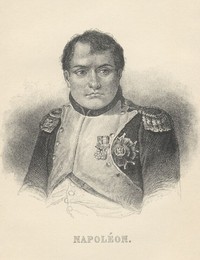
In later years Napoleon confessed that during the interval between the first and second Saxon campaigns he had been outwitted. His antagonists had, in his own language, "changed for the better"; at least they secured the war they so earnestly desired under conditions vastly more favorable to themselves than to their opponent. Both parties had been arming with might and main during the prolonged truce, but each member of the dynastic coalition now had the backing of a growing national enthusiasm, while Napoleon had to deal with waning zeal and an exhausted people. Thus, then, at the opening of the second campaign in Saxony, the allies had four hundred and thirty-five thousand men, and Napoleon but three hundred and fifty thousand. With this inferiority, it behooved the Emperor to use all his strategic powers, and he did so with a brilliancy never surpassed by him. Choosing the Elbe as his natural defensive line, Hamburg stood almost impregnable at one end, flanked to the southward by Magdeburg, Wittenberg, and Torgau, three mighty fortresses. Dresden, which was necessarily the focal point, was intrenched and palisaded for the protection of the army which was to be its main bulwark. Davout and Oudinot, with seventy thousand men, were to threaten Berlin, and, thereby drawing off as many as possible of the enemy, liberate the garrisons of Stettin and Küstrin; they were then to beleaguer Spandau, push the foe across the Oder, and stand ready to fall on the flank of the coalition army. Napoleon himself, with the remaining two hundred and eighty thousand, was to await the onset of the combined Russian, Prussian, and Austrian forces.
The allies now had in their camp two mighty strategists--Jomini, the well-known Swiss adventurer and military historian, and Moreau, who had returned from the United States. The former, pleading that he had lost a merited promotion by Berthier's ill-will, and that as a foreigner he had the right of choice, had gone over to the enemies of his employer; the latter, yielding to the specious pleas of his silly and ambitious wife that he might fight Napoleon without fighting France, had taken service with the Czar. The arrow which penetrated Napoleon's vitals was indeed feathered from his own pinions, since these two, with another of Napoleon's pupils--Bernadotte, the Crown Prince of Sweden--were virtually the council of war. Two of them, the latter and Moreau, saw the specter of French sovereignty beckoning them on. They dreamed of the chief magistracy in some shape, imperial, monarchical, consular, or presidential, and were more devoted to their personal interests than to those of the coalition. In the service of their ambition was formed the plan by which not only was Napoleon overwhelmed, but the fields of France were drenched with blood. Under their advice, three great armies were arrayed: that of the North, in Brandenburg, was composed of Prussians, Swedes, and a few Russians, its generals being Bülow, Bernadotte, and Tchernicheff; that of the East was the Prusso-Russian army in Silesia, now under Blücher, that astounding young cavalryman of seventy, and Wittgenstein; finally, that of the South was the new Austrian force under Schwarzenberg, with an adjunct force of Russian troops under Barclay, and the Russian guard under the Grand Duke Constantine. Bülow was in and near Berlin with about a hundred and fifty-six thousand men; Blücher had ninety-five thousand, and, having violated the armistice, was on August fourteenth already within the neutral zone at Striegau, before Breslau; the Austro-Russian force of almost two hundred and fifty thousand was in northern Bohemia, near Melnik; Bennigsen was in Poland building up a strong reserve. Schwarzenberg, though commander of the main army, was reduced to virtual impotence by the presence at his headquarters of all the sovereigns and of Moreau. Divided counsels spring from diverse interests; there was at the outset a pitiful caution and inefficiency on the part of the allies, while at Napoleon's headquarters there was unity of design at least.
Both contestants were apparently under serious misapprehensions. The allies certainly were, because Francis believed that, as so often before, Napoleon's goal would be Vienna. The plan adopted by them was therefore very simple: each division of the allied army was to stand expectant; if assailed it was to yield, draw on the French columns, and expose their flank or rear to the attacks of the other two allied armies; then by superior force the invaders were to be surrounded. The allies divined, or believed they divined, that Napoleon would hold his guard in reserve, throw it behind any portion of his line opposite which they were vulnerable, break through, and defeat them in detachments. Their idea was keen, and displayed a thorough grasp both of the principles on which their opponent had hitherto acted and of his normal character. But nevertheless they were deceived. Napoleon discarded all his old principles, and behaved most abnormally. In his conduct there are evidences of a curious self-deception, and his decisions contradicted his language. Perpetually minimizing in conversation the disparity between the two forces, and sometimes even asserting his own superiority, he nevertheless almost for the first time assumed the defensive. This unheard-of course may have been due to misapprehension and exaggeration, but it produced for the moment a powerful moral effect on his generals, who, without exception, had hitherto been clamorous for peace, and likewise upon his new boy recruits; both classes began to have a realizing sense that they were now fighting, not for aggression, but for life. If the Emperor had any such confidence as he expressed, it must have been due to the fact that boys had fought like veterans at Lützen and Bautzen, and that at last there were cavalry and artillery in fair proportion. Possibly, likewise, he may have been desperate; fully aware that he was about to cast the dice for a last stake, he may have been at once braggart and timid. If he should win in a common defensive battle, he believed, as his subsequent conduct goes to show, that he was safe indefinitely; and if he lost--the vision must have been too dreadful, enough to distract the sanest mind: an exhausted treasury, an exhausted nation, an empty throne, vanished hopes, ruin!
Yet at the time no one remarked any trace of nervousness in Napoleon. Long afterward the traitorous Marmont, whose name, like that of Moreau, was to be execrated by succeeding generations of honorable Frenchmen, recalled that the Emperor had contemptuously designated the enemy as a rabble, and that he had likewise overestimated the strategic value of Berlin. The malignant annalist asserted, too, that Napoleon's motive was personal spite against Prussia. It has also been studiously emphasized by others that the "children" of Napoleon's army were perishing like flowers under an untimely frost, forty thousand French and German boys being in the hospitals; that corruption was rife in every department of administration; and that the soldiers' pay was shamefully in arrears. An eye-witness saw Peyrusse, the paymaster, to whom Napoleon had just handed four thousand francs for a monument to Duroc, coolly pocket a quarter of the sum, with the remark that such was the custom. He would be rash indeed who dared to assert that there was no basis for this criticism. It is true that the instructions to Davout and Oudinot made light of Bülow's army, and that Berlin had vastly less strategic value than those instructions seemed to indicate. But, on the other hand, both generals and men were sadly in need of self-reliance, and to see their capitals occupied or endangered had still a tremendous moral effect upon dynastic sovereigns. As to the defects in his army, Napoleon could not have been blind; but in all these directions matters had been nearly, if not quite, as bad in 1809, and a victory had set them all in order.
What nervousness there was existed rather among the allies. Never before in her history, not even under the great Frederick, had Prussia possessed such an army; the Austrians were well drilled and well equipped; the Russians were of fair quality, numerous, and with the reserves from Poland would be a powerful army in themselves. Yet in spite of their strength, the allies were not really able. Austria was the head, but her commander, Schwarzenberg, was not even mediocre, and among her generals there was only one who was first-rate, namely, Radetzky. Frederick William and Alexander were of incongruous natures; their alliance was artificial, and in such plans as they evolved there was an indefiniteness which left to the generals in their respective forces a large margin for independence. The latter were quick to take advantage of the chance, and this fact accounts for the generally lame and feeble beginning of hostilities.
For example, it was through Blücher's wilfulness that the moral advantage lay with Napoleon in the opening of the struggle. On July ninth Bernadotte, Frederick William, and the Czar had met at Trachenberg to lay out a plan of campaign. In this conference, which first opened Napoleon's eyes to the determination of the allies, Blücher had secured for himself an independent command. The accession of Austria rendered the agreement of Trachenberg null, but Blücher did not abandon his ambition. Impatient of orders or good faith, he broke into the neutral zone at Striegau on August fourteenth, apparently without any very definite plan. Napoleon, hearing that forty thousand Russians from this army were marching toward Bohemia, advanced from Dresden on August fifteenth, to be within reach of the passes of the Iser Mountains on the Upper Elbe, and halted at Zittau as a central point, where he could easily collect about a hundred and eighty thousand men, and whence, according to circumstances, he could either strike Blücher, cut off the Russians, or return to Dresden in case of need. That city was to be held by Saint-Cyr. On August twentieth Blücher reached the banks of the Bober at Bunzlau; owing to Napoleon's nice calculation, Ney, Marmont, Lauriston, and Macdonald were assembled on the other side to check the advance, he himself being at Lauban with the guard. Had Blücher stood, the Russo-Prussians would have been annihilated, for their inferiority was as two to one. But the headstrong general did not stand; on the contrary, retreating by preconcerted arrangement behind the Deichsel, he led his antagonist to the false conclusion that he lacked confidence in his army.
Napoleon was not generally over-credulous, but this mistake was probably engendered in his mind by the steady stream of uneasy reports he was receiving from his own generals. On the twenty-third he wrote to Maret that his division commanders seemed to have no self-reliance except in his presence; "the enemy's strength seems great to them wherever I am not." Marmont was the chief offender, having severely criticized a plan of operations which would require one or more of the marshals to act independently in Brandenburg or Silesia or both, expressing the fear that on the day when the Emperor believed himself to have won a decisive battle he would discover that he had lost two. Seventeen years of campaigning had apparently turned the great generals of Napoleon's army into puppets, capable of acting only on their leader's impulse. Whatever the cause, Napoleon was set in his idea, and pressed on in pursuit. On the twenty-second Blücher was beyond the Katzbach, with the French van close behind, when word arrived at Napoleon's headquarters that the Austro-Russians had entered Saxony and were menacing Dresden. How alert and sane the Emperor was, how thoroughly he foresaw every contingency, appears from the minute directions he wrote for Macdonald, who was left to block the road for Blücher into Saxony, while Lauriston was to outflank and shut off the perfervid veteran from both Berlin and Zittau.