Public-domain ebook
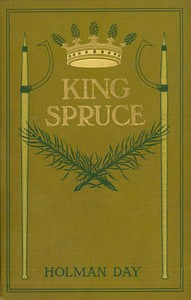
King Spruce, A Novel
by Holman Day
Language: en1,111 downloads on Project Gutenberg
Subjects
In: Novels·American Literature
Public-domain ebook sourced from Project Gutenberg #34948.
Public-domain ebook
by Holman Day
Language: en1,111 downloads on Project Gutenberg
Subjects
In: Novels·American Literature
Public-domain ebook sourced from Project Gutenberg #34948.
King Spruce is a regional novel set in the timber‑rich woods of Maine, where the lumber trade and its rough‑handed customs dominate the lives of its characters. The opening chapter drops the reader into the technical world of log‑driving, describing winter cuts, spring sluicing, and the specialized jargon of “cant‑dog,” “jill‑poke,” and “carding” the ledges, before shifting to a bustling mill town called Stillwater. Here a young, college‑educated outsider named Dwight Wade arrives at the imposing “Castle Cut ’Em,” the headquarters of the Umcolcus Lumbering and Log‑driving Association, to petition the powerful timber baron known as King Spruce. The scene is populated with weary stumpage buyers, gruff mill workers, and the iron‑clad official John Davis Barrett, whose office walls are lined with saws, axes, and trophies that underscore the ruthless control of the forest.
The narrative is rendered in a dense, early‑20th‑century prose style that mixes detailed technical exposition with vivid, almost theatrical description. Holman Day’s voice is both colloquial and formal, capturing the rhythm of New England speech while cataloguing the machinery of the logging industry. Readers who enjoy atmospheric regional fiction, especially stories that blend economic intrigue with a strong sense of place, will find this novel rewarding. It will appeal to those fascinated by historical depictions of American industry, the rough poetry of lumbermen’s life, and the subtle social maneuvering that underpins a world where timber is power.
The opening · free to read
When the trees have been cut and trimmed in the winter's work in the woods the logs are hauled in great loads to be piled at "landing-places" on the frozen streams, so that the spring floods will move them. Most of the streams have a succession of dams. On the spring drive the logs are floated to the dams, and then the gates are raised and the logs are "sluiced" through with a head of water behind them to carry them down-stream. Thus the drive is lifted along in sections from one dam to another. It will be seen that Pulaski D. Britt's series of dams on Jerusalem constituted a valuable holding, and enabled him to control the water and leave the logs of rivals stranded if he wished. The collection of water and quick work in "sluicing" are most important, for the streams give down only about so much water in the spring.
When a load of logs is suddenly set free from the cable holding it back on a steep descent, as in Chapter XXVI., it is said to be "sluiced."
When there is a jam of entangled logs as they are swept down-stream, if it is impossible to find and pry loose the "key-log," it is sometimes necessary to blow up the restraining logs with dynamite.
When the floating logs are caught upon rocks, and the men are prying them loose, they are said to be "carding" the ledges.
A "jill-poke," a pet aversion of drivers, is a log with one end lodged on the bank and the other thrust out into the stream.
The "cant-dog" is illustrated on the cover of the book.
The "peavy" is the Maine name for a slightly different variety of "cant-dog," which takes its title from its maker in Old Town.
The "pick-pole" is an ashen pole ten to twelve feet long, shod with an iron point with a screw-tip, which enables a driver to pull a log towards him or to push it away.
"Oh, the road to 'Castle Cut 'Em' is mostly all uphill. You can dance along all cheerful to the sing-song of a mill; King Cole he wanted fiddles, and so does old King Spruce, But it's only gashin'-fiddles that he finds of any use.
"Oh, come along, good lumbermen, oh, come along I say! Come up to 'Castle Cut 'Em,' and pull your wads and pay. King Cole he liked his bitters, and so does old King Spruce, But the only kind he hankers for is old spondulix-juice."
--From song by Larry Gorman, "Woods Poet."
The young man on his way to "Castle Cut 'Em" was a clean-cut picture of self-reliant youth. But he was not walking as one who goes to a welcome task. He saw two men ahead of him who walked with as little display of eagerness; men whose shoulders were stooped and whose hands swung listlessly as do hands that are astonished at finding themselves idle.
A row of mills that squatted along the bank of the canal sent after them a medley of howls from band-saws and circulars. The young man, with the memory of his college classics sufficiently fresh to make him fanciful, found suggestion of chained monsters in the aspect of those shrieking mills, with slip-openings like huge mouths.
That same imagery invested the big building on the hill with attributes that were not reassuring. But he went on up the street in the sunshine, his eyes on the broad backs of the plodders ahead.
King Spruce was in official session.
Men who were big, men who were brawny, yet meek and apologetic, were daily climbing the hill or waiting in the big building to have word with the Honorable John Davis Barrett, who was King Spruce's high chamberlain. Dwight Wade found half a dozen ahead of him when he came into the general office. They sat, balancing their hats on their knees, and each face wore the anxious expectancy that characterized those who waited to see John Barrett.
Wade had lived long enough in Stillwater to know the type of men who came to the throne-room of King Spruce in midsummer. These were stumpage buyers from the north woods, down to make another season's contract with the lord of a million acres of timber land. Their faces were brown, their hands were knotted, and when one, in his turn, went into the inner office he moved awkwardly across the level tiles, as though he missed the familiar inequalities of the forest's floor.
The others droned on with their subdued mumble about saw-logs, sleeper contracts, and "popple" peeling. The young man who had just entered was so plainly not of themselves or their interests that they paid no attention to him.
This was the first time Wade had been inside the doors of "Castle Cut 'Em," the name the humorists of Stillwater had given the dominating block on the main street of the little city. The up-country men, with the bitterness of experience, and moved by somewhat fantastic imaginings, said it was "King Spruce's castle."
In the north woods one heard men talk of King Spruce as though this potentate were a real and vital personality. To be sure, his power was real, and power is the principal manifestation of the tyrant who is incarnate. Invisibility usually makes the tyranny more potent. King Spruce, vast association of timber interests, was visible only through the affairs of his court administered by his officers to whom power had been delegated. And, viewed by what he exacted and performed, King Spruce lived and reigned--still lives and reigns.
Wade, not wholly at ease in the presence, for he had come with a petition like the others, gazed about the reception-room of the Umcolcus Lumbering and Log-driving Association, the incorporators' more decorous title for King Spruce. It occurred to him that the wall-adornments were not reassuring. A brightly polished circular-saw hung between two windows. It was crossed by two axes, and a double-handled saw was the base for this suggestive coat of arms. The framed photographs displayed loaded log-sleds and piles of logs heaped at landings and similar portraiture of destruction in the woods. Everything seemed to accentuate the dominion of the edge of steel. The other wall-decorations were the heads of moose and deer, further suggestion of slaughter in the forest. A stuffed porcupine on the mantel above the great fireplace mutely suggested that the timber-owners would brook no rivalry in their campaign against the forest; they had asked the State to offer a bounty for the slaughter of this tree-girdler, and a card propped against the "quill-pig" instructed the reader that the State had already spent more than fifty thousand dollars in bounties.
The deification of the cutting-edge appealed to Wade's abundant fancy. He had noticed, when he came past the windows of the lumber company's outfitting store on the first floor of the building, that the window displays consisted mostly of cutting tools.
When the door of the inner office opened and one of those big and awkward giants came out, Wade discovered that King Spruce had evidently placed in the hands of the Honorable John Davis Barrett something sharp with which to slash human feelings, also. The man's face was flushed and his teeth were set down over his lower lip with manifest effort to dam back language.
"Didn't he renew?" inquired one of the waiting group, solicitously.
"He turned me down!" muttered the other, scarcely releasing the clutch on his lip. "I've wondered sometimes why 'Stumpage John' hasn't been over his own timber lands in all these years. If he has backed many out of that office feelin' like I do, I reckon there's a good reason why he doesn't trust himself up in the woods." He struck his soft hat across his palm. He did not raise his voice. But the venom in his tone was convincing. "By God, I'd relish bein' the man that mistook him for a bear!"
"Give any good reason for not renewin'?" asked a man whose face showed his anxiety for himself.
"Any one who has been over my operation on Lunksoos," declared the lumberman, answering the question in his own way--"any fair man knows I haven't devilled: I've left short stumps and I 'ain't topped off under eight inches, though you all know that their damnable scale-system puts a man to the bad when he's square on tops. But I 'ain't left tops to rot on the ground. I've been square!"
Wade did not understand clearly, but the sincerity of the man's distress appealed to him.
One of the little group darted an uneasy look towards the door of the inner office. It was closed tightly. But for all that he spoke in a husky whisper.
"It must be that you didn't fix with What's-his-name last spring--I heard you and he had trouble."
The angry operator dared to speak now. He looked towards the door as though he hoped his voice would penetrate to King Spruce's throne-room.
"Trouble!" he cried. "Who wouldn't have trouble? I made up my mind I had divided my profits with John Barrett's blackmailin' thieves of agents for the last time. I lumbered square. And the agent was mad because I wasn't crooked and didn't have hush-money for him. And he spiked me with John Barrett; but you fellows, and all the rest that are willin' to whack up and steal in company, will get your contracts all right. And I'm froze out, with camps all built and five thousand dollars' worth of supplies in my depot-camp."
"Hold on!" protested several of the men, in chorus, crowding close to this dangerous tale-teller. "You ain't tryin' to sluice the rest of us, are you, just because you've gone to work and got your own load busted on the ramdown?"
"I'd like to see the whole infernal game of graft, gamble, and woods-gashin' showed up. Let John Barrett go up and look at his woods and he'll see what you are doin' to 'em--you and his agents! And the man that lumbers square, and remembers that there are folks comin' after us that will need trees, gets what I've just got!" He shook his crumpled hat in their faces. "And I'm just good and ripe for trouble, and a lot of it."
"Here, you let me talk with you," interposed a man who had said nothing before, and he took the recalcitrant by the arm, led him away to a corner, and they entered into earnest conference. At the end of it the destructionist drove his hat on with a smack of his big palm and strode out, sullen but plainly convinced.
The other man returned to the group and spoke cautiously low, but in that big, bare room with its resonant emptiness even whispers travelled far.
"I'll take a double contract and sublet to him," he explained. "Barrett won't know, and after this Dave will come back into line and handle the agent. I reckon he's got well converted from honesty in a lumberin' deal. It's what we're up against, gents, in this business; the patterns are handed to us and we've got to cut our conduct accordin' to other men's measurements. Barrett gets his first; the agent gets his; we get what we can squeeze out of a narrow margin--and the woods get hell."
A man came out of the inner office stroking the folds of a stumpage permit preparatory to stuffing it into his wallet, and the peacemaker departed promptly, for it was now his turn to pay his respects to King Spruce.
In what he had seen and what he had heard, Dwight Wade found food for thought. The men so manifestly had accepted the stranger as some one utterly removed from comprehension of their affairs or interest in their talk that they had not been discreet. It occurred to him that his own present business with John Barrett would be decidedly furthered were he to utilize that indiscretion.
The book keeps going
Reading is free forever. Sign up and watch scenes appear while you read.



Scenes Storieta drew for other classics.
New illustrated classics
Once or twice a month: the latest books to get full character casts, scene art, and free comic editions. No account needed.