Produced by Chris Curnow, Lindy Walsh, Mary Meehan and the Online Distributed Proofreading Team at http://www.pgdp.net
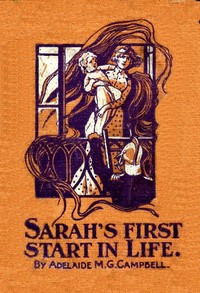
SARAH'S FIRST START IN LIFE.
BY ADELAIDE M. G. CAMPBELL.
PUBLISHED UNDER THE DIRECTION OF THE TRACT COMMITTEE.
LONDON: SOCIETY FOR PROMOTING CHRISTIAN KNOWLEDGE, NORTHUMBERLAND AVENUE, W.C.; 43, QUEEN VICTORIA STREET, E.C. BRIGHTON: 127, North Street. NEW YORK: E. & J. B. YOUNG AND CO.
PRINTED BY WILLIAM CLOWES AND SONS, LIMITED, LONDON AND BECCLES.
SARAH'S FIRST START IN LIFE.
"Now, Sarah, just you make haste with that kettle, and we will have a nice cup of tea for dad when he comes in."
"Dad's" real name was David Brown, and Sarah was his only child, just turned eighteen. The Browns were a happy family, though poor, and they put their trust in God, and did not worry about the morrow. Sarah had just been telling her mother of a situation as kitchen maid that she had been inquiring about, and had almost decided to take, but her father's permission was still wanting. Mr. Brown was a cab driver, and found it sometimes very hard work to make both ends meet, especially in the winter time, when coals were a necessity and dear at best.
This conversation took place on Christmas Day, and Brown had promised to be home for tea, knowing how disappointed his wife and Sarah would feel if he stayed out until his usual hour, which was half-past ten. Soon the kettle was singing away merrily on the hob, and Sarah was toasting some bread in front of a small bright fire, when a knock was heard, the door opened, and a man about twenty-four came in. He was evidently not unexpected, as four places were prepared at the table.
Dick Bream was one of a large family, and very much devoted to Sarah; they had told each other how they would work hard to earn some money and set up house together, and Sarah was now longing to tell him about her future situation. Dick was a footman, and had a very comfortable place in Belgrave Square--he was getting on well, and his master had promised to help him to get a place as upper servant in a year or two. He and Sarah kissed each other heartily under the misletoe, which was over the door, and Dick shook hands with Mrs. Brown, and they were beginning to talk about Sarah's future when Mr. Brown's cheerful voice was heard calling her to hold the horse, while he got down from the box. Up sprang Sarah, out she ran and stood at Bobby's head, patting and soothing him in his impatience to get to the warm stable and clean hay. Mr. Brown took the horse and harness to the stable, and Sarah held the lantern whilst he wiped down Bobby.
"Well, father," said Sarah, "tea is ready, your slippers are by the fire, and I have some news to tell you; but you shan't hear it till you have drunk a hot cup of tea and eaten one of my best baked cakes."
The father patted her cheek, kissed his wife, and, drawing off his coat, sat down at the head of the table.
After the grace was reverently said by Sarah, Mr. Brown said--
"Well, what is this wonderful news?"
Sarah looked across the table at Dick, whom Mrs. Brown had told about the situation, and smiled, whilst her mother began telling the father about Sarah's plan. Mr. Brown looked grave, and slowly shook his head when he heard that a departure was meditated.
"Nay, nay, I won't have my girl going out into the world and becoming independent and looking down on her old dad, when she sees the way fine folk treat one another;" so said Brown, and he evidently thought the discussion was at an end, as he got up, pulled out his pipe and invited Dick to take a turn.
But Sarah had set her heart on helping her family, and was not thus to be set aside.
"Oh, dad," she exclaimed, "how can you think such dreadful things about me? Can I ever forget how you and mother have worked for me since I was a baby? I only wish to help you, and mother is willing if you agree."
Mrs. Brown was silently wiping away a few tears with her apron, and Dick was comforting her with promises to do what he could to smooth matters.
"Well," said Mr. Brown, "I'll talk it over with your mother, and tell you to-morrow what we think." With this scanty comfort Sarah was obliged to content herself. Meanwhile Mr. Brown and Dick went outside to smoke, and naturally they began talking about Sarah's plan.
"I don't think my girl is fitted for service," said Mr. Brown; "she ought to stay at home and help her mother."
"But," interrupted Dick, "Sarah is a big girl now, and you cannot expect her always to stay at home; and what could she do if she were left without the experience service is sure to give her?"
Mr. Brown saw this, but was still undecided as to what should be done; but at last, after a little more persuasion, he agreed to let Sarah try service for a year. In saying good night Dick just whispered to her to be quite easy, as it was all right; so, like a wise girl, she went to bed, and in her prayers asked God to bless her future career and comfort her father. The next day at breakfast, which was at 6.30, Mr. Brown began by solemnly announcing that he had a thing or two to tell his family; so, with expectant eyes fixed on him, he said that Sarah might take the situation for a year, and went on to tell her of all the temptations and troubles she would meet with in service, and his parting advice was, "Honesty is the best policy."
After Mr. Brown had left for his day's work, and Sarah had cleared away the breakfast things and cleaned their three rooms, she put on her neatest dress and went off to ask when she might go into her situation and begin her new work. She took an omnibus to Sloane Square, and from there walked to Eaton Place, and went up to a big house, where she rang the bell, where, after the door was opened, she was shown into a little anteroom. After waiting half an hour a messenger was sent to conduct her to Lady James, her future mistress. Sarah felt very nervous, as, although she had already had an interview, this was the final one, and much depended on it. Lady James was busy writing letters, but when she saw Sarah, she put down her pen and turned to her with a bright smile and a few kind words of encouragement. After ten minutes had been passed in asking and answering questions, Lady James told Sarah she thought she would suit, and wished her to begin her work in three days. Poor Sarah thought this was rather too quick, but said she would certainly try and be ready; so she went out of the house feeling very important at the idea of at last going into service.
Of course the next few days were very busy ones, as she had to make two new print dresses and neatly mend her clothes. Mrs. Brown was very unhappy at the idea of losing her only child, but tried to make the last few days cheerful, and took as much of the housework off her hands as possible. At last only the good-byes remained to be said. Poor Mrs. Brown was sobbing bitterly, and Mr. Brown was fussing over Sarah's box and bag, whilst Dick, who was going with her as far as the house, was busy harnessing Bobby. The good-byes were at last over, Mrs. Brown was all but kissed away, and Sarah jumped into her father's cab, which was to take her to Eaton Place. Dick and Sarah were not so sad as the mother and father, for they felt that this was at last a step towards getting on in life, and, after all, "nothing venture nothing have."
Eaton Place was soon reached, and Mr. Brown pulled up at the door of the house where Sarah was to begin her new duties. The bell was rung, and the door was opened by a footman in silk stockings and powdered hair. Of course Sarah was much too frightened to ask this grand man what she should do, so she made Dick ask him if he might take her box upstairs, and whilst Sarah and her father were saying the real good-bye, Dick and the footman went up to the attic with the box. Dick, who was a friend of his, told him a little about Sarah, that this was her first place, and that he and she were engaged, etc. Mr. Brown had just driven off when Dick arrived downstairs to take his departure also.
"Now, miss," said Charles the footman, "will you come downstairs and have a cup of tea and see all your future friends?"
"I should like to very much," said Sarah; "but I must take off my jacket, and where can I put it?"
"Oh!" said Charles, "we arn't too particular, leave it anywhere."
Now, Sarah had been brought up, quite properly, to think tidiness one of the greatest virtues; however, she said nothing, and trotted happily away with her jacket on her arm.
At the bottom of the dark staircase, her jacket was rather roughly taken from her by Charles and flung on the dresser. "Well," thought Sarah, "if this is the way my things are to be treated, they won't last me long, and how can I get others?" However, the sound of tea-cups and laughter soon drove such thoughts out of her head, and she was shown into a fairly large room, in which about five servants were talking very merrily, and altogether making rather an unnecessary noise. Directly the two appeared there was a dead silence, and one of the housemaids called out to Sarah to come and sit beside her. She took the offered place, and had only just seated herself when she was asked all sorts of questions, as e.g. "How long have you been in service?" "What wages did you get?" and many others of the same kind. Sarah at last found time to answer all these various questions, which she did with her usual good temper, and, during loud exclamations, managed to tell them a little about her former life. She did not quite like all this catechising, but not wanting to be thought disagreeable, made the best of it. When she had finished, Edith, the housemaid, began at once to tell Sarah some of the trials of their downstairs life.
She told her that the cook, who was then in the kitchen, was very cross, and would be sure to give her a lot to do, and as she did not like any kind of dirty work herself, the kitchen-maid had to do it all, and keep the kitchen spotless. Sarah was rather frightened by this account of the cook, and begged Edith to tell her more; but she had some work to do, and could not stop to chat any longer. In a few minutes in came Mrs. Ellis, the cook, and told Sarah to hurry up as there were some pots to wash, and poor Sarah had to gulp down her cup of tea and eat her bread and butter very fast.
"Please, ma'am, may I first go and take off this dress?" asked Sarah, in a timid little voice.
"No," said Mrs. Ellis; "can't you pin that one up? It ain't so grand, you need not take such care of it."
Now, it was Sarah's best dress, so she thought this was very unkind, and told the cook she had no better, and was afraid of spoiling the neatest she had.
"Well," said Mrs. Ellis, "go up, and make haste; I can't have you wasting your time, there's enough to be done without that."
Sarah flew upstairs, not forgetting to take up her jacket on the way, and before the cook had found time to grumble at her absence was down again, dressed in a neat cotton gown and apron. Mrs. Ellis showed her where to find the pots, pans, hot water, and washing-up cloths, and Sarah set to work with might and main; but it was not so easy as she expected. First, some of the spots on the coppers would not come off, then the cloths got so wet there was nothing to dry up with, and altogether when Sarah had cleaned a dozen she felt her arms ache as they had never ached before. All at once she heard Mrs. Ellis calling her, so she ran into the kitchen where she found a great fuss going on, as dinner was being dished up, and Mrs. Ellis had burnt her hand badly in pouring out the soup.