DEDICATION.
To WILLIAM MICHAEL ROSSETTI.
There are many reasons which should make me glad to inscribe your name upon the forefront of this book. To you, among other debts, I owe this one--that it is not even more inadequate to the matter undertaken; and to you I need not say that it is not designed to supplant or to compete with the excellent biography of Blake already existing. Rather it was intended to serve as complement or supplement to this. How it grew, idly and gradually, out of a mere review into its present shape and volume, you know. To me at least the subject before long seemed too expansive for an article; and in the leisure of months, and in the intervals of my natural work, the first slight study became little by little an elaborate essay. I found so much unsaid, so much unseen, that a question soon rose before me of simple alternatives: to do nothing, or to do much. I chose the latter; and you, who have done more than I to serve and to exalt the memory of Blake, must know better how much remains undone.
Friendship needs no cement of reciprocal praise; and this book, dedicated to you from the first, and owing to your guidance as much as to my goodwill whatever it may have of worth, wants no extraneous allusion to explain why it should rather be inscribed with your name than with another. Nevertheless, I will say that now of all times it gives me pleasure to offer you such a token of friendship as I have at hand to give. I can but bring you brass for the gold you send me; but between equals and friends there can be no question of barter. Like Diomed, I take what I am given and offer what I have. Such as it is, I know you will accept it with more allowance than it deserves; but one thing you will not overrate--the affectionate admiration, the grateful remembrance, which needs no public expression on the part of your friend
A. C. SWINBURNE.
November, 1866.
CONTENTS.
[In justice to the fac-similist who has so faithfully copied the following designs from Blake's works, the publisher would state they were made under somewhat difficult circumstances, the British Museum authorities not permitting tracing from the copies in their possession. In every case the exact peculiarities of the originals have been preserved. The colouring has been done by hand from the designs, tinted by the artist, and the three illustrations from "Jerusalem" have been reduced from the original in folio to octavo. The paper on which the fac-similes are given has been expressly made to resemble that used by Blake.]
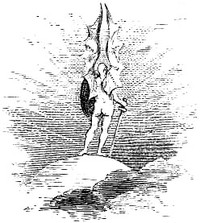
FRONTISPIECE. Gateway with eclipse. A reduction of plate 70; from "JERUSALEM."
TITLE-PAGE. A design of borders, selected from those in "JERUSALEM" (plates 5, 19, &c.), with minor details from "MARRIAGE OF HEAVEN AND HELL," and "BOOK OF THEL."
P. 200. Title from "THE BOOK OF THEL."
P. 204. Title from "MARRIAGE OF HEAVEN AND HELL."
P. 208. Plate 8, from the SAME (selected to show the artist's peculiar method of blending text with minute design).
P. 224. The Leviathan. From "MARRIAGE OF HEAVEN AND HELL."
P. 258. From "MILTON." Male figures; one in flames.
P. 276. Female figures. A reduction of Plate 81 from "JERUSALEM."
P. 282. Design with bat-like figure. A reduction of Plate 33 from "JERUSALEM."
LIST OF AUTHORITIES.
1. LIFE OF WILLIAM BLAKE. By Alexander Gilchrist. 1863.
2. POETICAL SKETCHES. By W. B. 1783.
3. SONGS OF INNOCENCE. 1789.
4. THE BOOK OF THEL. 1789.
5. THE MARRIAGE OF HEAVEN AND HELL. 1790.
6. VISIONS OF THE DAUGHTERS OF ALBION. 1793.
7. AMERICA: A PROPHECY. 1793.
8. SONGS OF EXPERIENCE. 1794.
9. EUROPE: A PROPHECY. 1794.
10. THE FIRST BOOK OF URIZEN. 1794.
11. THE BOOK OF AHANIA. 1795.
12. THE SONG OF LOS. 1795.
13. MILTON: A POEM IN TWO BOOKS. 1804.
14. JERUSALEM, AN EMANATION OF THE GIANT ALBION. 1804.
15. IDEAS OF GOOD AND EVIL. (MS.)
16. TIRIEL. (MS.)
WILLIAM BLAKE.
Tous les grands poetes deviennent naturellement, fatalement, critiques. Je plains les poetes que guide le seul instinct; je les crois incomplets. Dans la vie spirituelle des premiers, une crise se fait infailliblement, ou ils veulent raisonner leur art, decouvrir les lois obscures en vertu desquelles ils ont produit, et tirer de cette etude une serie de preceptes dont le but divin est l'infaillibilite dans la production poetique. Il serait prodigieux qu'un critique devint poete, et il est impossible qu'un poete ne contienne pas un critique.--CHARLES BAUDELAIRE.
I.--LIFE AND DESIGNS.
In the year 1827, there died, after a long dim life of labour, a man as worthy of remark and regret as any then famous. In his time he had little enough of recognition or regard from the world; and now that here and there one man and another begin to observe that after all this one was perhaps better worth notice and honour than most, the justice comes as usual somewhat late.
Between 1757 and 1827 the world, one might have thought, had time to grow aware whether or not a man were worth something. For so long there lived and laboured in more ways than one the single Englishman of supreme and simple poetic genius born before the closing years of the eighteenth century; the one man of that date fit on all accounts to rank with the old great names. A man perfect in his way, and beautifully unfit for walking in the way of any other man. We have now the means of seeing what he was like as to face in the late years of his life: for his biography has at the head of it a clearly faithful and valuable likeness. The face is singular, one that strikes at a first sight and grows upon the observer; a brilliant eager, old face, keen and gentle, with a preponderance of brow and head; clear bird-like eyes, eloquent excitable mouth, with a look of nervous and fluent power; the whole lighted through as it were from behind with a strange and pure kind of smile, touched too with something of an impatient prospective rapture. The words clear and sweet seem the best made for it; it has something of fire in its composition, and something of music. If there is a want of balance, there is abundance of melody in the features; melody rather than harmony; for the mould of some is weaker and the look of them vaguer than that of others. Thought and time have played with it, and have nowhere pressed hard; it has the old devotion and desire with which men set to their work at starting. It is not the face of a man who could ever be cured of illusions; here all the medicines of reason and experience must have been spent in pure waste. We know also what sort of man he was at this time by the evidence of living friends. No one, artist or poet, of whatever school, who had any insight or any love of things noble and lovable, ever passed by this man without taking away some pleasant and exalted memory of him. Those with whom he had nothing in common but a clear kind nature and sense of what was sympathetic in men and acceptable in things--those men whose work lay quite apart from his--speak of him still with as ready affection and as full remembrance of his sweet or great qualities as those nearest and likest him. There was a noble attraction in him which came home to all people with any fervour or candour of nature in themselves. One can see, by the roughest draught or slightest glimpse of his face, the look and manner it must have put on towards children. He was about the hardest worker of his time; must have done in his day some horseloads of work. One might almost pity the poor age and the poor men he came among for having such a fiery energy cast unawares into the midst of their small customs and competitions. Unluckily for them, their new prophet had not one point they could lay hold of, not one organ or channel of expression by which to make himself comprehensible to such as they were. Shelley in his time gave enough of perplexity and offence; but even he, mysterious and rebellious as he seemed to most men, was less made up of mist and fire than Blake.
He was born and baptized into the church of rebels; we can hardly imagine a time or scheme of things in which he could have lived and worked without some interval of revolt. All that was accepted for art, all that was taken for poetry, he rejected as barren symbols, and would fain have broken up as mendacious idols. What was best to other men, and in effect excellent of its kind, was to him worst. Reynolds and Rubens were daubers and devils. The complement or corollary of this habit of mind was that he would accept and admire even small and imperfect men whose line of life and action seemed to run on the same tramway as his own. Barry, Fuseli, even such as Mortimer--these were men he would allow and approve of. The devils had not entered into them; they worked, each to himself, on the same ground as Michael Angelo. To such effect he would at times prophesy, standing revealed for a brief glimpse on the cloudy and tottering height of his theories, before the incurious eyes of a public which had no mind to inhale such oracular vapour. It is hard to conjecture how his opinions, as given forth in his Catalogue or other notes on art, would have been received--if indeed they had ever got hearing at all. This they naturally never did; by no means to Blake's discouragement. He spoke with authority; not in the least like the Scribes of his day.