Public-domain ebook
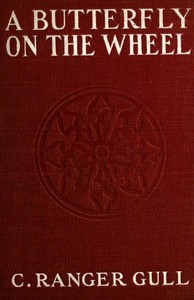
A Butterfly on the Wheel: A Novel
by Thorne, Guy; Hemmerde, Edward G. (Edward George); Neilson, Francis
English399 downloads on Project GutenbergDownload EPUB
Public-domain ebook sourced from Project Gutenberg #36467.
Public-domain ebook
by Thorne, Guy; Hemmerde, Edward G. (Edward George); Neilson, Francis
English399 downloads on Project GutenbergDownload EPUB
Public-domain ebook sourced from Project Gutenberg #36467.
The opening · free to read
It was shortly after midnight in the great Hôtel des Tuileries at Paris.
Beyond the façade of the hotel the gardens of the Tuileries were sleeping in the warm night. To the left the Louvre etched itself in solid black against the sky, and all up and down the Rue de Rivoli carriages and automobiles were still moving.
But in the great thoroughfare the tide of vehicles and foot passengers was perceptibly thinning. Paris is a midnight city, it is true, and at this hour the heights of Montmartre were thronged with pleasure-seekers, dancing and supping till the pale dawn should come with its message of purity and reproach.
But down in the Rue de Rivoli even the great hotels were beginning to prepare for sleep.
One enters the Hôtel des Tuileries, as every one knows, through the revolving doors, passes into the entresol, and then into the huge glass-domed lounge with its comfortable fauteuils, its big settee, its little tables covered with beaten copper, and its great palms, which seem as if they had been cunningly enamelled jade-green by some jeweller.
The lounge was now almost empty of people, though the shaded electric light threw a topaz-coloured radiance over everything.
In one corner--just where the big marble stair-case springs upwards to the gilded gallery--two men in evening dress were sitting together.
They were obviously English, tall, thin, bronzed men, as obviously in the service. As a matter of fact, one was Colonel Adams, attached to the Viceroy's staff in India, the other a civilian's secretary--Henry Passhe.
They were both smoking briar pipes--delighted that the lateness of the hour allowed them to do so in the lounge; and before each man was a long glass full of crushed ice and some effervescing water innocent of whisky.
A man in black clothes, obviously a valet, came up to Colonel Adams.
"I've put everything ready in your room, sir," he said. "Is there anything else?"
"No, there is nothing else, Snell," the soldier answered. "You can go to bed now."
The man was moving away when Adams called him back.
"Oh, by the way, Snell, did you find out what I asked you? It is Mrs. Admaston who is staying here, isn't it?"
"Yes, sir, she is here with her maid, and----"
"Well?"
The man seemed to hesitate slightly, but at length he spoke: "Mr. Roderick Collingwood is here too, sir."
"Is he, by Jove!" Adams said, more to his friend than to his servant. "Very well, Snell. Good night."
The valet withdrew, and Colonel Adams puffed vigorously at his pipe for a minute or two.
"_The_--the Mrs. Admaston?" the civilian asked.
Colonel Adams nodded. "The great, little Peggy herself," he said; "none other. Surely you've met her, Passhe?"
"I was introduced to her some months ago at a Foreign Office reception," the younger man answered; "but I really can't say that I know her. I've never been to any of the Admastons' parties. In fact, my dear Adams, I am a little bit out of things in town now. Ask me anything about any of the Indian set and I can tell you, but as far as society goes in London I am a back number. I won't say, though, that I haven't heard this and that about the Admastons. One can't go anywhere without hearing their names. However, I know nothing of the rights or wrongs of the story--if story there is at all. But certainly every one has heard this man Collingwood's name mentioned in connection with that of Mrs. Admaston. Who was she, any way? You know everything about everybody. Tell me all about them."
Colonel Adams sipped his Perrier quietly, and his brown, lean face became unusually meditative.
"Aren't you sleepy?" he said.
"Can't sleep, confound it!" Passhe replied. "Liver. Have lunch, take an afternoon nap, and then can't get to sleep at night for the Lord knows how long."
"I know," Adams said sympathetically. "Liver is the very devil. That's the worst of India. Now, there is nothing, my dear chap, that I should enjoy more at this moment than a two-finger peg of whisky. Can I take it? Damn it, no! I should have heartburn for hours--that's India! But since you are not sleepy, and I am sure I'm not, I will tell you about the Admastons."
The colonel's pipe had gone out. He relit it, pressed down the ashes with the head of a little silver pencil-case which he took from his waistcoat pocket, sent out a cloud of fragrant blue-grey smoke, leant back in his arm-chair, and began.
"Admaston," Colonel Adams began, "is one of the most hard-working Johnnies of the day. He's as rich as what-d'you-call-him, of course, but he hasn't used his wealth to make his position in Parliament or to get him his place in the Cabinet. He's done it by sheer ability, by Jove! He's of an old family, but there haven't been any members of it in big political positions to help him over the heads of those who have to shift for themselves.
"He was at Harrow with me, though considerably my junior, and I remember he played cricket with an energy that deserved a much higher batting average than he got. He wasn't a studious youth by any means, though he learnt enough to know his way about. He was still at school and I had just passed into Sandhurst when his father died and left him a huge fortune. Then he went to Oxford--New College it may have been, or possibly the House. I don't think he did anything much at Oxford. I'm told by men who were up with him that the sense of the enormous responsibility which fell on him after his father's death, and the anxieties of having to manage a great estate and a huge business, spoilt him for the schools and rather put him off cricket. He might have got into the Eleven, but he didn't care enough about it to try hard."
"A bit phlegmatic in temperament?" Passhe asked.
"That's it," replied Colonel Adams. "Nothing seemed to move him much. If ever a man was born with a silver spoon in his mouth, George Admaston was the chap. But I don't believe he cared particularly whether his spoon was silver or pewter, by Jove! Just a plain fellow of frugal habits. I am told that when he met the deputation from the Northern Division of Lancashire, which went up to town to ask him to contest that constituency, after the interview one of the local Johnnies said, 'Mr. Admaston was so nice that he might be nobody.' At anyrate, George has found his métier in politics. Three years in opposition gave him a great reputation as a quick and ready debater. He is a great asset to his party now, and at by-elections he's the night-before-the-poll man."
"But what about his wife?" said the civilian.
"I'm coming to that, Henry," Adams answered. "And if I am a bit long-winded you've jolly well brought it on yourself. It's like this. George's father was the head of Admaston, Grainger & Co., the big City financiers. Old Grainger had a daughter, much younger than George Admaston. Peggy Grainger was only a tiny little girl when Admaston's father died. I'm told that the old men when they were together would chaff each other about their children. Old Grainger used to say that they must certainly marry--keep the firm together, and so on, don't you know. In fact, the last letter that George ever got from his father referred to old Grainger's notion that George should marry Peggy. Now, Peggy's mother was a Frenchwoman, a Mlle. Guillou, and the girl was educated in France. George hadn't been long in the Cabinet when old Grainger brought Peggy to London. She was about nineteen then, and the prettiest, most flirtatious, whimsical little butterfly of a thing that you could possibly imagine. Well, her father established Peggy in a big house in St. James's--huge retinue of servants and so forth. All London began to talk about the rich Miss Grainger. The girl spent just what she liked--her father encouraged her to do it; there was really nothing else to be done with the money. But whenever George came to the house--and he saw a lot of the Graingers the first year when Peggy came to London--the old boy was always hinting to him that he ought to marry Peggy.
"One evening Admaston was called off the Treasury Bench in the House to speak at the telephone. He thought it was Peggy, but it wasn't. It was her old maid, Pauline, who is here with her in this hotel to-night, and who has looked after her all her life nearly. Pauline said that old Grainger had just passed in his cheques, by Jove! He was a big fleshy fellow--always did himself top hole. He'd made a big dinner, laughed at a joke like anything with his daughter, had a stroke, and was cooling by ten o'clock."
"And then?" Henry Passhe asked.
"Well, of course, Peggy was left quite alone. There were no relatives. In fact, there was nobody except this old nurse, Pauline, a woman of about forty. Mrs. Grainger had been a chronic invalid, and she had left the girl in charge of the 'bonne.' Old Grainger often used to say that Pauline was more of a mother to Peggy than even his wife had been, and after his death Peggy relied upon the woman for almost everything. She's been with her ever since, and is more like a mother to her still than a servant. Pauline, in fact, took charge of the household, looked after the servants in every way, and controlled everything. It was a curious ménage.
"One day Peggy and Admaston met at a country house for a week-end party. Nobody knows exactly how it happened, but at anyrate George proposed and Peggy accepted him. I remember the fuss they made about it in the society papers--fulsome, sickenin' sort of hog-wash they wrote. 'Love at first sight,' and all that sort of thing. 'Little Peggy was to be the wife of a Prime Minister'--'they adored each other,' etc. But I'll eat my hand if they did anything of the kind. They simply remembered the wishes of their fathers and saw it was best to consolidate their huge commercial interests. I daresay Peggy felt very lonely and George felt very sorry for her. At anyrate, the engagement was announced.
"George had an aunt--has her still, I suppose--the rich Miss Admaston, a damned old cat who gives thousands to foreign missions. I've met some of the missionaries of her particular gospel-shop in India, and a nice lot of touts they are too. Well, the old cat was fearfully cut up by the news of the engagement. She thought Peggy was far too French and frivolous for George, and, of course, Peggy has always been rather go-ahead. For my part, I don't care what they are saying now, I don't think there is an ounce of vice in the girl.
"It's gettin' rather late, Henry, and I'm afraid I'm boring you?"
"Not a bit; go on, do," the secretary answered.
The book keeps going
Reading is free forever. Sign up and watch scenes appear while you read.



Scenes Storieta drew for other classics.
New illustrated classics
Once or twice a month: the latest books to get full character casts, scene art, and free comic editions. No account needed.