Public-domain ebook
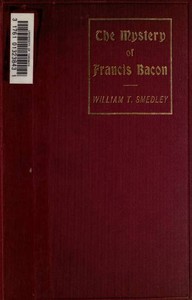
The Mystery of Francis Bacon
Language: en868 downloads on Project Gutenberg
Subjects
In: Biographies·History - Early Modern (c. 1450-1750)·Philosophy & Ethics
Public-domain ebook sourced from Project Gutenberg #36650.
Public-domain ebook
Language: en868 downloads on Project Gutenberg
Subjects
In: Biographies·History - Early Modern (c. 1450-1750)·Philosophy & Ethics
Public-domain ebook sourced from Project Gutenberg #36650.
The opening · free to read
BY WILLIAM T. SMEDLEY.
Ad D.B.
"Si bene qui latuit, bene vixit, tu bene vivis: Ingeniumque tuum grande latendo patet." --_John Owen's Epigrammatum_, 1612.
LONDON: ROBERT BANKS & SON, RACQUET COURT, FLEET STREET E.C.
1912.
"_But such is the infelicity and unhappy disposition of the human mind in the course of invention that it first distrusts and then despises itself: first will not believe that any such thing can be found out; and when it is found out, cannot understand how the world should have missed it so long._"
--"NOVUM ORGANUM," Chap. CX.
CONTENTS.
PAGE Preface 5 CHAPTER I.--Sources of Information 9 II.--The Stock from which Bacon Came 14 III.--Francis Bacon, 1560 to 1572 19 IV.--At Cambridge 25 V.--Early Compositions 29 VI.--Bacon's "Temporis Partus Maximus" 36 VII.--Bacon's First Allegorical Romance 47 VIII.--Bacon in France, 1576-1579 52 IX.--Bacon's Suit on His Return to England, 1580 62 X.--The "Rare and Unaccustomed Suit" 76 XI.--Bacon's Second Visit to the Continent and After 82 XII.--Is it Probable that Bacon left Manuscripts Hidden Away? 94 XIII.--How the Elizabethan Literature was Produced 98 XIV.--The Clue to the Mystery of Bacon's Life 103 XV.--Burghley and Bacon 114 XVI.--The 1623 Folio Edition of Shakespeare's Plays 123 XVII.--The Authorised Version of the Bible, 1611 126 XVIII.--How Bacon Marked Books with the Publication of Which He Was Connected 132 XIX.--Bacon and Emblemata 140 XX.--Shakespeare's Sonnets 148 XXI.--Bacon's Library 156 XXII.--Two German Opinions on Shakespeare and Bacon 161 XXIII.--The Testimony of Bacon's Contemporaries 170 XXIV.--The Missing Fourth Part of "The Great Instauration" 177 XXV.--The Philosophy of Bacon 187 Appendix 193
PREFACE.
Is there a mystery connected with the life of Francis Bacon? The average student of history or literature will unhesitatingly reply in the negative, perhaps qualifying his answer by adding:--Unless it be a mystery that a man with such magnificent intellectual attainments could have fallen so low as to prove a faithless friend to a generous benefactor in the hour of his trial, and, upon being raised to one of the highest positions of honour and influence in the State, to become a corrupt public servant and a receiver of bribes to pervert justice.--It is one of the most remarkable circumstances to be found in the history of any country that a man admittedly pre-eminent in his intellectual powers, spoken of by his contemporaries in the highest terms for his virtues and his goodness, should, in subsequent ages, be held up to obloquy and scorn and seldom be referred to except as an example of a corrupt judge, a standing warning to those who must take heed how they stand lest they fall. Truly the treatment which Francis Bacon has received confirms the truth of the aphorism, "The evil that men do lives after them; the good is oft interred with their bones."
It is not the intention in the following brief survey of Bacon's life to enter upon any attempt to vindicate his character. Since his works and life have come prominently before the reading public, he has never been without a defender. Montagu, Hepworth Dixon, and Spedding have, one after the other, raised their voices against the injustice which has been done to the memory of this great Englishman; and although Macaulay, in his misleading and inaccurate essay,[1] abounding in paradoxes and inconsistencies, produced the most powerful, though prejudiced, attack which has been made on Bacon's fame, he may almost be forgiven, because it provided the occasion for James Spedding in "Evenings with a Reviewer," to respond with a thorough and complete vindication of the man to whose memory he devoted his life. There rests on every member of the Anglo-Saxon race an obligation--imposed upon him by the benefits which he enjoys as the result of Francis Bacon's life-work--to read this vindication of his character. Nor should mention be omitted of the essay by Mr. J. M. Robertson on "Francis Bacon" in his excellent work "Pioneer Humanists." All these defenders of Bacon treat their subject from what may be termed the orthodox point of view. They follow in the beaten track. They do not look for Bacon outside his acknowledged works and letters. Since 1857, however, there has been steadily growing a belief that Bacon was associated with the literature of the Elizabethan and early Jacobean periods, and that he deliberately concealed his connection with it. That this view is scouted by what are termed the men of letters is well-known. They will have none of it. They refuse its claim to a rational hearing. But, in spite of this, as years go on, the number of adherents to the new theory steadily increases. The scornful epithets that are hurled at them only appear to whet their appetite, and increase their determination. Men and women devote their lives with enthusiasm to the quest for further knowledge. They dig and delve in the records of the period, and in the byeways of literature. Theories which appear extravagant and untenable are propounded. Whether any of these theories will come to be accepted and established beyond cavil, time alone can prove. But, at any rate, it is certain that in this quest many forgotten facts are brought to light, and the general stock of information as to the literature of the period is augmented.
In the following pages it is sought to establish what may be termed one of these extravagant theories. How far this attempt is successful, it is for the reader to judge. Notwithstanding all that may be said to the contrary, by far the greater part of Francis Bacon's life is unknown. An attempt will be made by the aid of accredited documents and books to represent in a new light his youth and early manhood. It is contended that he deliberately sought to conceal his movements and work, although, at the same time, he left the landmarks by which a diligent student might follow them. In his youth he conceived the idea that the man Francis Bacon should be concealed, and be revealed only by his works. The motto, "_Mente videbor_"--by the mind I shall be seen--became the guiding principle of his life.
[1] Attention is drawn to one of the inaccuracies in "An Introduction to Mathematics," by A. W. Whithead, Sc.D., F.R.S., published in the Home University Library of Modern Knowledge. The author says: "Macaulay in his essay on Bacon contrasts the certainty of mathematics with the uncertainty of philosophy, and by way of a rhetorical example he says, 'There has been no re-action against Taylor's theorem.' He could not have chosen a worse example. For, without having made an examination of English text-books on mathematics contemporary with the publication of this essay, the assumption is a fairly safe one that Taylor's theorem was enunciated and proved wrongly in every one of them."
The standard work is "The Life and Letters of Francis Bacon," by James Spedding, which was published from 1858-1869. It comprises seven volumes, with 3,033 pages. The first twenty years of Bacon's life are disposed of in 8 pages, and the next ten years in 95 pages, of which 43 pages are taken up with three tracts attributed to him. There is practically no information given as to what should be the most important years of his life. The two first volumes carry the narrative to the end of Elizabeth's reign, when Bacon had passed his fortieth year. There is in them a considerable contribution to the history of the times, but a critical perusal will establish the fact that they add very little to our knowledge of the man, and they fail to give any adequate idea of how he was occupied during those years. In the seven volumes 513 letters of Bacon's are printed, and of these no less than 238 are addressed to James I. and the Duke of Buckingham, and were written during the last years of his life. The biographies by Montagu and Hepworth Dixon are less pretentious, but contain little more information.
The first published Life of Bacon appears to have been unknown to all these writers. In 1631 was published in Paris a translation of the "Sylva Sylvarum," as the "Histoire Naturelle de Mre. Francois Bacon." Prefixed to it is a chapter entitled "Discours sur la vie de Mre. Francois Bacon, Chancelier D'Angleterre." Reference will be made to this important discourse hereafter. It is sufficient for the present to say that it definitely states that during his youth Bacon travelled in Italy and Spain, which fact is to-day unrecognised by those who are accepted as authorities on his life. In 1647 there was published at Leyden a Dutch translation of forty-six of Bacon's Essays--the "Wisdom of the Ancients" and the "Religious Meditations." The translation is by Peter Boener, an apothecary of Nymegen, Holland, who was in Bacon's service for some years as domestic apothecary, and occasional amanuensis, and quitted his employment in 1623. Boener added a Life of Bacon which is a mere fragment, but contains testimony by a personal attendant which is of value. In 1657 William Rawley issued a volume of unpublished manuscripts under the title of "Resuscitatio," and to these he added a Life of the great Philosopher. Rawley is only once mentioned by Bacon. His will contains the sentence: "I give to my chaplain, Dr. Rawleigh, one hundred pounds." Rawley was born in 1590. When he became associated with his master is not known, but it could only have been towards the close of his life. Bacon appears to have reposed great confidence in him. In 1627,[2] the year following Bacon's death, he published the "Sylva Sylvarum." This must have been in the press before Bacon's death. Rawley subsequently published other works, and was associated with Isaac Gruter during the seventeenth century in producing on the continent various editions of Bacon's works.
Rawley's account of Bacon's life is meagre, and, having regard to the wealth of information which must have been at his disposal, it is a very disappointing production. Still, it contains information which is not to be found elsewhere. How incomplete it is may be gathered from the fact that there is no reference in it to Bacon's fall.
In 1665 was published a volume, "The Statesmen and Favourites of England since the Reformation." It was compiled by David Lloyd. The biographies of the Elizabethan statesmen were written by someone who was closely associated with them, and who appears to have had exceptional opportunities of obtaining information as to their opinions and characters.[3] As to how these lives came into Lloyd's possession nothing is known. Prefixed to the biographies are two pages containing "The Lord Bacon's judgment in a work of this nature." The chapter on Bacon is a most important contribution to the subject, but it also appears to have escaped the notice of Spedding, Hepworth Dixon, and Montagu. In 1658 Francis Osborn, in Letters to his son, gives a graphic description of the Lord Chancellor. Perhaps one can better picture Bacon as he was in the strength of his manhood from Osborne's account of him than from any other source. Thomas Bushell, another of Bacon's household dependents, published in 1628 "The First Part of Youth's Errors." In a letter therein addressed to Mr. John Eliot, he has left contributions to our stock of knowledge. There are also some miscellaneous tracts written by him, and published about the year 1660, which contain references to Bacon.
The book keeps going
Reading is free forever. Sign up and watch scenes appear while you read.



Scenes Storieta drew for other classics.
New illustrated classics
Once or twice a month: the latest books to get full character casts, scene art, and free comic editions. No account needed.