It is remarkable that after a lapse of forty years the people of this country, from the President down, are manifesting a more lively interest than ever in the history of the women of the Confederacy. Bodily affliction only has prevented the author from rendering at an earlier date the service to their memory and the cause of the South which he feels that he has done in preparing this volume. His friends, Dr. J. Wm. Jones, and the lamented Dr. J. L. M. Curry, of Richmond, Va., made the suggestion of this work several years ago. They both rendered material assistance in the preparation of the lecture which appears in this volume as the author's tribute in the Symposium, and to Doctor Jones the author is greatly indebted for the practical brotherly assistance he has continued to render.
Thanks are due to the Virginia State Librarian, Mr. C. D. Kennedy, and his assistants, for kind attentions. The author is under obligations to the lady members of the Confederate Memorial Literary Society of Richmond, especially to Mrs. Lizzie Carey Daniels, Corresponding Secretary, and Mrs. Katherine C. Stiles, Vice-Regent of the Georgia Department of the Confederate Museum. In many ways great and valuable service was kindly rendered by Miss Isabel Maury, the intelligent House Regent of the Museum. To his old Commander, Gen. S. D. Lee, now General Commander of Confederate Veterans, he is under obligation for his practical help; also to Gen. Marcus J. Wright. In making selections from the works of others, great pains have been taken to give proper credit for all matter quoted. The author's home has been for more than thirty years his delightful Pearland Cottage, in the suburbs of Camilla, Ga. On account of his afflictions he has moved his family to Blakeley, Ga., while he himself may remain some time for medical treatment here in Richmond. The book is sent forth from an invalid's room with a fervent prayer that it may do good in all sections of our beloved country. Much of the work has been done under severe pain and great weakness, and special indulgence is asked for any defects.
J. L. UNDERWOOD.
Kellam's Hospital, Richmond, Va.
INTRODUCTION BY REV. DR. J. B. HAWTHORNE
RICHMOND, VA., January 30th, 1906.
Only within the last two years have I had the opportunity to cultivate an intimate personal acquaintance with Rev. J. L. Underwood, but as the greater part of our lives have been spent in the States of Georgia and Alabama, I have been quite familiar with his career through a period which embraces a half century. Wherever he is known he is highly esteemed for his intellectual gifts and culture, his fluency and eloquence in speech, his genial manner, his high moral and Christian ideals, and his unflinching fealty to what he believes to be his country's welfare. No man who followed the Confederate flag had a clearer understanding or a more profound appreciation of what he was fighting for. No man watched and studied more carefully the progress of the contest. No man interpreted more accurately the spirit, purposes, and conduct of the contending armies. When the struggle closed no man foresaw with more distinctness what was in the womb of the future for the defeated South. His cultivated intellect, his high moral and Christian character, his personal observations and experiences, his residence and travels in Europe, his extensive acquaintance and correspondence with public men, North and South, and his present devotion to the interests of our united country, render him pre-eminently qualified for the task of delineating some features of the greatest war of modern times.
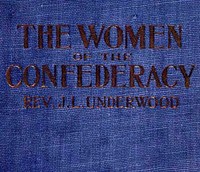
I have been permitted to read the manuscript of Mr. Underwood's book, entitled, "The Women of the Confederacy." I do not hesitate to pronounce it a valuable and enduring contribution to our country's history. There is not a page in it that is dull or commonplace. No man who starts to read it will lay it aside until he has reached the conclusion of it. The author's definitions of the relations of each sovereign State to the Federal Union and of her rights under the Federal Constitution are exact. His argument in support of the Constitutional right of secession amounts to a demonstration. His interpretation of the long series of political events which drove the South into secession is clear, just and convincing. His tributes to the patriotism and valor of the Southern women are brilliant and thrilling without the semblance of extravagance. His description of the vandalism of Sherman's army in its march through Georgia and South Carolina cannot fail to kindle a flame of indignation in the heart of any civilized man who reads it. His anecdotes, both humorous and pathetic, are well chosen.
The section of this book which relates most directly to "The Women of the Confederacy," including Mr. Underwood's tribute in the Symposium to their memory, is by far the most thrilling and meritorious part of it. Into this the author has put his best material, his deepest emotions, his finest sentiments, and his most eloquent words. To the conduct of Southern women in that unprecedented ordeal, history furnishes no parallel. Through many generations to come it will be the favorite theme of the poets and orators.
I need no prophetic gift to see that this book will be immensely popular and extensively circulated. Its aged and afflicted author has done a work in writing it which deserves the gratitude and applause of his fellow countrymen.
J. B. HAWTHORNE.
I have carefully examined the manuscript of Mr. J. L. Underwood on "The Women of the Confederacy" and I take great pleasure in saying that in my judgment it is a book of very great interest and value, and if properly published and pushed I have no doubt that it would have a very wide sale.
Mr. Underwood has given a great deal of time to the collecting of material for his book, and has had great advantages in doing so in having had free access to the libraries of Richmond, and his book abounds in touching and thrilling incidents, which present as no other book that has been published does the true story of our Confederate women, their sufferings and privations; their heroism and efficiency in promoting the Confederate cause. I do not hesitate to say that it is worthy of publication, and of wide circulation.
J. WM. JONES.
Author's Introduction
One of the last things the great Henry W. Grady said, was: "If I die, I die serving the South, the land I love so well. My father died fighting for it. I am proud to die speaking for it." The author of this volume fought for the South and is now so afflicted that he can no longer hope to speak for the South, but he will be happy to die writing for it. Not half has yet been told of the best part of the South, her women.
The Apostle John, on finishing his gospel story of Christ, said: "And there are many other things which Jesus did, the which if they could be written every one, I suppose that even the world itself could not contain the books that should be written." While at work preparing this volume, Mr. C. D. Kennedy, the courteous State librarian of Virginia, said to the writer it would "take a whole library to tell all about the Confederate women." As in the life of Christ, only a small part can be told; and only a small part is necessary.
It is remarkable that the life of Christ was the most tragic, thrilling, and beneficent life the world ever saw. And yet it is all told in four booklets of simple incidents. Those four little books have been worth more to the world than all other books combined. Neither is there any system in the gospel record. There was no system in Christ's life. It could not be told in a consecutive biography nor in a scientific treatise. Science and system all fail when it comes to telling of a life of such love and labor and sorrow.
It is not sacrilegious to say the same thing when we come to tell of the heroic lives, the courage, the trials, the work of the Confederate women. We can only give incidents, and these incidents tell all the rest.
Fortunately the author, while a patient in a Richmond hospital, has been strong enough to search the libraries of the city and gather material scattered among the Confederate records already made. With them and his own original sketches, it is hoped that a contribution of some value has been made to a good cause. The story of the Southern women is worth studying; and the author tells in his eulogy his estimate of their great virtues. Then he shows that his estimate is not from partiality or ignorance by giving a symposium of tributes from others, some from the North and some from Europe.
It may surprise some that so much attention is given to holding up the righteousness of the cause in which these women labored and suffered. Why not? The great cause ennobled them, and they adorned the Confederate cause. The truth must be told from both directions. This is the ground idea of this humble volume.
It is hoped that it will fill a good place in our Southern literature, suggesting further investigation on the same line. It has been a work of love, a comfort to him in the days of very fearful bodily affliction. He is conscious of the feebleness of his work and much indulgence is asked for.
The author deems his subject a consecrated theme. And he rejoices that he could labor at his task amid the consecrated memories of dear old Richmond, where he has had the assistance and the smiles of encouragement from the noble women who continue to keep guard over Hollywood and Oakwood Cemeteries, the Soldiers' Home, and the Home for Confederate Women, and keep vestal watch in the Confederate Museum.
Not a line is written in sectional prejudice or tainted by a touch of hate. The author was a Confederate soldier. He hates sham, injustice, falsehood, and hypocrisy everywhere, but he loves his fellow men, and still bears the old soldier's respect and warm hand for the true soldiers who fought on the other side. The barbarities of bummers and brutal commanders must be repudiated by us all that the honor of true soldiers like McClellan, Rosecrans, Thomas, and Buell, on the one side, and Lee, Jackson and Johnston on the other, may stand forth in its true light.
When our broad-brained and big-hearted President Roosevelt has just stepped down from the White House to tell on Capitol Hill at Richmond and at the feet of the monuments of Lee and Jackson, his great admiration for the Confederate soldiers and the Confederate women, it is time for us all to take a fresh look at their heroic lives.
J. L. UNDERWOOD.
KELLAM'S HOSPITAL, Richmond, Va., April 1st, 1906.
My Dear Mr. Underwood:
* I do not know in all history a finer subject than the heroism of our Southern women, God bless them. I have never forgotten our dear Mrs. Robt. E. Lee, sitting in her arm chair, where she was chained by the most agonizing form of rheumatism, cutting with her dear aching hands soldiers' gloves from waste pieces of their Confederate uniforms furnished to her from the government shops. These she persuaded her girl visitors to sew into gloves for the soldiers. Certainly these scraps were of immense use to all those who could get them, for I do not know how many children's jackets which kept the soldiers' children warm, I had pieced out of these scraps by a poor woman who sat in the basement of the mansion and made them for them.