Public-domain ebook
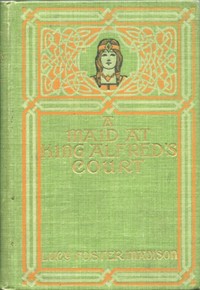
A Maid at King Alfred's Court: A Story for Girls
Language: en594 downloads on Project Gutenberg
Subjects
In: Historical Novels·Children & Young Adult Reading·Adventure
Public-domain ebook sourced from Project Gutenberg #37405.
Public-domain ebook
Language: en594 downloads on Project Gutenberg
Subjects
In: Historical Novels·Children & Young Adult Reading·Adventure
Public-domain ebook sourced from Project Gutenberg #37405.
The opening · free to read
Beautiful was the month of October in the year of our Lord 877. That part of merrie England called Wessex was covered, in this ancient time with a vast and extensive wood.
Only where the broad estuary of Southampton Water divided the tangled woodland, and along the river Itchen, was there any break in the forest. Formidable were the wastes of Andred's weald, and fortunate the traveler whose path lay not apart from the public roads.
Hundreds of wide-spreading, broad-headed oak trees covered the hills and valleys, and flung their gnarled branches over the rich grassy sward beneath. Intermingled with these, sometimes so closely as to hide the rays of the sun, were beeches, hollies, and copsewood of various descriptions.
The great trees were girt round about with mosses or wreaths of ivy that betokened their age, and their foliage was bright with the hues of autumn.
The leaves were falling, but through the openings thus made wider vistas of beauty were revealed. The rich burnished bronze of the oak mingled with the blazing orange of the beech. The gray branches of the graceful ash contrasted with the fir--stately daughter of autumn.
The sunshine streaming through the trees caught and intensified the vivid colorings. Red of many degrees, up to the gaudiest scarlet; every tint of yellow, from the wan gold of the primrose to the deep orange of the tiger lily; purple from lightest lilac to the darkest shade of the pansy, mingled and intermingled, until the whole forest seemed one mass of glowing, riotous color. Ever and anon the antlers of a deer might have been seen as he moved restlessly through the wold, and in the nearer glades the hares and conies came stealing forth to sport or to feed.
In the distance the mellow blasts of a horn could be heard, which grew nearer and more near until presently on the high road which wound through the wastes of forest land from Silchester to Winchester (or Winteceaster, as it was then called) appeared the forms of two people, an old man and a girl.
They moved slowly, the maiden accommodating her steps to those of her companion. Though not really old, for he was not much more than sixty, both the man's countenance and carriage indicated age. His complexion was fair and his cheeks ruddy; but his visage was deeply furrowed, and his long hair, which escaped from under his bonnet, was white as snow, as was also his large and forked beard. His dark blue woolen mantle was clasped on the shoulder by a broad ouche, or brooch; his leggins were also of blue woolen, cross-gartered by strips of leather. Blue, too, was the under tunic. His right arm encircled a harp.
The girl who accompanied him was somewhere about the age of fourteen. Her form was enveloped in a mantle of scarlet wool, to which was attached a hood of the same material. The face under the hood was wondrously lovely, and had already gained her the appellation of "The Fair."
"Grandfather, dearest," she cried as she beheld a log which lay under the overhanging branches of a large oak, "see! here is rest for thy weariness. I wot that thou art tired."
"Yes, child. The limbs of the old tire quickly, and alack! I am not so young as I was of yore. The way hath seemed long to-day, and we are yet far from Winchester. Prithee, wind the horn no longer, for I weary of its sound; and truly if there be any within hearing, they must know of our coming."
He sat down as he spake, resting his harp on his knee. The maiden let fall the horn that proclaimed their coming, according to the law of the forest, threw back her hood, unfastened the fibula that closed the mantle, and tossed the garment on the log beside the old man. Thus revealed, she stood forth in all her beauty.
Her long yellow hair, bound only by a golden band, was parted smoothly and hung in ringlets on her shoulders. Her complexion was dazzling in its fairness; her cheeks rosy; her eyes sparkling, and blue as periwinkles. She wore a tunic of blue woolen, falling to her ankles, and bordered by a band of needlework, for which the Anglo-Saxon women were famous. Over this was worn a short gonna of scarlet, the sleeves of which, reaching in long, loose folds to the wrists, were confined there by bracelets. The slenderness of her waist was disclosed by a girdle, and over her shoulders hung a chain, from which was suspended a pair of cymbals and the horn. A picturesque figure she made as she stood there, and one fair to look upon. The old man's eyes rested upon her fondly, and then he spake:
"Art thou not cold, Egwina? The Wyn (October) month hath bright sunshine, but his breezes carry also the chill that foretokens the coming of winter. Heaven forfend that thou shouldst become ill."
The girl laughed merrily.
"Be not irked, grandfather. The mantle was wearisome, and I did but cast it aside for a time. See! Lest thou shouldst needlessly fret thy mind, I will put on the garment again, and thou shalt tell me whither we go after Winchester."
Donning the mantle she sat down beside him. The grandfather looked at her tenderly.
"Egwina The Fair art thou called," said he, "but Egwina The Good art thou also. From Winchester, dear child, and its market, we will wend our way to the royal vill at Chippenham, where the king is to winter."
"Why to Chippenham?" asked the girl. "It is not often, grandfather, that thou carest to follow the king."
"True, child; for Alfred hath scops of his own in his court, and needeth not the glee of Wulfhere, the harper. But even as yon oak hath gathered the moss of years, so have sorrows come to me, and fain am I to lay down their burthen. Of bards there are many; but few glee maidens there be who sing as thou dost. For thy sake do I hope that the king will take us under his hand."
"But if he will not, then whither?" asked the maiden.
"He will," answered Wulfhere positively. "The meanest wayfarer hath the right to bed and board for a day and a night in any house. Thinkest, then, that Alfred will not give shelter and food to a gleeman and maiden? I trow that he will."
"Will not the court be hindrance to thee?" questioned the girl gently. "Dear grandfather, thou hast been so free always, I fear me much that thou wilt mislike to be housed with one lord."
"Were he younger, child, Wulfhere would have nought of it. I, and my father, and his father's father have always thus lived, wandering from shire to shire; from burgh to burgh; from mead hall to mead hall, with harp and song and story; and none were so welcome as they. Many lords have bestowed gifts upon them, and fain would have kept them to sing of their bold deeds. But all of us, from father to son, liked better to tell of the daring of many than the prowess of one. The song of a harp of one string becometh in time irksome both to hearer and singer. In sooth, 'tis a merry life and a free. Alack and a day that 'tis past! The Dane is abroad in the land. For a short time hath he left us in quiet, and now winter will still further stay his hand. Guthrum the old is bold, and I fear that the Northmen await only the bringing home of the summer ere falling upon Wessex."
"The saints forfend!" ejaculated the girl devoutly.
"So it is for thy weal, Egwina, that we seek the king. I would not have thee die as did thy brother, Siegbert. God wots how they could kill the pretty lad."
"Tell me of it," coaxed the maiden well knowing the tale, but thus did the old man ease his sorrow.
"Thou wert too young to mind thee now that it was seven years this harvest when Ubbo and Oskitul with the tearful Danes fell upon the abbey of Croyland. To the monks had I sent Siegbert, for the abbot had heard his singing and was pleased with his beauty. 'He shall be a second Cynewulf,' said he, 'when he shall have become learned.' I wotted not that I was sending the boy to his death. But even while the abbot and the priests, together with the choir, performed the mass and were singing the Psalter, the pagans swooped down upon them, and none were there left to tell the tale. So little do these heathen care for our holy religion. In sooth, meseems that it glads their hearts to destroy our minsters and abbeys. They cared neither for the helplessness of the old nor the harmlessness of childhood. Bright and beautiful as that Baldur whom they worship, methinks they would have spared him. But hearken! was not that a call?"
Both listened intently, and through the clear, crisp air there came a cry for help.
"Some mishap hath befallen a wayfarer!" exclaimed Wulfhere rising quickly to his feet, his weariness vanishing instantly. "Come, Egwina, wind thy horn that he may know that help is near."
The maiden blew a long, loud blast and then they hastened in the direction whence the cry had come. Soon a turn of the road brought them in sight of the figures of a youth and a maiden. The girl was lying prone upon the sward. The youth bent over her anxiously stroking her hands. Both were clothed in the bright-colored garments of which the Saxons were so fond. The embroidery and richness of adornment of their dress proclaimed them to be of noble rank. A falcon hovered disconsolately near them, and a spear lay on the ground.
As soon as the lad caught sight of Wulfhere and Egwina, he uttered an exclamation of joy.
"Be of good heart, Ethelfleda," he cried; "here comes a gleeman and his daughter. I wot that they will help us."
"Son, wherefore thy call?" queried the bard, approaching.
"My sister hath wrenched her foot against a stone," replied the youth. "We stole away to try my new falcon with the lure, and all would have been well had not this befallen us. Wilt thou not, good harper, hasten into Winchester and bespeak for us a palfrey?"
"Edward," spoke the maiden quickly, "seest thou not that the gleeman is old? Do thou go, my brother, and leave me with them."
"Truly hast thou spoken, Ethelfleda," returned the youth, rising. "I crave forgiveness, bard, that I saw not thy years. Quickly will I go and as quickly come again. Irk not thyself while I am gone, my sister." With a bow to Wulfhere and Egwina, and a salute for his sister the youth hurried away.
"I hear the ripling of a rill," remarked Egwina. "Cooling will its waters feel to thy foot."
"But how canst thou bring the water?" asked the maiden, curiously. "Thou hast no bowl either of horn or wood."
"Nay; but I have these," and Egwina touched her cymbals. "Though they be shallow, yet enough will they hold for thy ankle."
The book keeps going
Reading is free forever. Sign up and watch scenes appear while you read.



Scenes Storieta drew for other classics.
New illustrated classics
Once or twice a month: the latest books to get full character casts, scene art, and free comic editions. No account needed.