Public-domain ebook
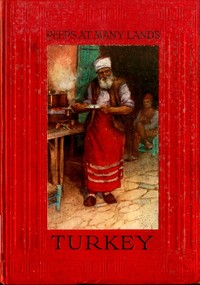
Peeps at Many Lands: Turkey
Language: en1,032 downloads on Project Gutenberg
Subjects
In: Travel Writing·History - Other
Public-domain ebook sourced from Project Gutenberg #37475.
Public-domain ebook
Language: en1,032 downloads on Project Gutenberg
Subjects
In: Travel Writing·History - Other
Public-domain ebook sourced from Project Gutenberg #37475.
Van Millingen’s work is a sweeping historical‑geographical survey of Turkey, written for a nineteenth‑century audience interested in travel and description. The opening chapter sketches the rise of the Turkic peoples from Central Asian nomads to the founders of the Ottoman Empire, tracing their conquests from Anatolia to Constantinople and beyond. It then pivots to a vivid portrait of the empire’s later decline, noting the corruption of its later sultans, the rise of the Young Turks, and the modern railway links that now bind Turkey to Europe and the Near East. Interspersed with detailed observations of regional peoples, Albanians, Pomaks, Tartars, Bulgarians, the narrative blends political history with ethnographic notes, offering a broad picture of the country’s past and present.
The author writes in a formal, didactic style typical of late‑Victorian travel literature, employing a measured, often moralizing tone while peppering the text with anecdotal episodes and illustrative sketches. Readers who enjoy dense, source‑rich accounts of empire, early‑modern geopolitics, and the cultural mosaic of the Ottoman lands will find this volume rewarding, especially those with a taste for the exhaustive, descriptive prose of 19th‑century scholars.
The opening · free to read
The rulers of Turkey are the Turks, originally a nomadic tribe from Central Asia. Compelled to abandon their homes on account of the desiccation or drying up of large tracts of their country, which were converted into a desert, they swarmed into Armenia and Persia in quest of new pasture-lands for their flocks and cattle. Like the in-coming tide, they swept everything before them, and finally overwhelmed, not only Asia Minor, but also Egypt and Northern Africa.
Converted at an early stage of their history to the Mahomedan faith, they propagated it wherever they went, and, under the leadership of the Sultans of the Seljuk dynasty, they established themselves in Konia, and advanced their rule to the gates of the Byzantine Empire. But it was reserved for a kindred tribe under Ertogrul to be the successors of the Seljuks and establish the Ottoman dynasty which still holds sway over Turkey.
The events leading up to it were as follows: Ertogrul, with a band of 400 followers, was wandering about Asia Minor, and accidentally came across a conflicting Mongolian and Seljuk army in the neighbourhood of Angora. He dashed into the fray in support of the latter, and changed impending defeat into a brilliant victory. In reward for this timely assistance the Seljuk Sultan awarded to Ertogrul the district of Anatolia, which bounded the Greek or Byzantine Empire, the capital of which Empire was then Constantinople.
During the summer the new-comers drove their flocks to the mountains, and during the winter they withdrew them to the plains, but, growing bolder and more powerful, Ertogrul waged war against the Greeks. Success followed upon success, until at last, in 1326, under the leadership of Othman, the son of Ertogrul, Nicea, noted for its Council which drew up the Nicean Creed, fell to the sword of the Moslem. Brusa also was taken, and there Othman enthroned himself as Sultan of the dynasty thenceforth known as the Ottoman.
Before proceeding further it might be interesting to relate an incident which pictures the primitive character and frugality of the founders of this dynasty. When the mighty Othman died, the only possessions he left behind were a salt-bowl, the symbol of hospitality, a spoon, his sword and standards, his cloak and white turban, a pair of horses, a yoke of oxen, and his flock of sheep. His sword is still preserved in Constantinople, and each successive Sultan is invested with it on his coronation. The descendants of his flock of sheep are still the heritage of the reigning Sultan, and still browse on the ranges of Bithynian Olympus, and supply butter and cheeses for the royal household.
The victories of the Ottoman Turks were followed by the incorporation of the Seljuks, and drew into their ranks crowds of recruits thirsting for blood and plunder. The Asiatic shores of the Bosphorus were ravaged with sword and fire, and shortly afterward (in 1453) Constantinople was invested and stormed, and the last of the Byzantine Emperors slain.
Driving everything before them, the victorious Turks marched northwards into Europe, devastating, burning, plundering, slaying, and making captives of women and children, until at last they reached the walls of Vienna, and at one moment it looked as if all Europe would fall to their sway.
But this was the limit of their Northern conquests, and, like the tide which recedes after it has reached its fulness, so this assault on Vienna and its repulse marks the high tide and first ebb of Turkey's greatness.
One by one they lost their possessions in Europe, such as Hungary, Roumania, Greece, Servia, and Bulgaria, and now only a comparatively small strip of country remains to them in Europe. In Asia also large tracts of country have been wrenched from Turkey by Russia; and in Africa, Egypt and Tunis are Turkish only in name.
The splendid conquests of the Turks were due to the hardihood of a race brought up in frugality and nomadic pursuits. Their strength and courage were amazing, and their religious zeal made them reckless of their lives. Their early Sultans, too, were men of extraordinary energy and sagacity, and were the first among the Turks to organize regular soldiers. A famous corps was that of the Janissaries, who were selected from the strongest and most beautiful Christian youth forced away from their parents or captured in battle. Confined all their lives in barracks, and daily drilled in the arts of war, they grew to be as invincible as Cromwell's Ironsides.
But as discipline relaxed they became insubordinate, dethroning Sultans and nominating others, until one day, in 1826, Sultan Mahmoud IV. had them secretly surrounded in their barracks and annihilated. A venerable planetree may yet be seen in the old Palace grounds where the survivors were hanged. Its hollow trunk ultimately served as the shop of a shoemaker.
The decline of the Ottoman Empire was due to the corruption of the Turks that followed acquisition of wealth. They lost their hardihood, and their Sultans became profligate and luxurious. They filled their harems with wives and numberless slaves, and addicted themselves to pleasure instead of duty. They became tyrants, and their jealousies and fears of being supplanted made them so cruel that it became customary for a Sultan ascending the throne to kill all his brothers or near male relatives. This was usually done by strangling them with a bow-string, or sewing them in bags and drowning them in the Bosphorus, as one would an undesirable litter of puppies.
Recent Sultans, it is true, have not dared to commit such deeds openly in the face of growing public opinion, but, with few exceptions, they have been equally selfish and corrupt. Indeed, in the reign of the recent ex-Sultan Abdul Hamid, rightly styled "the Great Assassin" by Mr. Gladstone, corruption and villainy reached unheard-of enormity. He planned and carried out wholesale massacres against his Armenian subjects, and spirited away thousands of innocent Mussulmans and Christians at the instigation of the army of spies whom he employed, and who enriched themselves with the bribes he offered.
At last matters reached such a pitch that life in Turkey became unbearable, and in sheer desperation he was dethroned in 1908 by his army, led by patriotic officers who styled themselves Young Turks.
In his stead they appointed his brother, Murad V., to be Sultan, and proclaimed a Constitution; that is, a form of Government like our own, with a Parliament consisting of representatives of the people.
Turkey is now doing its best to reform itself, and we wish it all success, but naturally, after so many years of misrule and corruption, it will take time before the Turks can set their house in proper order.
For now more than twenty years Turkey has been connected with Western Europe by rail, trains starting from Vienna and crossing the Danube at Belgrade. Shortly after, the main line branches off and one portion proceeds through Bulgaria to Constantinople, while the other terminates at Salonica. The journey from London to Constantinople occupies three and a half days, but may be accelerated.
There is no railway bridge over the Bosphorus, but a railway line, of recent construction, runs from its Asiatic entrance into Asia Minor as far as Konia, the Iconium of Scripture. This line is now being extended to reach Bagdad in Mesopotamia, and will be prolonged thence to the Persian Gulf, and doubtless, ultimately, to India, and will perhaps enable us to visit our friends there within a week's journey from London.
Another railway crosses the Lebanon mountains from Beyrout, and proceeds to Damascus, and thence extends, keeping to the east of the Jordan, to Mecca, in Arabia, the Holy City of the Moslems. This line is called the Sacred or Pilgrim railway, because it conveys large numbers of pilgrims to their shrine. It was built nearly entirely out of the contributions of the faithful, both in money and in free labour.
Having briefly narrated the history of the rise and decline of the Ottoman Empire, it may be interesting to have a peep at the various races and nationalities which at present constitute it.
Beginning with Turkey in Europe, we have the Albanians, who occupy the mountainous country north of Greece, and also Albania and Epirus on the eastern shore of the Adriatic. They are a brave, haughty, liberty-loving, but turbulent people, whom some maintain to be the descendants of the ancient Pelasgi, who originally occupied Greece. They boast of having given Alexander the Great to the world. The Albanians were never properly conquered by the Turks, and, excepting those inhabiting the lowlands, they do very much what they please, and even at this moment they are defying the Turkish troops sent to disarm them, and bring them under subjection. Some are Mahomedans, others are Roman Catholics, and others belong to the Greek Church. They have a language of their own, but until quite recently they had no alphabet for it, and it was only within the last forty years that a Scotsman, the agent of the British and Foreign Bible Society, endowed them with one, and printed the Scriptures in their tongue. It is this alphabet that the Turks are now trying to suppress by substituting the Arabic, and the Albanians are fighting to maintain. The national dress of the Albanians is a white kilted petticoat coming down to their knees, with a scarlet or purple embroidered vest, and a corresponding sleeveless jacket worn over a white shirt with wide sleeves. The waist is girded with a broad silken band folded many times round the body. Embroidered leggings, corresponding in colour with the jacket, protect the legs, and a red cap, called a fez, with a silken blue tassel, covers the head.
So attached are they to their national costume that an attempt made by Sultan Mahmoud to forbid it led to an insurrection in the same way that the edict in 1747 to do away with the kilts and tartans in the Scottish Highlands created the troubles which followed the rebellion. Naturally, the peasants cannot afford costly material, and their dress consists of a closely-woven, home-spun tweed called shayiak, which is very warm and enduring. They wear a skull-cap of the same material, shayiak knickers and leggings, and sandals instead of shoes. Over this girdle they wear a broad cartridge-belt, which bristles with old-fashioned pistols and formidable daggers.
The Albanians are a nation of clans, implacable in their hatred and constant in their friendships. Their covenant of friendship is cemented by tasting a drop of each other's blood, and from that moment they consider themselves blood kinsmen, and sworn to befriend, defend, or avenge each other.
Like the Israelites of old, the blood avenger pursues the murderer of his friend or clansman until he finds him, and if he should fail to do so during his lifetime, his children are bound to act on his behalf. You can thus understand that in accordance with this law of "vendetta," as they call it, whole families become sometimes exterminated.
The book keeps going
Reading is free forever. Sign up and watch scenes appear while you read.



Scenes Storieta drew for other classics.
New illustrated classics
Once or twice a month: the latest books to get full character casts, scene art, and free comic editions. No account needed.