
Public-domain ebook
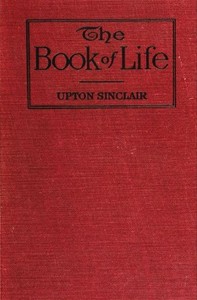
The Book of Life
Language: en1,536 downloads on Project Gutenberg
Subjects
Public-domain ebook sourced from Project Gutenberg #38117.
Public-domain ebook
Language: en1,536 downloads on Project Gutenberg
Subjects
Public-domain ebook sourced from Project Gutenberg #38117.
The Book of Life presents itself as a practical guide that grew out of the author’s forty‑two years of experience and the flood of questions he receives from ordinary people. From the opening, the writer explains that his purpose is to share hard‑won knowledge, about health, love, work, and the deeper questions of existence, without the pretensions of academic or religious authority. He frames the work as a “modern, wise, honest, and kind” book, promising to address everything from diet and disease to morality and the nature of consciousness, all laid out in a series of short, numbered chapters. The introductory passage already signals a conversational tone, inviting readers to consider their own “fog‑filled” lives and to seek answers that are missing from schools, newspapers, and churches.
The voice is that of a self‑educated, earnest man of the early twentieth century, blending the didactic style of popular philosophy with the straightforwardness of a newspaper column. Its language is plain, occasionally peppered with modest technical terms, and it avoids lofty jargon in favor of clarity. Readers who enjoy systematic, almost encyclopedic treatments of everyday concerns, particularly those who appreciate a blend of moral reflection, scientific curiosity, and practical advice, will find this book engaging. It appeals to the busy professional, the curious homemaker, and anyone who has ever wondered about the meaning of life while juggling the demands of work and family.
The opening · free to read
The writer of this book has been in this world some forty-two years. That may not seem long to some, but it is long enough to have made many painful mistakes, and to have learned much from them. Looking about him, he sees others making these same mistakes, suffering for lack of that same knowledge which he has so painfully acquired. This being the case, it seems a friendly act to offer his knowledge, minus the blunders and the pain.
There come to the writer literally thousands of letters every year, asking him questions, some of them of the strangest. A man is dying of cancer, and do I think it can be cured by a fast? A man is unable to make his wife happy, and can I tell him what is the matter with women? A man has invested his savings in mining stock, and can I tell him what to do about it? A man works in a sweatshop, and has only a little time for self-improvement, and will I tell him what books he ought to read? Many such questions every day make one aware of a vast mass of people, earnest, hungry for happiness, and groping as if in a fog. The things they most need to know they are not taught in the schools, nor in the newspapers they read, nor in the church they attend. Of these agencies, the first is not entirely competent, the second is not entirely honest, and the third is not entirely up to date. Nor is there anywhere a book in which the effort has been made to give to everyday human beings the everyday information they need for the successful living of their lives.
For the present book the following claims may be made. First, it is a modern book; its writer watches hour by hour the new achievements of the human mind, he reaches out for information about them, he seeks to adjust his own thoughts to them and to test them in his own living. Second, it is, or tries hard to be, a wise book; its writer is not among those too-ardent young radicals who leap to the conclusion that because many old things are stupid and tiresome, therefore everything that is old is to be spurned with contempt, and everything that proclaims itself new is to be taken at its own valuation. Third, it is an honest book; its writer will not pretend to know what he only guesses, and where it is necessary to guess, he will say so frankly. Finally, it is a kind book; it is not written for its author's glory, nor for his enrichment, but to tell you things that may be useful to you in the brief span of your life. It will attempt to tell you how to live, how to find health and happiness and success, how to work and how to play, how to eat and how to sleep, how to love and to marry and to care for your children, how to deal with your fellow men in business and politics and social life, how to act and how to think, what religion to believe, what art to enjoy, what books to read. A large order, as the boys phrase it!
There are several ways for such a book to begin. It might begin with the child, because we all begin that way; it might begin with love, because that precedes the child; it might begin with the care of the body, explaining that sound physical health is the basis of all right living, and even of right thinking; it might begin as most philosophies do, by defining life, discussing its origin and fundamental nature.
The trouble with this last plan is that there are a lot of people who have their ideas on life made up in tabloid form; they have creeds and catechisms which they know by heart, and if you suggest to them anything different, they give you a startled look and get out of your way. And then there is another, and in our modern world a still larger class, who say, "Oh, shucks! I don't go in for religion and that kind of thing." You offer them something that looks like a sermon, and they turn to the baseball page.
Who will read this Book of Life? There will be, among others, the great American tired business man. He wrestles with problems and cares all day, and when he sits down to read in the evening, he says: "Make it short and snappy." There is the wife of the tired business man, the American perfect lady. She does most of the reading for the family; but she has never got down to anything fundamental in her life, and mostly she likes to read about exciting love affairs, which she distinguishes from the unexciting kind she knows by the word "romance." Then there is the still more tired American workingman, who has been "speeded up" all day under the bonus system or the piece-work system, and is apt to fall asleep in his chair before he finishes supper. Then there is the workingman's wife, who has slaved all day in the kitchen, and has a chance for a few minutes' intimacy with her husband before he falls asleep. She would like to have somebody tell her what to do for croup, but she is not sure that she has time to discuss the question whether life is worth living.
Yet, I wonder; is there a single one among all these tired people, or even among the cynical people, who has not had some moment of awe when the thought came stabbing into his mind like a knife: "What a strange thing this life is! What am I anyhow? Where do I come from, and what is going to become of me? What do I mean, what am I here for?" I have sat chatting with three hoboes by a railroad track, cooking themselves a mulligan in an old can, and heard one of them say: "By God, it's a queer thing, ain't it, mate?" I have sat on the deck of a ship, looking out over the midnight ocean and talking with a sailor, and heard him use almost the identical words. It is not only in the class-room and the schools that the minds of men are grappling with the fundamental problems; in fact, it was not from the schools that the new religions and the great moral impulses of humanity took their origin. It was from lonely shepherds sitting on the hillsides, and from fishermen casting their nets, and from carpenters and tailors and shoemakers at their benches.
Stop and think a bit, and you will realize it does make a difference what you believe about life, how it comes to be, where it is going, and what is your place in it. Is there a heaven with a God, who watches you day and night, and knows every thought you think, and will some day take you to eternal bliss if you obey his laws? If you really believe that, you will try to find out about his laws, and you will be comparatively little concerned about the success or failure of your business. Perhaps, on the other hand, you have knocked about in the world and lost your "faith"; you have been cheated and exploited, and have set out to "get yours," as the phrase is; to "feather your own nest." But some gust of passion seizes you, and you waste your substance, you wreck your life; then you wonder, "Who set that trap and baited it? Am I a creature of blind instincts, jealousies and greeds and hates beyond my own control entirely? Am I a poor, feeble insect, blown about in a storm and smashed? Or do I make the storm, and can I in any part control it?"
No matter how busy you may be, no matter how tired you may be, it will pay you to get such things straight: to know a little of what the wise men of the past have thought about them, and more especially what science with its new tools of knowledge may have discovered.
The writer of this book spent nine years of his life in colleges and universities; also he was brought up in a church. So he knows the orthodox teachings, he can say that he has given to the recognized wise men of the world every opportunity to tell him what they know. Then, being dissatisfied, he went to the unrecognized teachers, the enthusiasts and the "cranks" of a hundred schools. Finally, he thought for himself; he was even willing to try experiments upon himself. As a result, he has not found what he claims is ultimate or final truth; but he has what he might describe as a rough working draft, a practical outline, good for everyday purposes. He is going to have confidence enough in you, the reader, to give you the hardest part first; that is, to begin with the great fundamental questions. What is life, and how does it come to be? What does it mean, and what have we to do with it? Are we its masters or its slaves? What does it owe us, and what do we owe to it? Why is it so hard, and do we have to stand its hardness? And can we really know about all these matters, or will we be only guessing? Can we trust ourselves to think about them, or shall we be safer if we believe what we are told? Shall we be punished if we think wrong, and how shall we be punished? Shall we be rewarded if we think right, and will the pay be worth the trouble?
Such questions as these I am going to try to answer in the simplest language possible. I would avoid long words altogether, if I could; but some of these long words mean certain definite things, and there are no other words to serve the purpose. You do not refuse to engage in the automobile business because the carburetor and the differential are words of four syllables. Neither should you refuse to get yourself straight with the universe because it is too much trouble to go to the dictionary and learn that the word "phenomenon" means something else than a little boy who can play the piano or do long division in his head.
Attempts to show what we know about life; to set the bounds of real truth as distinguished from phrases and self-deception.
Attempts to show what we can prove by our reason, and what we know intuitively; what is implied in the process of thinking, and without which no thought could be.
Attempts to show that in the field to which reason applies we are compelled to use it, and are justified in trusting it.
Shows the transition stage between instinct and reason, in which man finds himself, and how he can advance to a securer condition.
Attempts to show that wise conduct is an adjustment of means to ends, and depends upon the understanding of a particular set of circumstances.
Discusses the interaction between physical and mental things, and the possibility of freedom in a world of fixed causes.
Discusses the subconscious mind, what it is, what it does to the body, and how it can be controlled and made use of by the intelligence.
CHAPTER XIII. EXPLORING THE SUBCONSCIOUS 67
Discusses automatic writing, the analysis of dreams, and other methods by which a new universe of life has been brought to human knowledge.
CHAPTER XIV. THE PROBLEM OF IMMORTALITY 74
Discusses the survival of personality from the moral point of view: that is, have we any claim upon life, entitling us to live forever?
CHAPTER XV. THE EVIDENCE FOR SURVIVAL 81
Discusses the data of psychic research, and the proofs of spiritism thus put before us.
Concludes the Book of the Mind with a study of how to preserve and develop its powers for the protection of our lives and the lives of all men.
Discusses the body as a whole, and shows that health is not a matter of many different organs and functions, but is one problem of one organism.
The book keeps going
Reading is free forever. Sign up and watch scenes appear while you read.



Scenes Storieta drew for other classics.
New illustrated classics
Once or twice a month: the latest books to get full character casts, scene art, and free comic editions. No account needed.