Public-domain ebook
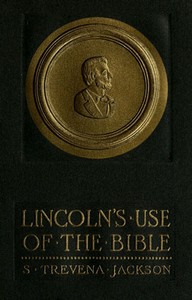
Lincoln's Use of the Bible
Language: en245 downloads on Project Gutenberg
Subjects
In: Biographies·History - American·History - Religious
Public-domain ebook sourced from Project Gutenberg #38434.
Public-domain ebook
Language: en245 downloads on Project Gutenberg
Subjects
In: Biographies·History - American·History - Religious
Public-domain ebook sourced from Project Gutenberg #38434.
The opening · free to read
"The Bible is the king's best copy, the magistrate's best rule, the housewife's best guide, the servant's best directory, and the best companion of youth."
In a log cabin at Nolin's Creek, Hardin County, Kentucky, the boy breathed the first breath of life. Hope's anchor hung on a slender string, if we are to measure by the child's home surroundings. But his birthplace possessed a soul; for a home with a good book in it has a soul. This book was the Bible. It mastered his manners, molded his mind, made mighty his manhood, and gave to America the matchless man.
In the Bible he found the truth for the ills of men, the secret for the solution of life's perplexing problems, the boon for the best beaten path, the succor for the suffering, the calmest comforts for the dying, and the faithful friend when foes are near and other friends so far away.
We shall speak of what others have said concerning Lincoln's use of the Bible; what he himself said of it; the use he made of it; and the influence of the Scriptures on his life and literature.
In Herndon's Life of Lincoln the partner and President is portrayed as a foe rather than a friend of the Bible. This is seen to be erroneous by simply reading his speeches, for they are like the dewdrops on the blades of green in early fall, sparkling everywhere. It is hard to read a great speech of Lincoln's without seeing the influence of the Bible on his life, works, and style.
Sarah K. Bolton writes: "Mrs. Lincoln possessed but one book in the world, the Bible; and from this she taught her children daily. Abraham had been to school for two or three months, to such a school as the rude country afforded, and had learned to read. Of quick mind and retentive memory, he soon came to know the Bible well-nigh by heart, and to look upon his gentle teacher as the embodiment of all the good precepts in the book."
Lincoln's mother died after a lingering illness when he was ten years old. It is said that during her sickness he cared for her as tenderly as a girl, and that he often sat at her side and read the Bible to her for hours. Much of his later life and style was influenced by his early reading of the Bible.
L. E. Chittenden says: "Except the instructions of his mother, the Bible more powerfully controlled the intellectual development of the son than all other causes combined. He memorized many of its chapters and had them perfectly at his command. Early in his professional life he learned that the most useful of all books to the public speaker was the Bible. After 1857 he seldom made a speech which did not contain quotations from the Bible."
Alexander Williamson, who was engaged as tutor in the Lincoln family in Washington, said: "Mr. Lincoln very frequently studied the Bible with the aid of Cruden's Concordance, which lay on his table." The Presbyterian pastor in Springfield, Rev. James Smith, states that Lincoln became a believer in the Bible and Jesus Christ as the Son of God. It is true that Mr. Smith placed before Lincoln the arguments for and against the divine authority of the Scriptures. He looked at it from a lawyer's viewpoint, and, at the conclusion, declared the argument in favor of divine authority and inspiration of the Bible unanswerable.
Mr. Arnold, in his Life of Lincoln, speaking of the Second Inaugural Address, said: "Since the days of Christ's Sermon on the Mount, where is the speech of emperor, king, or ruler which can compare with this? May we not without irreverence say that passages of this address are worthy of that holy book which he read daily, and from which, during his long days of trial, he had drawn inspiration and guidance? This paper in its solemn recognition of the justice of the Almighty God reminds us of the words of the old Hebrew prophets."
Bishop Simpson, in his funeral address, said: "Abraham Lincoln was a good man, a man of noble heart in every way. He read the Bible frequently; he loved it for its great truths; and he tried to be guided by its precepts. He believed in Christ as the Saviour of sinners, and I think he was sincere in trying to bring his life in harmony with the precepts of revealed religion. I doubt if any President has shown such trust in God, or in public document so frequently referred to divine aid."
In the year 1901 President Roosevelt delivered an address before the American Bible Society on "Reading the Bible," in which he said: "Lincoln, sad, patient, kindly Lincoln, who, after bearing upon his shoulders for four years a greater burden than that borne by any other man of the nineteenth century, laid down his life for the people whom, living, he had served so well, built up his entire reading upon his study of the Bible. He had mastered it absolutely, mastered it as later he mastered only one or two other books, notably Shakespeare, mastered it so that he became almost a man of one book who knew that book, and who instinctively put into practice what he had been taught therein; and he left his life as part of the crowning work of the century just closed."
Lincoln often spoke and wrote of the value of the Bible. To Joshua F. Speed, one of his most intimate friends, and at one time his roommate, he wrote: "I am profitably engaged in reading the Bible. Take all of this book upon reason that you can, and the balance on faith, and you will live and die a better man," Mrs. Speed gave Lincoln a Bible, and, after a visit to that home in 1841, he wrote to the daughter, Mary Speed, and at the close said: "Tell your mother I have not got her present (an Oxford Bible) with me, but I intend to read it regularly when I return home. I doubt not that it is really, as she says, the best cure for the blues, could one but take it according to truth."
On July 4, 1842, in writing to his friend Speed of the service he had been in bringing Joshua and Fanny, his sweetheart, together, he said: "I believe God made me one of the instruments of bringing you and Fanny together, which union I have no doubt he had foreordained. Whatever he designs he will do for me yet. 'Stand still and see the salvation of the Lord' is my text just now."
It is stated on good authority that after his election in 1860 he said to Judge Joseph Gillespie: "I have read on my knees the story of Gethsemane, where the Son of God prayed in vain that the cup of bitterness might pass from him. I am in the garden of Gethsemane now, and my cup is running over."
Lincoln's reply to a committee of colored people of Baltimore who presented him with a Bible, September 7, 1864, gives his opinion of the Bible: "In regard to this great book I have but to say: It is the best gift God has given to man. All the good Saviour gave to this world was communicated through this book. But for it we could not know right from wrong. All things most desirable for man's welfare here and hereafter are to be found portrayed in it. To you I return my most sincere thanks for the very elegant copy of the great Book of God which you present."
At Springfield he addressed the Bible Society and said: "It seems to me that nothing short of infinite wisdom could by any possibility have devised and given to man this excellent and perfect moral code. It is suited to men in all the conditions of life, and inculcates all the duties they owe to their Creator, to themselves, and to their fellow men."
In J. G. Holland's Life of Lincoln he gives us the conversation with Mr. Bateman: "Mr. Bateman, I have carefully read the Bible." Then he drew from his pocket a New Testament: "These men will know that I am for freedom in the territories, freedom everywhere as far as the Constitution and laws will permit, and my opponents are for slavery. They know this, yet, with this book in their hands, in the light of which human bondage cannot live a moment, they are going to vote against me. I know there is a God, and that he hates injustice and slavery. I see the storm coming, and I know that his hand is in it. If he has a place for me--and I think he has--I believe I am ready. I am nothing, but truth is everything. I know I am right, for Christ teaches it, and Christ is God."
In his Lyceum speech he speaks of the advantage of an education and being able to read the history of his own and other countries, by which we may appreciate the value of our free institutions, to say nothing of the advantages and satisfaction to be derived from all being able to read for themselves the Scriptures and other works both of a religious and moral nature. In this same speech he uses this language: "If destruction be our lot we must ourselves be its author and finisher." Then, speaking of the Revolution, he desired the history of it to "be read and recounted as long as the Bible shall be read."
The night before the President left Springfield for the White House a friend from Chicago sent him the American flag with these words: "Have not I commanded thee? Be strong and of a good courage; be not afraid, neither be thou dismayed: for the Lord thy God is with thee whithersoever thou goest. There shall not any man be able to stand before thee all the days of thy life: as I was with Moses, so I will be with thee."
It has been said by those who pride themselves on having no faith in the inspiration of the Scriptures that Lincoln held their views. But he addressed conventions and Sunday-schools, and the Bible was as often quoted by him as Blackstone. The addresses and letters of Lincoln are saturated with expressions from the Holy Scriptures. In his reply to Douglas he gave his speech great force by the words of Christ: "A house divided against itself cannot stand." In writing to Mr. W. Durley he uses scriptural terms: "By the fruit the tree is to be known. An evil tree cannot bring forth good fruit."
Ann Rutledge gave him a new view of the Bible and Shakespeare. Abraham Lincoln's is the language of the Bible. He never used the Bible in an irreverent way. In the Lincoln Museum, Washington, there is a copy of the Holy Scriptures. It is well worn, and shows the signs of good use. Inside the cover are these words in his own handwriting: "A. Lincoln, his own book."
He wrote a letter to Rev. J. M. Peck in 1848 asking him, "Is the precept, 'Whatsoever ye would that men should do to you, do ye even so to them,' obsolete, of no force, of no application?" In his description of Niagara he said: "It calls up the indefinite past when Christ suffered on the cross, when Moses led Israel through the Red Sea--nay, even when Adam first came from the hand of his Maker; then, as now, Niagara was roaring here."
In writing to John D. Johnston concerning his father's illness, he said: "I sincerely hope Father will recover his health, but, at all events, tell him to remember and call upon and confide in our great and good and merciful Maker. He notes the fall of the sparrow and numbers the hairs of our heads, and he will not forget the dying man who puts his trust in him."
Mr. William S. Speer wrote to Mr. Lincoln asking him to write a letter to give his definite views on the slavery question. Lincoln replied: "I have already done this many, many times, and it is in print and open to all who will read. Those who will not read or heed what I have already publicly said would not read or heed a repetition of it. 'If they hear not Moses and the prophets, neither will they be persuaded though one rose from the dead.'"
The book keeps going
Reading is free forever. Sign up and watch scenes appear while you read.



Scenes Storieta drew for other classics.
New illustrated classics
Once or twice a month: the latest books to get full character casts, scene art, and free comic editions. No account needed.