Public-domain ebook
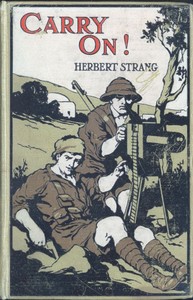
Carry On! A Story of the Fight for Bagdad
Language: en366 downloads on Project Gutenberg
Subjects
In: World War I·Historical Novels·Adventure
Public-domain ebook sourced from Project Gutenberg #38714.
Public-domain ebook
Language: en366 downloads on Project Gutenberg
Subjects
In: World War I·Historical Novels·Adventure
Public-domain ebook sourced from Project Gutenberg #38714.
The opening · free to read
Mesopotamia, "the land between the rivers," has been brought by Time's revolution once more into the foreground of the history of the world. The plains where Abraham, Isaac and Jacob tended their flocks and herds; where the hosts of Sennacherib, Shalmaneser and Alexander contended for "world-power" in their day; where the Arabs, heirs of ancient civilisations, reared a civilisation of their own until it fell under the blight of Turkish dominion: have become once more the battle-ground of opposing armies, the representatives of conflicting spirits and ideals.
This fertile land, whose history dates back many thousands of years, has long lain desolate. Swamps and marshes and the floods of the Tigris and the Euphrates cover immense tracts that were once the granary of the middle East. The old canals and irrigation works constructed by Babylonians and Assyrians are now obliterated by sand. Where once large populations throve and cultivated literature and the arts, now roam only a few tribes of Arabs, degenerate descendants of the race that at one time led the world in the things of the mind. Mesopotamia is the "abomination of desolation."
Here and there a mound--known to archæologists as a _tell_--marks the site of a buried city, and excavation has brought to light the remains of palaces and monumental tombs, and temples where "pale-eyed priests" chanted incantations to Assur and Ishtar and Merodach--the Baalim and Ashtoreth of the Bible. It was at one such tell that the story to be unfolded in the following pages had its beginning.
Early one morning in the autumn of 1916, any one who had chanced to be standing on this tell would have noticed, far in the eastern sky, a moving speck. It might have been a gigantic bird, but that, as it approached, its flight was swifter, more direct, more noisy. As it came nearer, it swept round in an immense circle, then descended in a spiral course, skimmed the surface of the tell, and finally alighted on a clear and level stretch of ground on the western side.
Through all its ages of solitude the tell had never known so strange a visitant. The shades of ancient priests and soothsayers might be imagined to shrink away from this intruder upon their haunts. What had remotest antiquity to do with this symbol of modernity, the last word in scientific invention in a world of scientific marvels?
Some such thoughts as these seemed to grip one of the two young men who disengaged themselves from the aeroplane.
"So this is your tell!" cried the elder of the two, in the loud tones that bespeak a cheerful soul. He looked with an air of mockery at the rugged contours of the mound.
"Hush, Ellingford!" said the other, in a stage whisper. "We are trespassers--on a spot where Assyrians worshipped when Rome was still a village."
"Well, they can't hear us. What's more to the point, the Arabs can, if they're about; so hurry up."
"Hopelessly matter-of-fact; everlastingly practical! Here are we, in the very nursery and cradle of mankind; yet you can't spare half a thought for the past! You live altogether in the present----"
"Look here, Burnet," said the other, cutting him short; "if you don't stop gassing we shall neither of us live in the future. Before you can say Jack Robinson--or Beelzebub, if you prefer it--we may have a swarm of Arabs round us with Mauser rifles and explosive bullets. I'm responsible for this machine. So buck up. You can commune with the spirits of the past when I am gone."
Captain Ellingford spoke good-humouredly, but with an undertone of seriousness. Roger Burnet laughed.
"Righto," he said. "I'll not keep you."
He glanced keenly around, as if looking for some landmark; then, having found what he sought, set off with quick step towards a group of ruins near the centre of the tell, about a hundred and fifty yards from where the aeroplane had landed. Captain Ellingford, first looking in all directions to assure himself that no one was near, followed his companion, ever and anon throwing a glance backward: he was loth to leave his machine.
The surface of the tell was irregular. At one part you would find a smooth expanse of sand; at another, drifted heaps, fragments of rubble, brick and stone; at a third, larger blocks of stone, broken columns, chips of cornice and frieze. Only at one spot was there any substantial relic of the ancient buildings. The lower portion of what had once been a magnificent gateway or porch, together with the remains of the adjacent walls, rose above the surrounding litter. Each side of the portal was formed of what appeared to be a massive solid block, carved to the image of some strange colossal animal, its mouth gaping in a hideous grimace, like the gargoyles on a medieval church. Through this gateway Burnet passed; then he turned to the right, stooped, and with a piece of broken sherd began to scrape away the sand from an area several feet square. Presently there was revealed a flat slab of stone, which, when he had cleared its edges of sand, he lifted, revealing a shallow flight of steps.
"Here we are," he said, turning to his companion. "We discovered it when we were digging here a few years ago, my poor old father and I, and covered it up, meaning to return. There was a German grubbing about in the neighbourhood, and my father didn't want any poaching on what he considered his preserves. But he never had a chance to come back. Come down and have a look."
He led the way down into a small subterranean room or cellar, and flashing his electric torch, pointed out strange markings on the walls.
"Queer hobby," remarked Ellingford. "Well, I must get back to the bus. Don't like leaving it so long."
They returned to the aeroplane. Burnet took a bundle from it. Ellingford got into his seat, saying:
"A month from now, then. I'll be here unless I'm pipped. Take care of yourself. Good luck!"
He started the engine. Burnet helped him to shove off; the machine jolted over the rough ground, rose into the air, and in five minutes was out of sight.
Burnet ascended to the highest point of the tell, and, unstrapping a pair of field glasses, made a careful survey of his surroundings. The country between himself and the river consisted mainly of swamp and marsh, dotted with islands of various sizes. There were no dwellings within view, but Burnet knew that the region was inhabited, though sparsely, and the flight of the aeroplane, its descent near the tell, its subsequent departure, must have been noticed by a certain number of Arabs. Curiosity, if no other motive, would impel any who were near to hasten to the spot; but he saw no movement on all the wide expanse around except among the birds of the marsh; and reflecting that those Arabs who had witnessed the return flight of the aeroplane would not guess that it had left a passenger behind, he restored the glasses to their case, and prepared to complete the errand that had brought him to the spot.
Descending to the foot of the tell, he made his way to a wady that bordered it on one side. A sluggish current of muddy water flowed through the channel, whose banks were thickly overgrown with reeds. A number of these he cut with his pocket-knife, binding the stalks with tendrils of a trailing plant. With this faggot of reeds in one hand and the bundle he had taken from the aeroplane in the other, he returned to the ruins on the tell. There he stuck the former in the grinning mouth of one of the grotesque animals at the porch; then he passed inside, and once more descended into the underground room, this time, however, letting the stone slab drop into its place above.
A few seconds later the bundle of reeds hanging out of the monster's mouth disappeared. The animal, so far from being a solid block, as it appeared, was hollow, and Burnet had climbed into it by means of notches in the wall at one corner of the cellar. He withdrew the reeds: next moment they reappeared at a similar orifice on the other side of the figure, which, like Janus, was double-faced, and with this roughly extemporised broom he swept a quantity of sand over the slab, until it was hidden sufficiently to pass unnoticed except by a careful observer acquainted with its position. This done, he drew the broom back and took it down with him to the dark and airless chamber below.
If any watching Arab had seen the young British officer disappear into the earth, he would have been somewhat startled, some twenty minutes later, when the slab was lifted again and an Arab lad cautiously emerged. His head was swathed in a strip of parti-coloured cloth held in position by two thick rings of camel's hair; a dirty, shapeless, yellowish robe descended to his knees; his legs, remarkably brown, were bare; his feet were encased in leather-thonged sandals. He carried a small bundle; across his shoulder was slung a British regulation water-bottle--the only article by which he could have been distinguished from the boatmen who might be seen any day on the Tigris. He lowered the slab, swept sand over it, obliterated the footprints around, and having thrust his reed-broom into the mouth of the stone animal, picked his way through the ruins to the north-west corner of the tell, where an uninterrupted view of the country could be obtained.
He was just turning the corner of a rugged wall when, beneath him at a distance of barely twenty yards, he saw a young Arab rushing up the slope, stumbling, recovering himself, his eyes directed always to his feet. Burnet edged backwards round the corner, and was out of sight when the Arab gained the top. But there was now only a few yards between them; in a second or two the Arab would himself turn the corner, and Burnet saw that if he made a dash for the nearest cover in his rear he must inevitably be observed by the stranger before he could reach it. Whipping out a pistol as a precaution--for he knew not whether the Arab was friend or foe--he stood back. The Arab darted round the corner at racing speed, saw the pistol pointed at him, and swerving slightly grabbed at Burnet's wrist. The sudden wrench jerked the pistol out of his hands and at the same time caused both men to lose their balance. Burnet, the first to recover himself, freed his arm with a dexterous twist, and the two men closed, stumbling and swaying over the broken surface of the tell.
As soon, however, as Burnet got a firm hold the issue was not long in doubt. The Arab wriggled like an eel, but he was no match for the Englishman either in physical strength or in athletic skill. Moreover he was already winded by his impetuous rush over the heavy ground. Burnet freed himself without much difficulty from his opponent's grip: then, getting his hand behind the Arab's neck in the position known to the wrestler as the "half-nelson," he forced him downwards and finally threw him helpless into a pocket of sand. In a few seconds he had secured the man's weapons--a clumsy pistol and a crooked dagger called _shabriyeh_--and regained his own pistol. Then he stood above the Arab, who now lay on his back, staring up at the supposed fellow-Arab who had thrown him so easily and in a manner so unfamiliar.
The book keeps going
Reading is free forever. Sign up and watch scenes appear while you read.



Scenes Storieta drew for other classics.
New illustrated classics
Once or twice a month: the latest books to get full character casts, scene art, and free comic editions. No account needed.