Storieta
English
Save & sign up

About this book

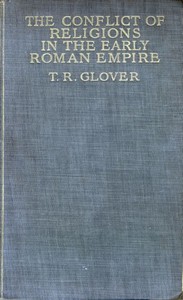
The work is a scholarly study of the religious turmoil that shaped the early Roman Empire, written by the historian T. R. Glover and first presented as a series of Dale Lectures at Oxford in 1907. The opening chapter situates the narrative in the chaotic aftermath of Julius Caesar’s assassination, using vivid literary quotations from Virgil, Polybius and other ancient sources to illustrate how political instability and moral decline prompted a search for religious renewal. Glover’s aim, set out in the preface, is to portray both Christian and pagan movements with equal fairness, to follow the clash of ideals through the personalities that embodied them, and to uncover the “living force” that transformed Roman thought and society. The book proceeds through a chronological series of essays, on Roman religion, Stoicism, Plutarch, Jesus of Nazareth, his followers, and the ensuing conflicts, each grounded in extensive citations of classical and contemporary scholarship.

Written in the formal, essayistic style of early‑20th‑century academia, the text combines detailed historical narrative with interpretive imagination, reflecting the influence of German philology and British classical studies. Its measured, sometimes rhetorical prose will appeal to readers who enjoy a rigorous, source‑rich exploration of early Christianity, Roman paganism, and the philosophical currents that intersected them. Scholars of church history, students of ancient religion, and anyone fascinated by the intellectual backdrop of the first six centuries of the empire will find Glover’s balanced, richly documented approach both rewarding and thought‑provoking.

Who appears in The Conflict of Religions in the Early Roman Empire

  • Julius CaesarMiddle-aged Roman general, short curly hair, laurel wreath, crisp white toga, dignified expression
  • Jesus of NazarethMiddle‑Eastern man, long dark hair, full beard, simple linen robe, humble gaze

The opening · free to read

A large part of this book formed the course of Dale Lectures delivered in Mansfield College, Oxford, in the Spring of 1907. For the lecture-room the chapters had to be considerably abridged; they are now restored to their full length, while revision and addition have further changed their character. They are published in accordance with the terms of the Dale foundation.

To see the Founder of the Christian movement and some of his followers as they appeared among their contemporaries; to represent Christian and pagan with equal goodwill and equal honesty, and in one perspective; to recapture something of the colour and movement of life, using imagination to interpret the data, and controlling it by them; to follow the conflict of ideals, not in the abstract, but as they show themselves in character and personality; and in this way to discover where lay the living force that changed the thoughts and lives of men, and what it was; these have been the aims of the writer,--impossible, but worth attempting. So far as they have been achieved, the book is relevant to the reader.

The work of others has made the task lighter. German scholars, such as Bousset, von Dobschütz, Harnack, Pfleiderer and Wernle; Professor F. C. Burkitt and others nearer home who have written of the beginnings of Christianity; Boissier, Martha and Professor Samuel Dill; Edward Caird, Lecky, and Zeller; with the authors of monographs, Croiset, de Faye, Gréard, Koziol, Oakesmith, Volkmann; these and others have been laid under contribution. In another way Dr Wilhelm Herrmann, of Marburg, and Thomas Carlyle have helped the {vi} book. The references to ancient authorities are mostly of the writer's own gathering, and they have been verified.

Lastly, there are friends to thank, at Cambridge and at Woodbrooke, for the services that only friends can render--suggestion, criticism, approval, correction, and all the other kindly forms of encouragement and enlightenment.

ST JOHN'S COLLEGE, CAMBRIDGE, February 1909.

The book keeps going

Keep reading, and see it illustrated

Reading is free forever. Sign up and watch scenes appear while you read.

Illustrated scene from The Great GatsbyIllustrated scene from Pride and PrejudiceIllustrated scene from Alice's Adventures in Wonderland

Scenes Storieta drew for other classics.

New illustrated classics

A new classic, drawn, in your inbox.

Once or twice a month: the latest books to get full character casts, scene art, and free comic editions. No account needed.