ABRAHAM, a descendant of Shem, one of the sons of Noah, was the father and founder of the great Israelitish, or Hebrew, nation. God chose him from all the people living on the earth at that time, for this purpose, promising that He would make his name great and that his descendants should have for their own the land of Canaan, a country in Palestine lying west of the river Jordan and the Dead Sea.
Abraham had a son named Isaac, who became the father of Jacob, and Jacob was the father of twelve sons, among whom was Joseph, who was sold into slavery by his brothers when but a boy. Joseph was taken to Egypt and in time rose from a slave to be the governor of that country under Pharaoh, its king.
Jacob, with his eleven sons and their families, settled in Egypt at the invitation of Pharaoh, and after the death of their father his sons continued to live there, and became prosperous. After the death of Joseph they increased rapidly in numbers, and from shepherds and herders of flocks became masters of various crafts and occupations. At this time they began to be called "The Children of Israel."
They lived in towns and villages in the land of Goshen, on the eastern border of Egypt, industrious and contented. The king who had been so friendly to Joseph was now dead, and another Pharaoh ruled the land. He watched with much distrust the growing wealth and greatness of the children of Israel and determined to prevent any possible harm they might do him by making them work for him instead of for themselves.
So Pharaoh began to treat the Israelites like slaves. Under the direction of his officers he set them at work making bricks and then had them build two cities to hold his treasures. From a prosperous people they were now reduced to the condition of common laborers, working without pay day after day in the burning heat of that country.
But in spite of their hardships the Israelites increased in numbers, and, to further crush them, Pharaoh ordered that all their boys should be destroyed as soon as they were born. But the people would not obey this order, and then Pharaoh commanded that all boys should be flung into the Nile, the sacred river of Egypt, immediately after their birth.
At this time a child was born among the Israelites whose life was to be one of the most remarkable that history has recorded for us. His father's name was Amram and his mother's Jochebed, and they belonged to the tribe of Levi, the third son of Jacob. They had two older children, a son named Aaron and a daughter named Miriam.
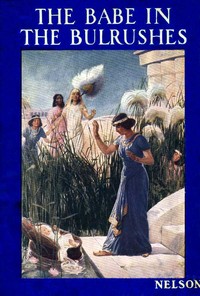
The mother of this little boy managed to keep him out of sight for three months, and then she made a little boat of the water-reeds called papyrus, fastening them together with clay and pitch. It was not much more than a basket, but she put the baby into it and placed it among the rushes at the edge of the river Nile, leaving her daughter Miriam to see what became of her baby brother.
The Egyptians had many beliefs which appear very strange to us now. One of them was that anything surrounded by papyrus would be safe from the crocodiles which infested the river. Possibly Jochebed had some faith in this superstition, for during the time when the Israelites were living contentedly in the land of Goshen, many of them had fallen into the customs of the Egyptians, worshipping Ra, the sun-god, Apis, the sacred calf, and others of their national deities.
While Miriam was watching the little boat and its precious burden, the daughter of Pharaoh, with her attendants, came to the river to bathe. She saw the little boat floating among the rushes and ordered it to be brought to her. As she looked down at the baby it cried, and, while she must have known that it was the child of Israelitish parents, her heart went out to it in pity, and she declared that she would bring it up as if it had been her own child.
Miriam then came forward and asked if she might find a nurse for the child. The princess sent her on this errand and the little girl hastened to bring her mother. Then the princess gave the baby into the charge of its own mother, and promised her that she should be paid for taking good care of the child.
When the baby had grown to be quite a boy the princess took him to her palace and treated him as if he had been a son of her own. She named him Moses, which means "drawn out," because she had taken him from the water.
Then the princess had him trained and taught as though he were really to be a prince. He was instructed in all the wisdom of the Egyptians and became learned and powerful. All the pleasures and honors of Pharaoh's court were open to him, and from them he could have selected what pleased him most.
But the misery and degradation of his own people appealed to him more strongly than the splendor and preferments of the Egyptian court. His spirit was especially stirred one day when he saw an Egyptian overseer abusing an Israelite in the fields where that oppressed people were still making bricks.
In his anger at this sight he killed the Egyptian and buried the body in the sand. The next day he interfered in another quarrel--this time between two of his own people, but all he received for his efforts as peacemaker was the knowledge that they knew he had killed the Egyptian the day before.
For this reason, and also because Pharaoh suspected him of scheming to deliver the Israelites from their bondage, Moses felt that his life was not safe in Egypt, so he left the court and went to the land of Midian. He was then forty years old.
One day when he was resting by the side of a well, the seven daughters of Jethro, the chief and priest of Midian, came there to water their father's sheep. Some shepherds, who also wanted to use the well, drove them away, but Moses took the part of the maidens and watered their flocks for them.
When Jethro heard of this he invited Moses to be his shepherd and to live in his house. Moses accepted the home offered him, and in time married Zipporah, one of Jethro's daughters. They had two sons, one named Gershom, a word which means "stranger," and Eliezer, or "God is my help."
For the next forty years Moses led the life of a shepherd in the land of Midian, in gradual preparation for the great work he was to do later. He certainly learned patience and must have become familiar with the country through which he was to lead the children of Israel when the time of their deliverance from Egypt came. During this time the afflictions of the Israelites had been increased. Another Pharaoh ruled the land, but his reign brought no relief to the nation toiling under cruel taskmasters.
One day Moses was feeding his flocks on a mountain called Horeb, when he saw a bush of wild thorn, or acacia, apparently on fire. He looked more closely but could see no smoke, neither were the leaves and twigs blackened or consumed.
Then a Voice which seemed to come from the bush called, "Moses, Moses." Understanding that it was the Voice of God, Moses answered, "Here am I." Then God told him to come no nearer, and to take off his shoes and stand with bare feet, for His presence made the spot holy ground.
Moses tremblingly obeyed and stood with covered face while God told him that He had heard the cries and seen the affliction of the children of Israel, and that He would set them free from their bondage in Egypt. He told Moses that He had chosen him to be the deliverer of His people and their leader to the land of Canaan, which He had promised to Abraham.
Moses felt unequal to this great undertaking and tried to excuse himself on various grounds. He said that the Israelites would not listen to him unless he could, by means of signs and wonders, convince them that he was the divinely appointed leader, and he also said that he was not a ready speaker.
But God told him just what he had to do and that his brother Aaron should be his spokesman. He bestowed upon him the power to do wonderful things and promised His own protection and help. Moses could refuse no longer, and accepted the divine commission. Then the Voice ceased, the vision of the burning bush faded away, and Moses was alone again with his flocks.
When Moses returned to his home he told Jethro that he wished to go to Egypt, and in the speech of those days Jethro replied, "Go in peace." So Moses set out on his journey and on the way met his brother Aaron, whom God had sent to meet him.
Then Moses related to Aaron all that God had said to him from the burning bush, told him the part he was to take in God's plan, and showed him the rod which he was to use in performing the wonderful things by which the Israelites were to be convinced that he was their divinely appointed deliverer from the land of Egypt. Then the two brothers went on their way together.
As soon as Moses and Aaron arrived in Egypt, they called the people together and told them that God was going to deliver them from their bondage and give them the land of Canaan. At first the Israelites were very thankful for the message, but after the first failure of Moses to get Pharaoh's consent to let them go they began to doubt it, especially as from that time the King imposed harder tasks than ever upon them.
Then Moses and Aaron went a second time to Pharaoh. Aaron threw down his rod and it became a serpent. The magicians of the court did the same thing, and threw down their rods, which became serpents, but Aaron's rod swallowed theirs. Then the King once more refused to let the people go.
Then, one after another, God sent terrible plagues upon the Egyptian people to show Pharaoh that He was the one Living and True God and that the children of Israel must be allowed to go to the land He had promised them.
The first of these plagues was the changing of the waters of the Nile into blood. The Egyptians were a very cleanly people, paying great attention to their bodies, and were generally dressed in white. They were accustomed to bathe in the Nile, and its appearance at this time must have filled them with loathing. But Pharaoh again refused to let the people go.
Then one after another eight more plagues were sent upon the land. They were equally disgusting to such a people and gave them the greatest discomfort possible, but, while Pharaoh relented from time to time, he persisted in his refusal to let the children of Israel depart from his kingdom.
During all this time the land of Goshen, where the Israelites lived, was exempt from these inflictions. Pharaoh must have known this and he must have begun to understand that their God punished those who refused to do as He told them, but he was obstinate and still refused his consent. It required another and a more severe judgment before Pharaoh consented to let the children of Israel go.
It was now the month of Nisan or Abib, which means the "month of green ears," and in consequence of what occurred at that time Abib has ever since been the first month of the Hebrew sacred year. By God's command the blood of a lamb was to be sprinkled upon the sides and top of the doorway to every Israelitish home. The lamb itself was to be roasted and eaten by the family, who were to be dressed for a journey and ready to start on it at a moment's notice.