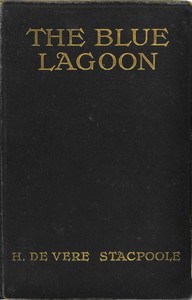
The Blue Lagoon is the story of two cousins, Dicky and Emmeline Lestrange, stranded on a remote island with a beautiful lagoon. As children, they are cared for by Paddy Button, a portly sailor who drinks himself to death after only two and a half years in paradise. Frightened and confused by the man’s gruesome corpse, the children flee to another part of Palm Tree Island. Over a period of five years, they grow up and eventually fall in love. Sex and birth are as mysterious to them as death, but they manage to copulate instinctively and conceive a child. The birth is especially remarkable: fifteen-year-old Emmeline, alone in the jungle, loses consciousness and awakes to find a baby boy on the ground near her. Naming the boy Hannah (an example of Stacpoole’s penchant for gender reversals), the Lestranges live in familial bliss until they are unexpectedly expelled from their tropical Eden.
The parallels between The Blue Lagoon and the Biblical story of Adam and Eve are obvious and intentional, but Stacpoole was also influenced by Lewis Carroll’s Alice’s Adventures in Wonderland (1865), which he invokes in a passage describing the castaways’ approach Palm Tree Island:
“One could see the water swirling round the coral piers, for the tide was flooding into the lagoon; it had seized the little dinghy and was bearing it along far swifter than the sculls could have driven it. Sea-gulls screamed about them, the boat rocked and swayed. Dick shouted with excitement, and Emmeline shut her eyes TIGHT.
“Then, as though a door had been swiftly and silently closed, the sound of the surf became suddenly less. The boat floated on an even keel; she opened her eyes and found herself in Wonderland.”
This direct reference to Wonderland prepares the reader for the many parallels that follow. When their adventures begin, both girls are about the same age, Alice seven and a half, Emmeline exactly eight. Just as Alice joins a tea party in Wonderland, Emmeline plays with her tiny tea set on the beach after they land. Emmeline’s former pet, like the Cheshire Cat, “had white stripes and a white chest, and rings down its tail” and died “showing its teeth.” Whereas Alice looks for a poison label on a bottle that says “Drink Me,” Emmeline innocently tries to eat “the never-wake-up berries” and receives a stern rebuke and a lecture about poison from Paddy Button. “The Poetry of Learning” chapter echoes Alice’s dialogue with the caterpillar. Like the wily creature smoking a hookah, Paddy smokes a pipe and shouts “Hurroo!” as the children teach him to write his name in the sand. The children lose “all count of time,” just as the Mad Hatter does. Whereas Alice grows nine feet taller, Dick sprouts “two inches taller” and Emmeline “twice as plump.” Like the baby in the “Pig and Pepper,” Hannah sneezes at the first sight of Dicky. The novel is artfully littered with references to wonder, curiosity, and strangeness—all evidence of Stacpoole’s conscious effort to invoke and honor his Victorian predecessor.
Stacpoole presented The Blue Lagoon to Publisher T. Fisher Unwin in September 1907 and went to Cumberland to assist another ailing doctor in his practice. Every day from Eden Vue in Langwathby, Stacpoole wrote to his fiancee, Margaret Robson (or Maggie, as he called her), and waited anxiously for their wedding day. On December 17, 1907, the couple were married and spent their honeymoon at Stebbing Park, a friend’s country house in Essex, about three miles from the village of Stebbing. It was there that they stumbled upon Rose Cottage, where Stacpoole lived for several years before he moved to Cliff Dene on the Isle of Wight in the 1920s.
Published in January 1908, The Blue Lagoon was an immediate success, both with reviewers and the public. “[This] tale of the discovery of love, and innocent mating, is as fresh as the ozone that made them strong,” declared one reviewer. Another claimed that “for once the title of ‘romance,’ found in so many modern stories, is really justified.” The novel was reprinted more than twenty times in the next twelve years and remained popular in other forms for more than eighty years. Norman MacOwen and Charlton Mann adapted the story as a play, which ran for 263 performances in London from August 28, 1920, to April 16, 1921. Film versions of the novel were made in 1923, 1949, and 1980.
Stacpoole also wrote two successful sequels: The Garden of God (1923) and The Gates of Morning (1925). These three books and two others were combined to form The Blue Lagoon Omnibus in 1933. The Garden of God was filmed as Return to the Blue Lagoon in 1992.
This Gutenberg etext of The Blue Lagoon: A Romance is based on the 1908 first American edition published by J. B. Lippincott Company of Philadelphia.
1. On page 18:
London edition: he sat with it on his knees staring at the white sunlit main-deck barred with the black shadows of the standing rigging.
US edition: he sat with it on his knees staring at the white sunlit main-deck barred with the white shadows of the standing rigging.
Stacpoole originally indicated black shadows of the rigging on the deck.
3. On page 24:
London edition: The dinghy was rather a larger boat than the ordinary ships’ dinghy, and possessed a small mast and lug-sail.
US edition: The dinghy was rather a larger boat than the ordinary ships’ dinghy, and possessed a small mast and long sail.
A lug-sail (modern: lugsail) is an evolved version of the classical square sail that is correct for the boat as described.
The book keeps going
Keep reading, and see it illustrated
Reading is free forever. Sign up and watch scenes appear while you read.
Scenes Storieta drew for other classics.