Public-domain ebook
Moores Fables for the Female Sex
by Edward Moore
Language: en342 downloads on Project Gutenberg
Subjects
In: Mythology, Legends & Folklore·British Literature
Public-domain ebook sourced from Project Gutenberg #39499.
Public-domain ebook
by Edward Moore
Language: en342 downloads on Project Gutenberg
Subjects
In: Mythology, Legends & Folklore·British Literature
Public-domain ebook sourced from Project Gutenberg #39499.
The opening · free to read
The moral lay, to beauty due, I write, FAIR EXCELLENCE, to you; Well pleas'd to hope my vacant hours Have been employ'd to sweeten your's. Truth under fiction I impart, To weed out folly from the heart, And shew the paths that lead astray The wand'ring nymph from wisdom's way.
I flatter none. The great and good Are by their actions understood; Your monument if actions raise, Shall I deface by idle praise? I echo not the voice of Fame; That dwells delighted on your name: Her friendly tale, however true, Were flatt'ry, if I told it you.
The proud, the envious, and the vain, The jilt, the prude, demand my strain; To these, detesting praise, I write, And vent in charity my spite: With friendly hand I hold the glass To all, promiscuous, as they pass: Should folly there her likeness view, I fret not that the mirror's true; If the fantastic form offend, I made it not, but would amend.
With friendly hand I hold the glass To all promiscuous, as they pass;
Page 2.
_London: Published May 1st 1799 by T. Heptinstall. No. 304 High Holborn._]
Virtue, in ev'ry clime and age, Spurns at the folly-soothing page; While satire, that offends the ear Of vice and passion, pleases her.
Premising this, your anger spare; And claim the fable you who dare.
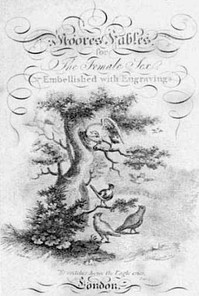
The BIRDS in place, by faction press'd, To JUPITER their pray'rs address'd; By specious lies the state was vex'd, Their counsels libellers perplex'd; They begg'd (to stop seditious tongues) A gracious hearing of their wrongs. JOVE grants their suit. The EAGLE sate, Decider of the grand debate.
The PYE, to trust and pow'r preferr'd, Demands permission to be heard. Says he, 'Prolixity of phrase You know I hate. This libel says, "Some birds there are, who, prone to noise, Are hir'd to silence WISDOM'S voice; And, skill'd to chatter out the hour, Rise by their emptiness to pow'r." That this is aim'd direct at me, No doubt, you'll readily agree: Yet well this sage assembly knows, By parts to government I rose; My prudent counsels prop the state; MAGPIES were never known to prate.'
The KITE rose up. His honest heart In VIRTUE'S suff'rings bore a part. That there were birds of prey he knew; So far the libeller said true, "Voracious, bold, to rapine prone, Who knew no int'rest but their own; Who, hov'ring o'er the farmer's yard, Nor pigeon, chick, nor duckling spar'd." This might be true--but if apply'd To him, in troth, the sland'rer ly'd. Since IGN'RANCE then might be misled, Such things, he thought, were best unsaid.
The CROW was vext. As yester-morn He flew across the new-sown corn, A screaming boy was set for pay, He knew, to drive the CROWS away: SCANDAL had found him out in turn, And buzz'd abroad--that CROWS love corn.
The OWL arose, with solemn face, And thus harangu'd upon the case: 'That MAGPIES prate, it may be true; A KITE may be voracious too; CROWS sometimes deal in new-sown pease; He libels not, who strikes at these; The slander's here--"But there are birds, Whose wisdom lies in looks, not words; Blund'rers who level in the dark, And always shoot beside the mark." He names not me; but these are hints Which manifest at whom he squints; I were indeed that blund'ring fowl, To question if he meant an OWL.' "Ye wretches, hence!" the EAGLE cries, "'Tis conscience, conscience that applies; The virtuous mind takes no alarm, Secur'd by innocence from harm; While GUILT, and his associate, FEAR, Are startled at the passing air."
FABLE II.
THE PANTHER, HORSE, AND OTHER BEASTS.
The man who seeks to win the fair, (So custom says) must truth forbear; Must fawn and flatter, cringe and lie, And raise the goddess to the sky; For truth is hateful to her ear, A rudeness which she cannot bear-- A rudeness?--Yes,--I speak my thoughts, For truth upbraids her with her faults.
How wretched, CHLOE, then am I, Who love you, and yet cannot lie; And still, to make you less my friend, I strive your errors to amend! But shall the senseless fop impart The softest passion to your heart, While he who tells you honest truth, And points to happiness your youth, Determines, by his cares, his lot, And lives neglected and forgot?
Trust me, my dear, with greater ease, Your taste for flatt'ry I could please. And similes in each dull line, Like glow-worms in the dark, should shine. What if I say your lips disclose The freshness of the op'ning rose? Or that your cheeks are beds of flow'rs, Enripen'd by refreshing show'rs? Yet certain as these flow'rs shall fade, Time ev'ry beauty will invade. The BUTTERFLY of various hue, More than the flow'r, resembles you: Fair, flutt'ring, fickle, busy thing, To pleasure ever on the wing, Gayly coquetting for an hour, To die, and ne'er be thought of more.
Would you the bloom of youth should last? 'Tis virtue that must bind it fast; An easy carriage, wholly free From sour reserve, or levity; Good-natur'd mirth, an open heart, And looks unskill'd in any art; Humility, enough to own The frailties which a friend makes known; And decent pride, enough to know The worth that virtue can bestow.
These are the charms which ne'er decay, Tho' youth and beauty fade away; And time, which all things else removes, Still heightens virtue and improves.
You'll frown, and ask to what intent This blunt address to you is sent; I'll spare the question, and confess I'd praise you, if I lov'd you less; But rail, be angry, or complain, I will be rude, while you are vain.
Beneath a LION'S peaceful reign, When beasts met friendly on the plain, A PANTHER, of majestic port, (The vainest female of the court) With spotted skin, and eyes of fire, Fill'd ev'ry bosom with desire; Where'er she mov'd, a servile crowd Of fawning creatures cring'd and bow'd; Assemblies ev'ry week she held, (Like modern belles) with coxcombs fill'd, Where noise and nonsense, and grimace, And lies and scandal, fill'd the place.
Behold the gay, fantastic thing, Encircled by the spacious ring; Low-bowing, with important look, As first in rank, the MONKEY spoke:
"Gad take me, madam! but I swear No angel ever look'd so fair---- Forgive my rudeness, but, I vow, You were not quite divine till now; Those limbs! that shape! and then those eyes, O close them, or the gazer dies!"
'Nay, gentle PUG, for goodness hush, I vow and swear you make me blush; I shall be angry at this rate---- 'Tis so like flatt'ry, which I hate.'
The FOX, in deeper cunning vers'd, The beauties of her mind rehears'd, And talk'd of knowledge, taste, and sense, To which the fair have most pretence; Yet well he knew them always vain Of what they strive not to attain, And play'd so cunningly his part, That PUG was rival'd in his art.
The GOAT avow'd his am'rous flame, And burnt--for what he durst not name; Yet hop'd a meeting in the wood Might make his meaning understood. Half angry at the bold address, She frown'd; but yet she must confess, Such beauties might inflame his blood; But still his phrase was somewhat rude.
The HOG her neatness much admir'd; The formal ASS her swiftness fir'd; While all to feed her folly strove, And by their praises shar'd her love.
The HORSE, whose gen'rous heart disdain'd Applause by servile flatt'ry gain'd, With graceful courage silence broke, And thus with indignation spoke:
From public view her charms will screen And rarely in the crowd be seen
Page 12.
_London: Published by Scatcherd & Letterman, Ave Maria Lane._]
"When flatt'ring MONKEYS fawn and prate, They justly raise contempt, or hate; For merit's turn'd to ridicule, Applauded by the grinning fool. The artful FOX your wit commends, To lure you to his selfish ends; From the vile flatt'rer turn away, For knaves make friendship to betray. Dismiss the train of fops and fools, And learn to live by wisdom's rules. Such beauties might the LION warm, Did not your folly break the charm; For who would court that lovely shape, To be the rival of an APE?" He said; and snorting in disdain, Spurn'd at the crowd, and sought the plain.
FABLE III.
THE NIGHTINGALE AND GLOW-WORM.
The prudent nymph, whose cheeks disclose The lily and the blushing rose, From public view her charms will skreen, And rarely in the crowd be seen: This simple truth shall keep her wise, "The fairest fruits attract the flies."
One night a GLOW-WORM, proud and vain, Contemplating her glitt'ring train, Cry'd sure there never was in nature, So elegant, so fine a creature; All other insects that I see, The frugal ANT, industrious BEE, Or SILK-WORM, with contempt I view; With all that low, mechanic crew, Who servilely their lives employ In business, enemy to joy. Mean, vulgar herd! ye are my scorn, For grandeur only I was born; Or sure am sprung from race divine, And plac'd on earth to live and shine. Those lights, that sparkle so on high, Are but the GLOW-WORMS of the sky; And kings on earth their gems admire, Because they imitate my fire.
She spoke. Attentive on a spray, A NIGHTINGALE forbore his lay; He saw the shining morsel near, And flew, directed by the glare; Awhile he gaz'd with sober look, And thus the trembling prey bespoke:
Deluded fool, with pride elate, Know, 'tis thy beauty brings thy fate; Less dazzling, long thou might'st have lain, Unheeded on the velvet plain; Pride, soon or late, degraded mourns, And beauty wrecks whom she adorns.
FABLE IV.
The book keeps going
Reading is free forever. Sign up and watch scenes appear while you read.



Scenes Storieta drew for other classics.
New illustrated classics
Once or twice a month: the latest books to get full character casts, scene art, and free comic editions. No account needed.