Public-domain ebook
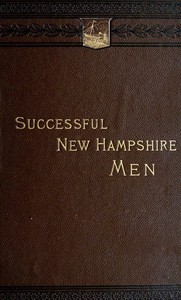
Sketches of Successful New Hampshire Men
by Various
Language: en7,455 downloads on Project Gutenberg
Subjects
In: Biographies·History - American
Public-domain ebook sourced from Project Gutenberg #39634.
Public-domain ebook
by Various
Language: en7,455 downloads on Project Gutenberg
Subjects
In: Biographies·History - American
Public-domain ebook sourced from Project Gutenberg #39634.
The volume is a collection of biographical sketches that celebrate the men who helped shape New Hampshire’s industrial and civic life. It opens with a tribute to Hon. Charles Williams, presented by O. C. Moore, and immediately frames his story within a broader argument about the virtues, industry, probity, intelligence, judgment and executive ability, that undergird a prosperous state. The author traces Williams’s lineage back six generations to a Welsh forebear, linking his family to notable figures such as Richard Williams, the ancestor of Oliver Cromwell, and to a line of New England jurists, military officers and legislators. The narrative then follows Charles’s own path: a modest farm upbringing, apprenticeship in iron‑works, a westward venture, and the establishment of the S. & C. Williams foundry in Nashua. It details his rise from a twenty‑nine‑year‑old entrepreneur to a bank vice‑president, city councilman and, finally, mayor, while also sketching his family’s education and tragedies.
The work is written in a formal, nineteenth‑century style that blends factual genealogy with moral commentary, reflecting the period’s reverence for industrious pioneers. Its tone is earnest and laudatory, employing long sentences and a diction that emphasizes civic duty and personal virtue. Readers who enjoy detailed historical biographies, genealogical research, or studies of early American industry will find it rewarding, as will those interested in the social fabric of New England towns during the antebellum and post‑Civil‑War eras.
The opening · free to read
The qualities of character that contribute to success in large fields of commercial enterprise are sometimes difficult to define, while their influence is apparent and is seen and felt by all. A prominent trait is great deliberation in reaching decisions, yet firmness in maintaining them. Sagacious insight of character in choosing agents and subordinates, while holding them to a strict accountability, is also a quality of executive merit. We see this last trait in a marked degree in the small sums represented in the items, "damages" and "gratuities," in all reports of the railroad management of Gen. Stark. Every employe, from the highest to the lowest position, on roads under his superintendence, had printed instructions of duties, to which he was required to assent. Under no circumstances were men retained in important posts who used intoxicating liquors, and no cafe or restaurant connected with the stations was allowed to keep alcoholic drinks for sale.
In personnel Gen. Stark is characterized by a quiet, deliberate, yet courteous manner that is not disturbed by the varied conditions and incidents of business life. This trait of an habitual mental equipoise is a peculiarity that impresses itself prominently on an observer. He has a natural, unrestrained manner in conversation, and social qualities that are freely manifested in company with tested and worthy friends. As a writer of business documents and reports he manifests power, method, and perspicuity, and his manuscript shows a careful arrangement, neatness and precision of chirography quite remarkable in one of his extensive business experience. At the age of fifty-eight he is yet in the full tide and vigor of business life. His family residence at Nashua, though showing no taste for ostentation or display, is an elegant structure in the villa style, furnished with every comfort and convenience, and adorned with works of art.
Gen. Stark was married, in 1845, to Elizabeth A. Parker, daughter of Daniel Parker, of Bedford, N. H. She died in 1846. In 1848 he was united by marriage to Mary G. Bowers, daughter of Col. Joseph Bowers, of Chelmsford, Mass. His two children are John F. and Emma G. Stark.
HON. HIRAM A. TUTTLE.
BY JOHN WHEELER, M. D.
Hon. HIRAM A. TUTTLE was born in Barnstead, October 16, 1837, being the elder of a family of two sons. His father, George Tuttle, and his grandfather, Col. John Tuttle, were also natives of the same town. His great-grandfather, John Tuttle, settled in Barnstead in 1776, coming there from that locality in Dover known as "Back River," where a part of the Tuttle family had resided since the settlement there of their emigrant ancestor, John Tuttle, who came from England before 1641.
His mother, Judith Mason Davis, is a descendant from Samuel Davis, a soldier of the Revolution, and one of the primeval settlers of Barnstead. Brave soldiers of the Davis family from four generations have represented that town in the four great wars in which the country has been engaged.
When Mr. Tuttle was nine years of age he moved, with his father's family, to the adjoining town of Pittsfield, where he attended the public schools and Pittsfield Academy, while the latter was under the charge, successively, of I. F. Folsom, Lewis W. Clark, and Prof. Dyer H. Sanborn.
After having been engaged in several vocations, in all of which he showed industry and faithfulness, at the age of seventeen years he became connected with the clothing establishment of Lincoln & Shaw, of Concord, where he remained several years. The ability and zeal which he exhibited while there won for him the confidence and respect of his employers, who established him in the management of a branch store in Pittsfield, of which he soon became the proprietor. His business increased gradually at first, and then rapidly till his establishment had gained an extensive patronage, and ranked among the largest clothing-houses in the State. It is so favorably remembered by former residents and patrons that orders are received for goods from distant states and territories. Mr. Tuttle has also been interested in real estate. He has built many dwelling-houses, including a fine residence for himself, and the best business buildings in the village. In many ways he has promoted the growth, social and business interests, and general prosperity of his adopted town. He is a trustee of the savings bank, a director of the national bank, and a trustee of the academy in Pittsfield.
When he had attained his majority, in 1859, he expressed his intention of casting his first vote with the Republicans, although all his relatives belonged to the Democratic party. The Democrats of Pittsfield had been victorious and powerful since the days of Jackson, under such distinguished leaders as Moses Norris, Jr., Charles H. Butters, and Lewis W. Clark, all being able lawyers, impressive public speakers, and having popular manners. Mr. Norris, a native of the town, represented it repeatedly in the legislature, was speaker of the house twice, a councilor, representative in congress four years, and was elected to the United States senate for six years while residing here. The ability and courteous manners of Mr. Clark (now Judge Lewis W. Clark) made him no less popular than Mr. Norris, with all classes, during the shorter time he was in business life in town. Seeing in young Tuttle qualities that might make him troublesome if opposed to them, but useful if in accord with their party, the Democrats used their most eminent persuasive powers to induce him to cleave to the party of all his kindred and vote with the hitherto victorious; but he obeyed his convictions and remained true to the Republican party. In 1860 the Republicans, though so long hopelessly beaten, made a sharp contest. When the day of election came, Mr. Clark was elected moderator, having been a most acceptable presiding officer for several years. The election of town clerk was made the test of the strength of the two parties. After a very exciting ballot, Mr. Tuttle was elected town clerk and the Democrats were beaten for the first time in thirty-three years. Although Pittsfield has a Democratic majority under normal circumstances, Mr. Tuttle has received the support of a large majority of its votes at times when his name has been presented for position. In 1873 and 1874 he was representative to the legislature. In 1876 he received an appointment, with the rank of colonel, on the staff of Governor Cheney, and with the governor and staff visited the Centennial Exhibition at Philadelphia. He was elected a member of the executive council from the second district in 1878, and was re-elected in 1879, under the new constitution, for the term of two years.
Mr. Tuttle has been very successful in all that he has undertaken; but his thrift has never made him arrogant or indifferent. He has cheerfully shared with others the results of the good fortune that Providence has granted him. He is an agreeable and companionable gentleman in all the honorable relations of life. As a citizen, neighbor, and friend, he is held in the highest estimation. He has furnished employment for many, and has been kind to the poor, very respectful to the aged, charitable to the erring, and a sympathizing helper of the embarrassed and unfortunate. Few men have more or firmer personal friends whose friendship is founded on kindness and substantial favors received. He gives with remarkable generosity to all charitable objects presented to him, and is very hospitable in his pleasant home. Mr. Tuttle accepts the Christian religion, and worships with the Congregational church. While he contributes very liberally for the support of the denomination of his choice, he does not withhold a helping hand from the other religious sects in his town. In his domestic relations he has been very fortunate. He married, in 1859, Miss Mary C. French, the only child of John L. French, Esq., formerly cashier of the Pittsfield bank. Their only child,--Hattie French Tuttle,--born January 17, 1861, is a member of the junior class in Wellesley College.
REV. ALONZO A. MINER, D. D.
BY REV. GEORGE H. EMERSON, D. D.
The subject of this sketch owes his name to the grace of one of England's greatest kings. In the wars between England and France, to which belongs the renown of Cressy and Poictiers, the English sovereigns accepted such assistance in munitions and men as their subjects could proffer. Henry Bullman of Mendippe Hills, Somersetshire, was a miner. He fitted out a company of one hundred, armed with battle-axes, many of them laborers in his mines, and presented the same to Edward III. for his use in Continental conquest. In his gratitude Edward conferred upon him a coat of arms and gave him the name of "Miner." This honored subject, and the first of the name of Miner, died in 1359. From him descended Thomas Miner, who came to Boston with the elder Winthrop in 1630. Charles Miner, of the fifth generation from Thomas, was a Revolutionary soldier. At the close of the war he removed from Connecticut to New Hampshire.
A descendant of King Edward's friend, seventh in descent from Thomas, the grandson of Charles, ALONZO AMES MINER was the son of Benajah Ames and Amanda (Cary) Miner,--an only son and the second of five children. He was born at Lempster, Sullivan county, N. H., Aug. 17, 1814.
Grace Miner, granddaughter of Thomas, above named, married Samuel Grant, Jr., of Windsor, Conn., April 11, 1688. From that union descended Ulysses S. Grant, ex-President of the United States.
The subject of this sketch inherited neither fortune nor even health. Mental powers, a constitutional integrity, and a lack of the lower ambitions came as his only birthright. All else is his by conquest. Till the years of late boyhood he was an invalid. His opportunities for education in the village school were very intermittent. His feeble health and a grave uncertainty as to his ever reaching mature manhood constantly broke in upon the systematic training of the school. He filled out the school studies in the invalid's chair at home. None predicted for him length of days. Even the cautious physician made thirty years the utmost limit of life allotted him. He, however, supplemented his broken studies with academic training at Hopkinton, Lebanon, and Franklin, N. H., and at Cavendish, Vt. Beginning public life as a school-teacher at the age of sixteen, he took charge of the village school, alternating this labor with his studies at the academies. His pupilage at Cavendish was soon followed by promotion. Mr. John Garvin was the principal. He was a very zealous Calvinist. Young Miner was a no less zealous Universalist. It was at a time when sectarian lines were sharply drawn. It was then a custom with zealous Calvinists to regard Universalists, not simply as unsound in doctrine, but also as wicked in life and conduct! But Mr. Garvin saw something in the young pupil that dispelled the prejudice. He took him into partnership in the management of the school in 1834. In this position young Miner served a year.
The book keeps going
Reading is free forever. Sign up and watch scenes appear while you read.



Scenes Storieta drew for other classics.
New illustrated classics
Once or twice a month: the latest books to get full character casts, scene art, and free comic editions. No account needed.