It was very quiet in the wide, richly furnished library. The May night was still, but a faint suspiration, heavy with the fragrance of jasmin flowers, stirred the Venetian blind before the open window and rustled the moon-silvered leaves of the aspens outside. As the incisive professional pronouncement of the judge cut through the lamp-lighted silence, the grim, furrowed face with its sunken eyes and gray military mustaches on the pillow of the wheel-chair set more grimly; a girl seated in the damask shadow of the fire-screen caught her breath; and from across the polished table the Reverend Henry Sanderson turned his handsome, clean-shaven face and looked at the old man.
A peevish misogynist the neighborhood labeled the latter, with the parish chapel for hobby, and for thorn-in-the-flesh this only son Hugh, a black sheep whose open breaches of decorum the town had borne as best it might, till the tradition of his forebears took him off to an eastern university. A reckless life there and three wastrel years abroad, had sent him back to resume his peccadilloes on a larger scale, to quarrel bitterly with his father, and to leave his home in anger. In what rough business of life was Hugh now chewing the cud of his folly? Harry Sanderson was wondering.
"Wait," came the querulous voice from the chair. "Write in 'graceless' before the word 'desertion'."
"_For his dissolute career and his--graceless--desertion_," repeated the lawyer, the parchment crackling under his pen.
The stubborn antagonism that was a part of David Stires' nature flared under the bushy eyebrows. "As a man sows!" he said, a kind of bitter jocularity in the tone. "That should be the text, if this sermon of mine needed any, Sanderson! It won't have as large an audience as your discourses draw, but it will be remembered by one of its hearers, at least."
Judge Conwell glanced curiously at Harry Sanderson as he blotted the emendation. He knew the liking of the cross-grained and taciturn old invalid--St. James' richest parishioner--for this young man of twenty-five who had come to the parish only two months before, fresh from his theological studies, to fill a place temporarily vacant--and had stayed by sheer force of personality. He wondered if, aside from natural magnetic qualities, this liking had not been due first of all to the curious resemblance between the young minister and the absent son whom David Stires was disinheriting. For, as far as mold of feature went, the young minister and the ne'er-do-well might have been twin brothers; yet a totally different manner and coloring made this likeness rather suggestive than striking.
No one, perhaps, had ever interested the community more than had Harry Sanderson. He had entered upon his duties with the marks of youth, good looks, self-possession and an ample income thick upon him, and had brought with him a peculiar charm of manner and an apparent incapacity for doing things in a hackneyed way. Convention sat lightly upon Harry Sanderson. He recognized few precedents, either in the new methods and millinery with which he had invested the service, or in his personal habits. Instead of attending the meeting of St. Andrew's Guild, after the constant custom of his predecessor, he was apt to be found playing his violin (a passion with him) in the smart study that adjoined the Gothic chapel where he shepherded his fashionable flock, or tramping across the country with a briar pipe in his mouth and his brown spaniel "Rummy" nosing at his heels. His athletic frame and clean-chiselled features made him a rare figure for the reading-desk, as his violin practice, the cut of his golf-flannels, the immaculate elegance of his motor-car--even the white carnation he affected in his buttonhole--made him for the younger men a goodly pattern of the cloth; and it had speedily grown to be the fashion to hear the brilliant young minister, to memorize his classical aphorisms or to look up his latest quotation from Keats or Walter Pater. So that Harry Sanderson, whose innovations had at first disturbed and ruffled the sensibilities of those who would have preferred a fogy, in the end had drifted, apparently without special effort, into a far wider popularity than that which bowed to the whim of the old invalid in the white house in the aspens.
Something of all this was in the lawyer's mind as he paused--a perfunctory pause--before he continued:
"_... I do give and bequeath the sum of one thousand dollars, and the memory of his misspent youth._"
Harry Sanderson's eyes had wandered from the chair to the slim figure of the girl who sat by the screen. This was Jessica Holme, the orphaned daughter of a friend of the old man's early years, who had recently come to the house in the aspens to fill the void left by Hugh's departure. Harry could see the contour of throat and wrists, the wild-rose mesh of the skin against the Romney-blue gown, the plenteous red-bronze hair uncoiled and falling in a single braid, and the shadowy pathos of her eyes. Clear hazel eyes they were, wide and full, but there was in them no depth of expression--for Jessica Holme was blind. As the crisp deliberate accent pointed the judicial period, as with a subterranean echo of irrefutable condemnation, Harry saw her under lip indrawn, her hands clasp tightly, then unclasp in her lap. Pliant, graceful hands, he thought, which even blindness could not make maladroit. In the chapel porch stood the figure of an angel which she had modelled solely by the wonderful touch in the finger-tips.
"Go on," rasped the old man.
"_The residue of my estate, real and personal, I do give and bequeath to my ward, Jessica Holme, to be and become--_"
He broke off suddenly, for the girl was kneeling by the chair, groping for the restless hand that wandered on the afghan, and crying in a strained, agitated voice: "No ... no ... you must not! Please, please! I never could bear it!"
"Why not?" The old man's irritant query was belligerent. "Why not? What is there for you to bear, I'd like to know!"
"He is your son!"
"In the eyes of the law, yes. But not otherwise!" His voice rose. "What has he done to deserve anything from me? What has he had all his life but kindness? And how has he repaid it? By being a waster and a prodigal. By setting me in contempt, and finally by forsaking me in my old age for his own paths of ribaldry."
The girl shook her head. "You don't know where he is now, or what he is doing. Oh, he was wild and reckless, I have no doubt. But when he quarrelled and left you, wasn't it perhaps because he was too quick-tempered? And if he hasn't come back, isn't it perhaps because he is too proud? Why, he wouldn't be your son if he weren't proud! No matter how sorry he might be, it would make no difference then. I could give him the money you had given me, but I couldn't change the fact. You, his own father, would have disowned him, disinherited him, taken away his birthright!"
"And richly he'd deserve it!" he snapped, his bent fingers plucking angrily at the wool of the afghan. "He doesn't want a father or a home. He wants his own way and a freedom that is license! I know him. You don't; you never saw him."
"I never saw you either," she said, a little sadly.
"Come," he answered a shade more gently. "I didn't mean your eyes, my dear! I mean that you never met him in your life. He had shaken off the dust of his feet against this house before you came to brighten it, Jessica. I've not forgiven him seven times; I've forgiven him seventy times seven. But he doesn't want forgiveness. To him I am only 'the old man' who refused to 'put up' longer for his fopperies and extravagances! When he left this house six months ago, he declared he would never enter it again. Very well--let him stay away! He shan't come back when I am in my grave, to play ducks and drakes with the money he misuses! And I've fixed it so that you won't be able to give it away either, Jessica. Give me the pen," he said to the judge, "and, Sanderson, will you ring? We shall need the butler to witness with you."
As Harry Sanderson rose to his feet the girl, still kneeling, turned half about with a hopeless gesture. "Oh, won't you help me?" she said. She spoke more to herself, it seemed, than to either of the men who waited. Harry's face was in the shadow. The lawyer with careful deliberation was putting a new pen into the holder.
"Sanderson," said the old man with bitter fierceness, lifting his hand, "I dare say you think I am hard; but I tell you there has never been a day since Hugh was born when I wouldn't have laid down my life for him! You are so like! When I look at you, I seem to see him as he might have been but for his own wayward choice! If he were only as like you in other things as he is in feature! You are nearly the same age; you went to the same college, I believe; you have had the same advantages and the same temptations. Yet you, an orphan, come out a divinity student, and Hugh--my son!--comes out a roisterer with gambling debts, a member of the 'fast set,' one of a dissolute fraternity known as 'The Saints,' whose very existence, no doubt, was a shame to the institution!"
Harry Sanderson turned slowly to the light. A strange panorama in that moment had flashed through his brain--kaleidoscopic pictures of an earlier reckless era when he had not been known as the "Reverend Henry Sanderson." An odd, sensitive flush burned his forehead. The hand he had outstretched to the bell-cord dropped to his side, and he said, with painful steadiness:
"I think I ought to say that I was the founder, and at the time you speak of, the Abbot of The Saints."
The pen rattled against the mahogany, as the man of law leaned back to regard the speaker with a stare of surprise whetted with a keen edge of satiric amusement. The old man sat silent, and the girl crouched by the chair with parted lips. The look in Harry's face was not now that of the decorative young churchman of the Sabbath surplice. It held a keen electric sense of the sharp contrasts of life, touched with a wakeful pain of conscience.
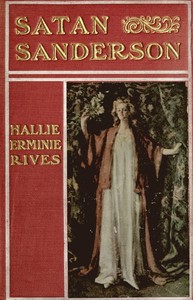
"I was in the same year with Hugh," Harry went on. "We sowed our wild oats together--a tidy crop, I fancy, for us both. That page of my life is pasted down. I speak of it now because it would be cowardly not to. I have not seen Hugh since college closed four years ago. But then I was all you have called him--a waster and a prodigal. And I was more; for while others followed, I led. At college I was known as 'Satan Sanderson'."
He stopped. The old man cleared his throat, but did not speak. He was looking at Harry fixedly. In the pause the girl found his gnarled hand and laid her cheek against it. Harry leaned an elbow upon the mantelpiece as he continued, in a low voice:
"Colleges are not moral strait-jackets. Men have there to cast about, try themselves and find their bearings. They are in hand-touch with temptation, and out of earshot of the warnings of experience. The mental and moral machine lacks a governor. Slips of the cog then may or may not count seriously to character in the end. They sometimes signify only a phase. They may be mere idiosyncrasy. I have thought that it stood in this case," he added with the glimmer of a smile, "with Satan Sanderson; he seems to me from this focus to be quite another individual from the present rector of St. James."