Public-domain ebook
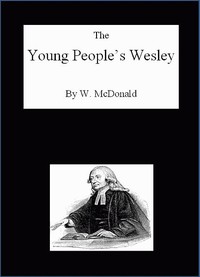
The Young People's Wesley
by W. McDonald
Language: en481 downloads on Project Gutenberg
Subjects
In: Children & Young Adult Reading·Biographies·History - British
Public-domain ebook sourced from Project Gutenberg #39864.
Public-domain ebook
by W. McDonald
Language: en481 downloads on Project Gutenberg
Subjects
In: Children & Young Adult Reading·Biographies·History - British
Public-domain ebook sourced from Project Gutenberg #39864.
The opening · free to read
BORN IN TROUBLOUS TIMES.
DURING the latter part of the seventeenth and the first part of the eighteenth century England was the theater of stirring events. War was sounding its clarion notes through the land. Marlborough had achieved a series of brilliant victories on the Continent, which had filled and fired the national heart with the spirit of military glory.
The English, at that time, had an instinctive horror of popery and power. James II, cruel, arbitrary, and oppressive, had been hurled from the throne as a plotting papal tyrant, and his grandson, Charles Edward, known as the Pretender, was making every possible effort to regain the throne and to subject the people to absolute despotism. To add to their dismay, the fleets of France and Spain were hovering along the English coast, ready, at any favorable moment, to pounce upon her. The means of public communication by railroad and telegraph were unknown. There were few mails, and reliable information could not be readily or safely obtained. Under these circumstances it is not surprising that strange and exaggerated reports should have kept the public mind in a state of great excitement and general consternation.
It was also, pre-eminently, an infidel age. Disrespect for the Bible and the Christian religion prevailed among all classes. Hobbes, with his scorpion tongue; Toland, with his papal-poisoned heart; Tindal, with his infidel dagger concealed under a cloak of mingled popery and Protestantism; Collins, with a heart full of deadly hate for Christianity; Chubb, with his deistical insidiousness; and Shaftesbury, with his platonic skepticism, hurled by wit and sarcasm--these, with their corrupt associates, made that the infidel age of the world. Christianity was everywhere held up to public reprobation and scorn.
It is true that Steele, Addison, Berkeley, Samuel Clarke, and Johnson exposed the follies and sins of the times, but the character of these efforts was generally more humorous and sarcastic than serious. Occasionally they gave a sober rebuke of the religion of the day. Berkeley attacked, with his keen logic and finished style, the skeptical opinions which prevailed. Most of his articles were on the subject of "Free Thinking." Johnson, the great moralist, stood up, it is said, "a great giant to battle, with both hands against all error in religion, whether in high places or low."
These men, and Young, with his vast religious pretentiousness, are said to have walked in the garments of literary and social chastity; but Swift, greater intellectually than any of them, and a high church dignitary to boot, would have disgraced the license of the "Merry Monarch's" court and outdone it in profanity. Even Dryden made the literature of Charles II's age infamous for all time.
"Licentiousness was the open and shameless profession of the higher classes in the days of Charles, and in the time of Anne it still festered under the surface. Gambling was an almost universal practice among men and women alike. Lords and ladies were skilled in knavery; disgrace was not in cheating, but in being cheated. Both sexes were given to profanity and drunkenness. Sarah Jennings, Duchess of Marlborough, could swear more bravely than her husband could fight. The wages of the poor were spent in guzzling beer, in wakes and fairs, badger-baiting and cockfighting."[A] And yet the reign of Anne claims to have been the golden age of English literature. It did show a polish on the surface, but within it was "full of corruption and dead men's bones."
Added to this, the Church, which should have been the light of the world, was in a most deplorable state. Irreligion and spiritual indifference had taken possession of priest and people, and ministers were sleeping over the threatened ruins of the Church, and, in too many instances, were hastening, by their open infidelity, the day of its ruin. The Established Church overtopped everything. She possessed great power and little piety. Her sacerdotal robes had been substituted for the garments of holiness; her Prayer Book had extinguished those earnest, spontaneous soul-breathings which bring the burdened heart into sympathetic union with the sympathizing Saviour. Spirituality had well-nigh found a grave, from which it was feared there would be no resurrection. Isaac Taylor says: "The Church had become an ecclesiastical system, under which the people of England had lapsed into heathenism;" and "Nonconformity had lapsed into indifference, and was rapidly in a course to be found nowhere but in books." In France hot-headed, rationalistic infidelity was invading the strongholds of the Reformation, and French philosophers were spreading moral contagion through Europe, which resulted in the French Revolution. The only thing which saved England from the same catastrophe was the sudden rise of Methodism, which, as one writer says, "laid hold of the lower classes and converted them before they were ripe for explosion." When preachers of the Gospel celebrated holy communion and preached to a handful of hearers on Sabbath morning, and devoted the afternoon to card-playing, and the rest of the week to hunting foxes, what else could have been expected? It is doubtful if in any period of the history of the Church the outlook had been darker.
The North British Review says: "Never has a century risen on Christian England so void of soul and faith; it rose a sunless dawn following a dewless night. The Puritans were buried, and the Methodists were not born." The Bishop of Lichfield said, in a sermon: "The Lord's day now is the devil's market day. More lewdness, more drunkenness, more quarrels and murders, more sin is conceived and committed, than on all the other days of the week. Strong drink has become the epidemic distemper of the city of London. Sin in general has become so hardened and rampant that immoralities are defended, yea, justified, on principle. Every kind of sin has found a writer to teach and vindicate it."
"The philosopher of the age was Bolingbroke; the moralist was Addison; the minstrel was Pope; and the preacher was Atterbury. The world had an idle, discontented look of a morning after some mad holiday."
Over this state of moral and religious apostasy a few were found who made sad and bitter lamentations. Bishop Burnet was "filled with sad thoughts." "The clergy," he said, "were under more contempt than those of any other Church in Europe; for they were much more remiss in their labors and least severe in their lives. I cannot look on," he says, "without the deepest concern, when I see imminent ruin hanging over the Church, and, by consequence, over the Reformation. The outward state of things is black enough, God knows, but that which heightens my fears arises chiefly from the inward state into which we are fallen."
Bishop Gibson gives a heart-saddening view of the matter: "Profaneness and iniquity are grown bold and open." Bishop Butler declared the Church to be "only a subject of mirth and ridicule." Guyes, a Nonconformist divine, says that "preacher and people were content to lay Christ aside." Hurrian, another Dissenter, sees "faith, joy, and Christian zeal under a thick cloud." Bishop Taylor declares that "the spirit was grieved and offended by the abominable corruption that abounded;" while good Dr. Watts sings sadly of the "poor dying rate" at which the friends of Jesus lived, saying: "I am well satisfied that the great and general reason of this is the decay of vital religion in the hearts and lives of men, and the little success that the administration of the Gospel has made of late in the conversion of sinners to holiness."
This was the state of the English Church, and of Dissenters as well, at the opening of the eighteenth century. And well it might be when, as has been said, the philosopher of the age was Bolingbroke, the moralist was Addison, the minstrel was Pope, and the preacher was Atterbury. But when darkness seems most dense the day-star of hope is near to rising.
On the 17th of June, 1703, was born in the obscure parish at Epworth, of Samuel and Susannah Wesley, John Wesley, the subject of this sketch. He was one of nineteen children. The names of fifteen have been recorded; the others, no doubt, died in infancy. Of these fifteen, John was the twelfth. He was born in the third year of the eighteenth century. His long life of eighty-eight years covered eleven of the twelve years of Queen Anne's reign, thirteen of that of George I, thirty-three of George II, and more than thirty of George III. This remarkable child was to more than revive the dead embers of the Reformation; he was chosen of God to inaugurate a spiritual movement which was to fill the world with the spirit of holy being and doing, and bring to the people ransomed by Jesus, in every clime and of every race, "freedom to worship God."
SAMUEL WESLEY, father of John, was for forty years rector of Epworth Parish. He was an honest, conscientious, stern old Englishman; a firmer never clung to the mane of the British lion. He was the son of John Wesley, a Dissenting minister, who enjoyed, for a time, all the rights of churchmen. But, after the death of Cromwell, Charles II, whom the Dissenters had aided in restoring to the throne, and who had promised them toleration and liberty of conscience, on his return, finding the Church party in the ascendency, violated his pledge and approved of the most cruel and oppressive laws passed by Parliament against Dissenters. By one of these inhuman acts more than two thousand ministers, and among them many of the most pious, useful, learned, and conscientious in the land, were deprived of their places in the Church, of their homes and support, and were compelled to wander homeless and friendless, without being allowed to remain anywhere, until they found rest in the grave.
"Stopping the mouths of these faithful men," says Dr. Adam Clarke, "was a general curse to the nation. A torrent of iniquity, deep, rapid, and strong, deluged the whole land, and swept away godliness and vital religion from the kingdom. The king had no religion, either in power or in form, though a papist at heart. He was the most worthless that ever sat on a British throne, and profligate beyond all measure, without a single good quality to redeem his numerous bad ones; and Church and State joined hand in hand in persecution and intolerance. Since those barbarous and iniquitous times, what hath God wrought!"[B]
Mr. Wesley had been for some years pastor of Whitchurch, Dorchestershire, and was greatly beloved by his people. But the law forbade anyone attending a place of worship conducted by Dissenters. Whoever was found in such an assembly was tried by a judge without a jury, and for the third offense was sentenced to transportation beyond the seas for seven years; and if the offender returned to his home before the seven years expired he was liable to capital punishment. This was an example of refined cruelty. The minister who had grown gray in the service of his Lord, whose annual income was barely sufficient to meet the pressing needs of his family, was turned adrift upon the world without support, and the poor man was not permitted to live within five miles of his charge, nor of any other which he might have formerly served. As Mr. Wesley could not teach, or preach, or hold private meetings, he, for a time, turned his attention to the practice of medicine for the support of his family.
The book keeps going
Reading is free forever. Sign up and watch scenes appear while you read.



Scenes Storieta drew for other classics.
New illustrated classics
Once or twice a month: the latest books to get full character casts, scene art, and free comic editions. No account needed.