Public-domain ebook
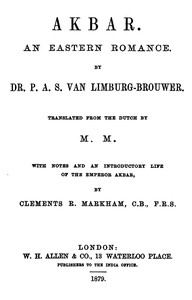
Akbar: An Eastern Romance
by P. A. S. van Limburg Brouwer
English1,204 downloads on Project GutenbergDownload EPUB
Public-domain ebook sourced from Project Gutenberg #40155.
Public-domain ebook
by P. A. S. van Limburg Brouwer
English1,204 downloads on Project GutenbergDownload EPUB
Public-domain ebook sourced from Project Gutenberg #40155.
Akbar: An Eastern Romance is a nineteenth‑century Dutch work rendered into English by the orientalist Dr P. A. S. van Limburg‑Brouwer. Framed as a “sketch” rather than a full biography, the book opens with a scholarly preface that explains the author’s aim: to give English readers a generally accurate picture of the Mughal court and to spark further inquiry into the reign of Akbar, the third Timurid emperor of Hindustan. The narrative then moves swiftly into a vivid recounting of the early years of Akbar’s life, his birth amid Humayun’s exile, the hardships of the fleeing party, and the subsequent consolidation of the empire under the young ruler. Interwoven with these events are detailed observations on the emperor’s military conquests, administrative reforms, and the intellectual atmosphere of his court, especially the famed Thursday‑evening discussions at the Ibadat‑Khana.
The prose reflects the Victorian taste for didactic yet romanticized history, blending factual exposition with a literary flourish that seeks to educate as much as to entertain. Its tone is earnest and scholarly, marked by the author’s confidence in his Oriental research and by a clear admiration for Akbar’s tolerance and learning. Readers who enjoy richly detailed historical settings, especially those interested in Mughal India, the interplay of religion and governance, or the style of 19th‑century European scholarship, will find this work a rewarding entry point into the era.
The opening · free to read
The object of the Romance which is now presented to English readers, in a translated form, is to convey a generally accurate idea of the court of Akbar, the greatest and best native ruler that ever held sway over Hindustan. The author, Dr. Van Limburg-Brouwer, was an oriental scholar, who strove, by this means, to impart to others the knowledge he had himself acquired, through the study of contemporary writers, of the thoughts and habits of the great Emperor, and of the manners and civilization of those who surrounded him.
If he has attained any measure of success in this attempt, his labours will certainly have been useful, and his work deserves translation. For on Englishmen, more than on any other people, is a knowledge of so important a period of Indian history incumbent. This romance of Akbar is, it is true, but a sketch, and is only intended to excite interest in the subject. But if it has that effect, and leads to further inquiry and research, it will secure the object with which it was written, and will have done useful service.
"Akbar, an Eastern Romance," ("Akbar, een Oostersche Roman,") was first published in Dutch, at the Hague, in 1872, the year before the author's death. [1] A German translation appeared at Leipzig in 1877. [2] A native of Holland might not unnaturally undertake such a work, for the best European contemporary account of the reign of Akbar was written by a Dutchman, Pieter Van den Broeck. [3]
Students of Indian history are looking forward to the publication of the Life of Akbar by Prince Frederick of Schleswig Holstein. A really good biography of so great a ruler will be a work of the highest importance, and the Prince's proved literary skill [4] and thoroughness in research justify the anticipation that his Life of Akbar will be worthy of the subject. The romance by Van Limburg-Brouwer, in its English dress, will answer its purpose if it gives rise to a desire for more full and complete information in a graver form, and thus serves as an avant courier to the life of Akbar by Prince Frederick.
The epoch of Akbar is the one of greatest importance to English students of the history of India, for two reasons. It is the period when administration under native rule was best and most efficient, and it is, consequently, the one with which a comparison with British rule should be made. It is also the period of which the most detailed and exact accounts have been written and preserved; so that such a comparison will be reliable and useful.
A brief introductory notice of the great Emperor's life may, perhaps, be acceptable to readers of Van Limburg-Brouwer's historical romance. Akbar was the third Indian sovereign of the House of Timur. Hindustan had been ruled by Afghans for two centuries and a half [5] when Baber crossed the Indus and founded the Mughal [6] Empire in 1525. Baber died in the Charbagh at Agra, on December 26th, 1530, and his son and successor, Humayun, was defeated and driven out of India by the able and determined Afghan chief, Shir Shah, in 1540. Shir Shah died on the throne, and was succeeded by a son and grandson, while Humayun took refuge with Tahmasp, the Shah of Persia. The restored Afghans kept their power for fifteen years.
The story of Humayun's flight is told by his faithful ewer bearer, named Jauhar, who accompanied him in his exile. [7]
Jauhar tells us that, in October 1542, a little party of seven or eight horsemen and a few camels was wearily journeying over the sandy wastes of Sind, worn out with fatigue, and famished with thirst. The fugitive Prince Humayun, his wife the youthful Hamida, [8] the ewer bearer Jauhar, an officer named Rushen Beg, and a few others, formed the party. Extreme misery had destroyed alike the differences of rank and the power of concealing the true character. When Rushen's horse was worn out, he insisted upon taking one which he had lent to the Queen, a young girl of fifteen within a few days of her confinement. Humayun gave his own horse to his wife, walked some distance, and then got on a baggage camel. A few hours afterwards the forlorn wanderers entered the fort of Amarkot, near Tatta, which is surrounded by a dreary waste of sand-hills. Here, under the shade of an arka tree, [9] young Hamida gave birth to a prince, who afterwards became the most enlightened thinker, and the ablest administrator of his age. Akbar was born on the 14th of October 1542. Jauhar, by Humayun's order, brought a pod of musk, which the fugitive king broke and distributed among his followers, saying, "This is all the present I can afford to make you on the birth of my son, whose fame, I trust, will one day be expanded all over the world, as the perfume of the musk now fills this room."
The fugitives then fled up the Bolan Pass, and the little Akbar remained for some time in the hands of his turbulent uncles at Kandahar and Kabul, while his parents took refuge at the court of Persia. Then the wheel of fortune turned. Assisted by Bairam Khan, a very able general and a native of Badakshan, Humayun fought his way back into military possession of Lahore and Delhi, and died in 1556, leaving his inheritance, such as it was, to his young son.
At the time of his father's death, Akbar was only in his fifteenth year. He was then in the Punjab, with Bairam Khan, putting down the last efforts of the Afghan faction. Bairam Khan became Regent, and remained in power until 1560, when the young King assumed the sovereignty.
In order to appreciate the full extent of Akbar's achievements, it must be considered that he had to conquer his dominions first, before he could even think of those great administrative improvements which signalized the latter part of his life and immortalized his name. In his first year he possessed the Punjab, and the country round Delhi and Agra; in the third year he acquired Ajmir; in the fourth, Gwalior and Oudh; and in 1572 he conquered Gujrat, Bengal, and Bihar; but it took several years before order could be established in those countries. Orissa was annexed to Akbar's empire in 1578, by Todar Mall, who made a revenue survey of the province in 1582. In 1581 Kabul submitted, and was placed under the rule of Akbar's brother, Mirza Hakim. Kashmir was annexed in 1586, [10] Sind in 1592, and in 1594 Kandahar was recovered from the Persians. In 1595 Akbar commenced a long war with the Muhammadan Kings of the Dakhin, ending in the acquisition of Berar. These wars, which were spread over nearly the whole of Akbar's reign, need not further engage our attention. But in contemplating the reforms of this admirable prince, it must be borne in mind that their merit is enhanced by the fact that most of them were effected during troublous times, and at periods when there must have been great pressure on his finances. He was a renowned warrior, skilled in all warlike exercises, and an able and successful general. But it is not these qualities which raise Akbar so far above the common herd of rulers. His greatness consists in his enlightened toleration, in his love of learning, in his justice and magnanimity, and in the success with which he administered a vast empire. The excellence of his instruments is one striking proof of his capacity and genius.
The commencement of Akbar's intellectual revolution dates from the introduction to him of Faizi and Abú-l Fazl, the illustrious sons of Mubarak. Their father, Shaikh Mubarak, traced his descent from an Arabian dervish, of Yemen, who settled in Sind. The Shaikh was a man of genius and great learning, and, having established himself at Agra, gave his two sons excellent educations. Faizi, the eldest, was born in 1545. He first went to court in 1568, at the age of twenty-three, and soon became the Emperor's constant companion and friend. In 1589 he was made Poet Laureate, and he was employed on several diplomatic missions. He was a man of profound learning and original genius. He was loved by the Emperor, who was thrown into the deepest grief at his death, which took place at the age of fifty, on October 5th, 1595. "Shaikh Jío," he exclaimed, "I have brought Hakim Ali with me, will you not speak to me?" Getting no answer, in his grief he threw his turban on the ground, and wept aloud.
Shaikh Abú-l Fazl, called Allami, the younger son of Mubarak, was born on January 14th, 1551, at Agra. He zealously studied under the care of his father; and in his seventeenth year, towards the end of 1574, he was presented to the Emperor Akbar by his brother Faizi.
Owing to the birth of his eldest surviving son Salim, at Sikri, in 1570, Akbar had made that place a royal abode. He built a palace and other splendid edifices there, and it became one of his favourite places of residence. It was called Fathpúr Sikri. Thither Akbar went after his campaign in Bihar in 1574, and there his intimacy with Abú-l Fazl commenced. It was at this time that the memorable Thursday evening discussions began. Akbar's resolution was to rule with even hand men of all creeds in his dominions, and he was annoyed by the intolerance and casuistry of the Ulamas or learned men of the predominant religion. He himself said, "I have seen that God bestows the blessings of His gracious providence upon all His creatures without distinction. Ill should I discharge the duties of my station were I to withhold my indulgence from any of those committed to my charge." But he invited the opinions of others on religious points, and hence these discussions arose. Akbar caused a building to be erected in the royal garden of Fathpúr Sikri for the learned men, consisting of four halls, called aiwán, where he passed one night in the week in their company. The western hall was set apart for Seyyids, the south for Ulamas, the north for Shaikhs, and the east for nobles and others whose tastes were in unison with those of the Emperor. The building was called Ibadat-Khana, and here discussions were carried on, upon all kinds of instructive and useful topics.
Besides Faizi and Abú-l Fazl, there were many learned men in constant attendance on the Emperor. Their father, Shaikh Mubarak, was a poet, and a profound scholar. Mulla Abdul Kadir, called El Badauni, was born at Badaun, in 1540, and studied music, astronomy, and history. He was employed to translate Arabic and Sanscrit works into Persian; but he was a fanatical Muhammadan, and in his "Tarikh-i Badauni," a history brought down to 1595, he always speaks of Faizi and Abú-l Fazl as heretics, and all references to the speculations of Akbar and his friends are couched in bitter and sarcastic terms. He, however, temporized, and did not allow his religion to interfere with his worldly interests. His history contains much original matter. He also translated the great Hindu epic "Mahabharata" in 1582, and the "Ramayana" between 1583 and 1591. Of the former poem he says, "At its puerile absurdities the eighteen thousand creations may well be amazed. But such is my fate, to be employed on such works! Nevertheless, I console myself with the reflection that what is predestined must come to pass." The Khwaja Nizamu-d din Ahmad was another historian of Akbar's court. He also was a good, but not a bitter Musalman. His "Tabakat-i Akbari" is a history of the Muhammadan Kings of Hindustan from Mahmud of Ghazni to the year 1594, which was that of his own death. Other historians of the reign were Shaikh Illahdad Faizi Sirhindi, whose "Akbar-nama" comes down to 1602; Maulana Ahmad, of Tatta, who compiled the "Tarikh-i Alfi," under the Emperor's own superintendence, and Asad Beg, who related the murder of Abú-l Fazl and the death of Akbar, bringing his narrative down to 1608. The greatest settlement officer and financier of Akbar's court was Todar Mall. There were also poets, musicians, and authors of commentaries who were encouraged by the liberality of the Emperor.
The book keeps going
Reading is free forever. Sign up and watch scenes appear while you read.



Scenes Storieta drew for other classics.
New illustrated classics
Once or twice a month: the latest books to get full character casts, scene art, and free comic editions. No account needed.