Public-domain ebook
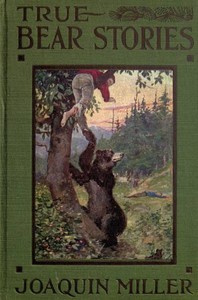
True Bear Stories
Language: en447 downloads on Project Gutenberg
Subjects
In: Short Stories·Children & Young Adult Reading·Humour
Public-domain ebook sourced from Project Gutenberg #40869.
Public-domain ebook
Language: en447 downloads on Project Gutenberg
Subjects
In: Short Stories·Children & Young Adult Reading·Humour
Public-domain ebook sourced from Project Gutenberg #40869.
The opening · free to read
6. THE GRIZZLY BEAR: Ursus horribilis Ord. Found in the western parts of North America.
Under this species are four varieties: the original horribilis, or Rocky Mountain grizzly, from Montana to the Great Basin of Utah; the variety californicus Merriam, the California grizzly, from the Sierra Nevada; variety horriaeus Baird, the Sonora grizzly, from Arizona and the South; and variety alascensis Merriam, the Alaska grizzly, from Alaska.
7. THE BARREN GROUND BEAR: Ursus richardsoni Mayne Reid. A kind of grizzly found about Hudson Bay.
IV. GREAT BROWN BEARS.
8. THE YAKUTAT BEAR: Ursus dalli Merriam. From about Mount St. Elias.
9. THE SITKA BEAR: Ursus sitkensis Merriam. From about Sitka.
10. THE KADIAK BEAR: Ursus middendorfi Merriam. From Kadiak and the Peninsula of Alaska.
These three bears are even larger than the grizzly, and the Kadiak Bear is the largest of all the land bears of the world. It prowls about over the moss of the mountains, feeding on berries and fish.
The sea-bear, Callorhinus ursinus, which we call the fur seal, is also a cousin of the bear, having much in common with its bear ancestors of long ago, but neither that nor its relations, the sea-lion and the walrus, are exactly bears to-day.
Of all the real bears, Mr. Miller treats of five in the pages of this little book. All the straight "bear stories" relate to Ursus americanus, as most bear stories in our country do. The grizzly stories treat of Ursus horribilis californicus. The lean bear of the Louisiana swamps is Ursus luteolus, and the Polar Bear is Thalarctos maritimus. The author of the book has tried without intrusion of technicalities to bring the distinctive features of the different bears before the reader and to instruct as well as to interest children and children's parents in the simple realities of bear life.
DAVID STARR JORDAN.
Leland Stanford, Jr., University.
TRUE BEAR STORIES.
I.
A BEAR ON FIRE.
It is now more than a quarter of a century since I saw the woods of Mount Shasta in flames, and beasts of all sorts, even serpents, crowded together; but I can never forget, never!
It looked as if we would have a cloudburst that fearful morning. We three were making our way by slow marches from Soda Springs across the south base of Mount Shasta to the Modoc lava beds--two English artists and myself. We had saddle horses, or, rather, two saddle horses and a mule, for our own use. Six Indians, with broad leather or elkskin straps across their foreheads, had been chartered to carry the kits and traps. They were men of means and leisure, these artists, and were making the trip for the fish, game, scenery and excitement and everything, in fact, that was in the adventure. I was merely their hired guide.
This second morning out, the Indians--poor slaves, perhaps, from the first, certainly not warriors with any spirit in them--began to sulk. They had risen early and kept hovering together and talking, or, rather, making signs in the gloomiest sort of fashion. We had hard work to get them to do anything at all, and even after breakfast was ready they packed up without tasting food.
The air was ugly, for that region--hot, heavy, and without light or life. It was what in some parts of South America they call "earthquake weather." Even the horses sulked as we mounted; but the mule shot ahead through the brush at once, and this induced the ponies to follow.
The Englishmen thought the Indians and horses were only tired from the day before, but we soon found the whole force plowing ahead through the dense brush and over fallen timber on a double quick.
Then we heard low, heavy thunder in the heavens. Were they running away from a thunder-storm? The English artists, who had been doing India and had come to love the indolent patience and obedience of the black people, tried to call a halt. No use. I shouted to the Indians in their own tongue. "Tokau! Ki-sa! Kiu!" (Hasten! Quick! Quick!) was all the answer I could get from the red, hot face that was thrown for a moment back over the load and shoulder. So we shot forward. In fact, the horses now refused all regard for the bit, and made their own way through the brush with wondrous skill and speed.
We were flying from fire, not flood! Pitiful what a few years of neglect will do toward destroying a forest! When a lad I had galloped my horse in security and comfort all through this region. It was like a park then. Now it was a dense tangle of undergrowth and a mass of fallen timber. What a feast for flames! In one of the very old books on America in the British Museum--possibly the very oldest on the subject--the author tells of the park-like appearance of the American forests. He tells his English friends back at home that it is most comfortable to ride to the hounds, "since the Indian squats (squaws) do set fire to the brush and leaves every spring," etc.
But the "squats" had long since disappeared from the forests of Mount Shasta; and here we were tumbling over and tearing through ten years' or more of accumulation of logs, brush, leaves, weeds and grass that lay waiting for a sea of fire to roll over all like a mass of lava.
And now the wind blew past and over us. Bits of white ashes sifted down like snow. Surely the sea of fire was coming, coming right on after us! Still there was no sign, save this little sift of ashes, no sound; nothing at all except the trained sense of the Indians and the terror of the "cattle" (this is what the Englishmen called our horses) to give us warning.
In a short time we struck an arroyo, or canyon, that was nearly free from brush and led steeply down to the cool, deep waters of the McCloud River. Here we found the Indians had thrown their loads and themselves on the ground.
They got up in sulky silence, and, stripping our horses, turned them loose; and then, taking our saddles, they led us hastily up out of the narrow mouth of the arroyo under a little steep stone bluff.
They did not say a word or make any sign, and we were all too breathless and bewildered to either question or protest. The sky was black, and thunder made the woods tremble. We were hardly done wiping the blood and perspiration from our torn hands and faces where we sat when the mule jerked up his head, sniffed, snorted and then plunged headlong into the river and struck out for the deep forest on the farther bank, followed by the ponies.
The mule is the most traduced of all animals. A single mule has more sense than a whole stableful of horses. You can handle a mule easily if the barn is burning; he keeps his head; but a horse becomes insane. He will rush right into the fire, if allowed to, and you can only handle him, and that with difficulty if he sniffs the fire, by blindfolding him. Trust a mule in case of peril or a panic long before a horse. The brother of Solomon and willful son of David surely had some of the great temple-builder's wisdom and discernment, for we read that he rode a mule. True, he lost his head and got hung up by the hair, but that is nothing against the mule.
As we turned our eyes from seeing the animals safely over, right there by us and a little behind us, through the willows of the canyon and over the edge of the water, we saw peering and pointing toward the other side dozens of long black and brown outreaching noses. Elk!
They had come noiselessly, they stood motionless. They did not look back or aside, only straight ahead. We could almost have touched the nearest one. They were large and fat, almost as fat as cows; certainly larger than the ordinary Jersey. The peculiar thing about them was the way, the level way, in which they held their small, long heads--straight out; the huge horns of the males lying far back on their shoulders. And then for the first time I could make out what these horns are for--to part the brush with as they lead through the thicket, and thus save their coarse coats of hair, which is very rotten, and could be torn off in a little time if not thus protected. They are never used to fight with, never; the elk uses only his feet. If on the defense, however, the male elk will throw his nose close to the ground and receive the enemy on his horns.
Suddenly and all together, and perhaps they had only paused a second, they moved on into the water, led by a bull with a head of horns like a rocking-chair. And his rocking-chair rocked his head under water much of the time. The cold, swift water soon broke the line, only the leader making the bank directly before us, while the others drifted far down and out of sight.
Our artists, meantime, had dug up pencil and pad and begun work. But an Indian jerked the saddles, on which the Englishmen sat, aside, and the work was stopped. Everything was now packed up close under the steep little ledge of rocks. An avalanche of smaller wild animals, mostly deer, was upon us. Many of these had their tongues hanging from their half-opened mouths. They did not attempt to drink, as you would suppose, but slid into the water silently almost as soon as they came. Surely they must have seen us, but certainly they took no notice of us. And such order! No crushing or crowding, as you see cattle in corrals, aye, as you see people sometimes in the cars.
And now came a torrent of little creeping things: rabbits, rats, squirrels! None of these smaller creatures attempted to cross, but crept along in the willows and brush close to the water.
They loaded down the willows till they bent into the water, and the terrified little creatures floated away without the least bit of noise or confusion. And still the black skies were filled with the solemn boom of thunder. In fact, we had not yet heard any noise of any sort except thunder, not even our own voices. There was something more eloquent in the air now, something more terrible than man or beast, and all things were awed into silence--a profound silence.
And all this time countless creatures, little creatures and big, were crowding the bank on our side or swimming across or floating down, down, down the swift, woodhung waters. Suddenly the stolid leader of the Indians threw his two naked arms in the air and let them fall, limp and helpless at his side; then he pointed out into the stream, for there embers and living and dead beasts began to drift and sweep down the swift waters from above. The Indians now gathered up the packs and saddles and made a barricade above, for it was clear that many a living thing would now be borne down upon us.
The two Englishmen looked one another in the face long and thoughtfully, pulling their feet under them to keep from being trodden on. Then, after another avalanche of creatures of all sorts and sizes, a sort of Noah's ark this time, one of them said to the other:
"Beastly, you know!"
"Awful beastly, don't you know!"
As they were talking entirely to themselves and in their own language, I did not trouble myself to call their attention to an enormous yellow rattlesnake which had suddenly and noiselessly slid down, over the steep little bluff of rocks behind us, into our midst.
The book keeps going
Reading is free forever. Sign up and watch scenes appear while you read.



Scenes Storieta drew for other classics.
New illustrated classics
Once or twice a month: the latest books to get full character casts, scene art, and free comic editions. No account needed.