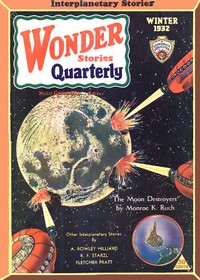
The three men in the tiny space ship showed their apprehension as they watched the gravity meters. Something was distinctly wrong with the ship.
"Are you sure that there isn't some undiscovered moon of Jupiter?" asked the youngest of them. He was only about 25, which was very young indeed when his scientific attainments were considered, even for the human race's stage of intellectual development in 1,000,144 A. D. His figure was stocky, powerful, his face rather thin, bold, with piercing black eyes. He was naked, save for short, brilliantly red trunks of metalsilk. His name, "Sine," followed by a numerical identification code, was tattooed indelibly in thin, sharp characters on his broad, bronze-hard chest.
The man at the ampliscope removed his head from the eyepiece and shook his head impatiently. His body was bronzed and spare, but the complete absence of hair on his head made him look older than the 48 years indicated by the code following the name on his chest, "Kass."
"I tell you, Sine, this pull is no gravity effect. No body of such mass could be invisible, unless it were composed entirely of protons. And even then it would yank Jupiter out of shape, making it look like a pear, but there--"
Jupiter presented its usual appearance. The solar system's largest planet seemed enormous at this distance of only a few million miles. It showed its usual marked depression at the poles, but no distortion such as might be caused by a nearby body of enormous mass.
"What do you think, Lents?" Kass turned to the third occupant of the little space ship. Lents raised his broad placid face from the pad upon which he had been figuring a complicated equation. He was a large man, slow-moving, and fat. He was sensitive to that fact, so that, besides the usual trunks, he also wore a toga-like garment. His brown eyes blinked in folds of flesh.
"No doubt you're right, Kass," Lents rumbled in a deep voice. "I can't see how such a body could exist without pulling all of Jupiter's moons to itself. No, we seem to be specially honored by its attention."
They looked at one another soberly.
"The question is, can it out-pull us?" Sine remarked.
"You ought to know," Kass said. "You designed and built her."
Sine made his way forward. It was no longer necessary to use the handholds, for the pull of the mysterious body was already so powerful that it entirely eliminated the free floating so familiar to space travelers. Sine looked through the grated outlook windows, past the gracefully curved bow of the ship. At the very tip was the ether screw of his invention, resembling the screws used for water propulsion in ancient times, except that the pitch was extremely sharp. The tachometer showed that the screw had slowed down to 50,000 revolutions a minute, although the thermometer indicated that the molecular bearings were still reasonably cool. But how long could she stand the strain? How long, indeed, could the sturdy little atomic motor keep those blades turning? It was designed to pull directly away at a distance of only a million miles from the sun, and yet it was being beaten far out here in space by an object as yet invisible.
"What a crash that'll be!" Sine murmured, watching the agony of tortured metal.
Amidship, Kass was again studying the eyepiece of the ampliscope. Suddenly he stiffened.
"I see it! Why, it can't be over a couple of hundred feet in diameter. Cylindrical, I think. Head on to us now."
They crowded around him. Lents, with hasty computations, determined that they were still about three thousand miles from the object.
"No chance to pull away from it, if we pull straight," and his heavy voice was full of energy as his sleepiness vanished with the need for action. "Set her over, Sine, about 40 degrees. Try for a circular orbit around it--if we can get up enough speed centrifugal force will save us!"
Sine did as he was told, and the ship heeled over so that it presented its side to the sinister object, which was still invisible to the unassisted eye. While Kass watched it through the ampliscope, his companions stared through the thick ports at the velvet, gem-studded firmament. They could feel the attraction growing with terrifying speed.
"It's turning with us," Kass announced, "and getting closer. If we can swing around it, it will be a very sharp ellipse indeed!"
"Try and see if you can get a few more revs out of the screw," Lents suggested, and Sine crept forward, his powerful muscles straining against the pull. He lifted the leaden weight of his arm to the lever. He must get a little more power out of the motor, or they would crash to their deaths in a few minutes! A fine ending for their daring dash to Jupiter--the first space flight since the great comet swarm of 800,768 A. D.
Sine pulled back hard on the lever, and the motor gamely responded, moaned and shuddered under the tremendous overload. The tachometer needle quivered, began to climb, 52,000, 55,000, 56,000----
The ship gave a lurch--there was a dull grinding, a hollow, metallic groan. The men picked themselves up from the floor--realizing at once the fatal significance of the lack of effort required. Their movement carried them off the floor--made them grasp handholds. Floating free! That meant falling free!
Sine glanced at the tachometer. The dead needle stood at zero. Through the forward window he could see one of the four screw blades, black, motionless.
Lents, obeying the habits of a lifetime, elbow hooked in a handhold, was figuring the time required for them to strike. He looked up with a puzzled frown.
"We should have struck about right now! Check on that body's position, will you, Kass?"
The bald-headed scientist pulled himself to the ampliscope. But it was possible to see the object through the ports now, quite plainly. It was black, cylindrical, glinting dully in the sun's light. The space ship was tumbling end over end, lazily, bringing the thing into view first at one port--then another.
"No acceleration!" Kass reported, amazement mingling with hope. "Same speed--we may still hit--but no evidence of gravity. We're falling toward it on momentum alone!"
Lents' brown eyes twinkled with perplexity in their pits of fat.
"The force, whatever it is, doesn't seem like anything in nature. But if we're traveling on momentum alone we can pull away with our emergency rockets--though I hate to waste the fuel."
Sine leaped to the rocket controls. "Grab handholds!" he snapped over his shoulder. The men rolled into the padded niches provided for that purpose. Sine's niche was so placed that it would not be necessary to lift a hand against the tremendous pressure of rocket acceleration. A lateral swing of the lever along its quadrant operated the rockets.
"Oof!" came a smothered exclamation from Lents as the ship seemed to pause, to leap forward in space again. The star-studded heavens as seen through the ports were hidden by a curtain of flame, electric blue and as stiff seeming as a steel bar--the trail of the forward rockets.
For some minutes there was no sound save the subdued thunder of the hull as it trembled under the tug of the rockets. Then a light flashed redly and a gong sounded. The signal that meant, "fuel half gone." Sine shut off the power, crawled out stiffly. His first glance out of a port showed that they were still falling toward the mysterious cylindrical space wanderer.
Kass wiped the sweat from his bald head.
"No use wasting any more effort," he said hoarsely. "That thing is a space ship, and there are men in it. The force they have been using on us is some kind of gravity beam--probably it's also their means of space propulsion. They mean to capture us, no doubt----"
"And they've reversed the beam!" Lents puffed as he turned away from the ampliscope, pulling his sweat-soaked toga away from his fat body with thumb and forefinger. "We're decelerating fast, but we can't feel it because the force acts on every particle of our bodies exactly the same as on the ship----"
"Proving," added Sine, looking out of the port curiously, "that it's a true gravity beam!"
The utter stillness of their ship gave the illusion that she was motionless, and that the sinister stranger was drifting toward them.
"It is a ship!" Lents rumbled. "Look at her ports. But they're shuttered."
"Not a bad idea," Sine agreed. "Protection against pin-point meteorites, anyway." They saw now that the cylinder was slightly rounded at each end, and the end presented to them had at its nose a circular projection, not unlike a very large button, that glowed with a lavender light, which they guessed to be the source of the gravity beam.
They were torn between the excitement of discovery and a very natural apprehension. In the dim past, more than 200,000 years ago, there had been a regular commerce between Earth and the Jovian colonies. But the comet swarm, coming out of the mysterious depths of space, had released to the solar system such swarms of meteorites as to make interplanetary travel in the spatial belt between Mars and Jupiter utterly suicidal. It required the passing of two thousand centuries to thin them out sufficiently to permit the voyage of exploration in which these three men were engaged.
What would these children of Earth look like after 200,000 years of Jovian evolution? Would they be friendly?