Public-domain ebook
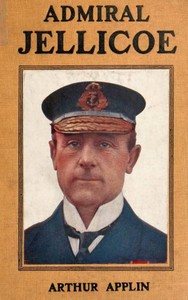
Admiral Jellicoe
Language: en333 downloads on Project Gutenberg
Subjects
In: Biographies·History - British·History - Modern (1750+)
Public-domain ebook sourced from Project Gutenberg #41109.
Public-domain ebook
Language: en333 downloads on Project Gutenberg
Subjects
In: Biographies·History - British·History - Modern (1750+)
Public-domain ebook sourced from Project Gutenberg #41109.
The opening · free to read
If Admiral Sir John Jellicoe had been born in 1858 instead of a year later, he would have first opened his eyes on this now sorely troubled world on the Centenary of Nelson's natal day.
But the gods timed his arrival exactly one hundred and one years later, and it was on the cold and blustering dawn of December the 5th, 1859, that Captain John H. Jellicoe was informed of the happy event. How happy for the Empire, as well as for himself and his wife, the gallant Captain little dreamed at the time.
Southampton was Jellicoe's birthplace, and he came of the race that the sea breeds. His father, who only died in the autumn of 1914 at the age of ninety, was Commodore of the Royal Mail Steam Packet Company until he retired from active service at the age of seventy years--still a young man. He then became a director of the Company and took an active part in its affairs almost until the day of his death.
Though as British as the seas which christened the Admiral of the Fleet and the Guardian of our Empire, Sir John Jellicoe's name is derived from the French, and it is probable that the family originally was of French extraction:--"Admiral Sir John Jellicoe serait, parâite il d'origine française, et descendrait d'une famille protestante emigrée à la Révocation de l'édit de Nantes, et son Nom indiquerait son origine. Jellicoe serait une sorte de contraction de Angélycois, nom des habitants de St. Jean d'Angely."
Gentilcorps--anglicized Noblebody--would be the modern French equivalent. There is an English surname somewhat similar, "Handsomebody," a name that was found on the Honours List some five or six years ago. Jellicorse is another form of Sir John's name, and it is doubtless from this that one of the nicknames has been derived which is popular among the men of the Fleet--Jellymould.
Admiral Patton, Second Sea Lord at the time of the Battle of Trafalgar, was Jellicoe's great grandfather; it is something of a coincidence that at the outbreak of the present World-War Admiral Jellicoe was also Second Sea Lord. Jellicoe's youngest daughter is called Prudence Patton, and Prudence Patton served King Charles II. faithfully in the troubles and wars that filled that unfortunate monarch's reign.
Like all popular men in the Service--with the sole exception of Admiral May, who, though loved and respected by everyone, has, like the Springtime, been always "May"--Sir John can boast a multitude of nicknames.
"Jacky-Oh!" "Hell Fire Jack!" (owing to the revolution he made in Naval gunnery), "All-Jelly" (reminiscent of Epsom Race Course on Derby Day, but again due probably to the deadly effect of his ship's gunnery), "The Little Admiral" (this in polite society), "Silent Jack" and "Dreadnought Jack."
Jellicoe, as everyone connected with the Navy knows, was a Dreadnought man, and one of Lord Fisher's most enthusiastic pupils.
The nickname most in favour in the "forecastle" for Sir John is Hell Fire Jack, yet there is nothing of the fire-eating commander or the bold buccaneer in Admiral Jellicoe's personal appearance. He was always a little boy--his mother and father's "little boy," without a doubt--and, physically, he is a little man. Nelson might have been able to give him half an inch in height. And it is worth remembering that the majority of great leaders of men have been small of stature, from Julius Cæsar to Napoleon, Domville, Sir John French or the late great little Lord Roberts.
Marat was insignificant to look at, and the Kaiser, in his socks, hardly suggests the leader of the Race of Nietzsche's Great Blonde Beasts.
Not only does Jellicoe lack inches, but Nature built him on the lean, light pattern, yet hard as well-tempered steel. He possesses a vast amount of vitality and reserve force.
Time has given his bright, piercing eyes shrewdness and kindliness; they are the eyes of a man who, while he is willing to give all, demands all--or nothing--from those who serve. His nose is long and adventurous rather than Napoleonic.
Quiet as a boy, he has less to say as a man when he is at work. But among his intimate friends he has the reputation of a brilliant conversationalist and a wit, and when Jellicoe speaks those about him listen. At sea he has not the usual flow of highly-coloured language generally associated with those who go down to the sea in ships. A small vocabulary has always sufficed him. His mouth is remarkable; the thin, lightly-compressed lips suggest determination and severity; but they turn up at the corners in a curious way, and one feels instinctively that the disciplinarian has a delicious sense of humour.
Sir John has an elder brother, who is in the Church; beyond a general family likeness there seems little resemblance between the two men. It is enough that the life of each has been given to the services of his God and his Country.
Jellicoe's sister, on the other hand, bears a quite remarkable likeness to the "Little Admiral." The same keen, flashing eyes, adventurous nose and firm mouth--a trifle more tender of course, but with the same delightful suggestion of fun lurking at the corners.
One day, not so very long ago, Miss Jellicoe and a friend had stopped at a street corner to watch a pavement artist at work. He had just completed a picture of the Kaiser, a not too flattering one, and he was busy on the outlines of another picture.
As the portrait progressed beneath his chalky fingers the man occasionally sat upright and surveyed his work and gave a sly chuckle.
A minute or two later the "Little Admiral's" sister--who is as modest and retiring as her brother--started and gave a cry of embarrassment. A small boy, also watching the work of the pavement artist, had nudged her:
"He's a drawing of yer picture, Miss!"
And so apparently he was. There, in bold chalky outlines, were the adventurous nose, the bright eyes, the humorous mouth.
Miss Jellicoe tried to escape through the gathering crowd.
"'er portrait," shouted the artist in disgusted tones. "Not likely! Carn't you recognize Hell Fire Jack, you idjit--him as is going ter give the Road 'Og here a early mornin' dip in the North Sea!"
If he had glanced at Miss Jellicoe he might have received a shock--and been able to congratulate himself on the cleverness of his portrait.
But she fled.
In Sir John Jellicoe one realizes a man, something infinitely greater than the human machine beloved of the Prussian Military Caste. A man, human and humane; devoid of fear, with an unbreakable will. Those gentle eyes can flame and the quiet voice thrill when a command is issued, though he seldom raises it above the ordinary conversational tone.
Probably no one really knows Admiral Jellicoe but his men. And the Navy likes to keep her heroes to herself. She does not talk about them: they are one of her secrets. She kept Nelson to herself, and no one talked about him--beyond the quarter deck or outside the forecastle--until after his death. Then the sea gave up her secret and entrusted the memory of one of England's greatest heroes to her keeping.
And to-day the sea has given us Jellicoe. Just in time--lest we forget.
Jellicoe commenced his education at a small school at Rottingdean. near Brighton, and though he was considered a bright little lad, he did not attract any more attention than the other boys. In holiday-time he loved nothing better than to be left alone in the company of his father and to hear from him the wonders of the Deep, and tales of the distant lands of Romance and Mystery which he had visited.
One can picture the big bronzed sailor and his little son walking about the lovely Isle of Wight watching the coming and going of the ships, and sniffing the salt of the breeze that flung the savour and thrill of unconquerable oceans against the shores of her faithful lover England; Little Jellicoe eagerly questioning Big Jellicoe; and Big Jellicoe recounting inexhaustible yarns and seaman's tales that would have delighted the heart of and inspired Stevenson himself.
It was thus, on the shores of the Isle of Wight, and on the quays and docks of Southampton, in communion with his father and the sea, that the seeds of adventure and patriotism were first sown in Jellicoe's heart--destined to flourish into such a rich harvest for his country.
There is a little story told of Master Jack soon after he learned to toddle which shows that his character was forming even at that early age.
"Jacky" had a habit of running ahead of his nurse and suddenly darting across the road. The spirit of adventure; probably he was ambitious to be a boy scout. Eventually, finding that warnings were not heeded, the nurse told him that when she saw a policeman she would ask the Representative of Law and Order to take him away and put him in prison.
Presently a policeman appeared on the horizon of the pavement.
"Now, Master Jacky, you'd better behave yourself!" the nurse whispered warningly.
But young Jellicoe was not the least afraid of the man in blue. He advanced to meet him and solemnly looked him up and down.
"Nurse says you're to take me in charge," he announced.
The constable, taken aback, smiled and asked the nature of the "Charge."
"Disobeying orders," was Master Jack's reply. "And I say, policeman, what ripping buttons you've got on your uniform!"
Jellicoe never knew fear or favour. But evidently as a youngster he realized the meaning of discipline and order.
The book keeps going
Reading is free forever. Sign up and watch scenes appear while you read.



Scenes Storieta drew for other classics.
New illustrated classics
Once or twice a month: the latest books to get full character casts, scene art, and free comic editions. No account needed.