Public-domain ebook
The Accumulation of Capital
Language: en1,554 downloads on Project Gutenberg
Subjects
In: Economics
Public-domain ebook sourced from Project Gutenberg #41405.
Public-domain ebook
Language: en1,554 downloads on Project Gutenberg
Subjects
In: Economics
Public-domain ebook sourced from Project Gutenberg #41405.
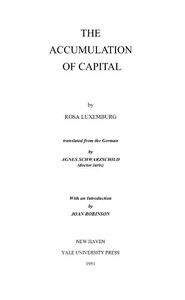
Rosa Luxemburg’s The Accumulation of Capital is a scholarly work that tackles the dynamics of capitalist development through a Marxist lens. The book opens with an extensive front matter that situates the text within a series of “Rare Masterpieces of Philosophy and Science,” noting its 1951 Yale University Press edition and the translation by Agnes Schwarzschild. After a biographical note on Luxemburg’s revolutionary background, the introduction by W. Stark frames the work as a response to contemporary academic attempts to move beyond static equilibrium models, promising a “dynamic model of a developing economy.” The first substantive chapter launches into a systematic exposition of reproduction theory, laying out the variables c, v, and s that represent constant capital, wages, and surplus, respectively, and establishing the assumptions of constant real wages and unchanged production techniques. This analytical foundation sets the stage for Luxemburg’s critique of Marx’s unfinished notes on capital accumulation.
The text is written in dense, early‑20th‑century academic prose, heavy with Marxist terminology and detailed numerical examples. Its style combines rigorous economic modeling with historical commentary, reflecting the intellectual climate of pre‑World‑War I socialism. Readers who enjoy deep economic theory, the history of Marxist thought, or the intersection of politics and economics will find it rewarding, while those seeking a light narrative or a purely popular overview may find the density challenging.
[Transcriber's notes: Inconsistent hyphenation and use of umlauts retained. Equations are surrounded by indicating that the variables are all italicised. If there are non-italicised alphabetic characters in the equation the variables are surrounded by separately. [sqrt] has been used to represent square root (radical) sign. A full list of errors that have been changed can be found at the end.] …
Keep reading free · start reading with no account
New illustrated classics
Once or twice a month: the latest books to get full character casts, scene art, and free comic editions. No account needed.