Public-domain ebook
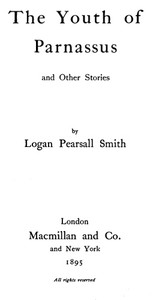
The Youth of Parnassus, and Other Stories
Language: en323 downloads on Project Gutenberg
Subjects
In: Short Stories·British Literature·American Literature
Public-domain ebook sourced from Project Gutenberg #41682.
Public-domain ebook
Language: en323 downloads on Project Gutenberg
Subjects
In: Short Stories·British Literature·American Literature
Public-domain ebook sourced from Project Gutenberg #41682.
The opening · free to read
He came straight to Oxford from his American home, Parnassus City, a town in the Western State of Indiana.
The first time Foley saw him was one wet October evening, when, splashing across the quadrangle towards his rooms, he noticed a large umbrella moving through the dripping twilight--an umbrella which, from its undecided motion, must belong, he had told himself, to some tourist, who, in spite of the rain and darkness, was finishing a day of sight-seeing at St. Mary's. But when the umbrella collapsed in front of his own staircase, and Foley saw the spectacles and pale face of a young man who turned to enter there, he decided that it must be an agent, come to collect money for missions or something of the kind. And as he followed upstairs, in the wet footprints of the feet he could still hear mounting above him, he asked himself with vague annoyance what right they had--people like that--to push themselves into the rooms of Oxford men.
The melancholy footsteps went on till they reached the top; nor did Foley hear them again descend. Soon after he was told that an American had come into College, and was living above him; and when he went to call, he recognized, in the person who awkwardly rose to receive him, the young man he had taken for a mission agent in the rain that evening. A thin, small young man, in a long, black broadcloth coat of provincial cut, he seemed at first sight nothing but the traditional Western American Foley had read of in books, or seen in the theatre sometimes--a student who looked curiously out of place in that old panelled room.
The young Englishman talked to him as best he could, asking the questions always asked of a new-comer; questions which this one answered with the usual shyness, but in a very unusual voice and accent.
He had just come from America; he had left there on the sixth. He had come to study under Dr. Joseph at the new Methodist College. Dr. Joseph had arranged for him to come to St. Mary's; their own College wasn't built yet. Foley asked if he thought he would like Oxford. "Yes, sir," the other replied, drawing a large handkerchief from his coat-tails, "I guess I will; though," he added cautiously after a moment, "it does seem kind of old and mouldy."
Foley thought he had done his duty in calling, and meant for the future to see as little as possible of his new neighbour. And yet there had been something pleasant and sensitive in his face, he remembered afterwards; and at times he was haunted by the thought of this stranger sitting as he had found him, alone and lonely in the room upstairs, with two or three books in the empty shelves, a few photographs of home that made the mantelpiece and bare walls look all the more homeless and unfriendly. Now and then he would hear footsteps above moving vaguely about, or he would meet the American on the stairs, or see him walking out alone, and at last, out of kindness, he went again to call.
Before long he began to take a certain liking to Sutton, and would often go up in the evenings with a cigarette to his rooms. To the young Englishman the American was certainly a curious and amusing study. How curious were the views and impressions of Oxford, that, breaking through his shy reserve, he would once in a while express, in his prim middle-aged way! He was a good deal shocked by the wine-drinking, card-playing, and Sabbath-breaking that seemed so prevalent there; what religion there was, (well, he didn't guess there was much,) he thought mechanical and dead. Of course there was a great deal of culture in Oxford; but in other things, like telephones and electric lights, why England was behind the Mississippi Valley!
II.
Foley began to have ideas of his own about this Mississippi Valley. He had already read of its rivers and railways and mushroom towns, and he remembered some of the proud things that Sutton had said at different times of Parnassus City and its importance--it was almost the only subject on which the reticent young man ever seemed willing to talk--the thought-out comparisons he would draw between that place and Oxford, in his attempts to explain to himself what he saw, and account for it all, according to his principles.
One evening, in a burst of unusual talkativeness, he described how Parnassus City had been laid out twenty years before, on what had been till then an unploughed prairie; but now there were thousands of inhabitants, rows of business buildings, and elegant residences in the outskirts. There were electric trolleys too in the streets; and the whole town was lighted by natural gas. Not only had the place grown fast in trade and population, but there had been, he explained, a pretty rapid growth in culture. Oh, they didn't intend to let the moss grow on them out in Indiana! Schools and churches were built--the most elegant was the First Methodist, the Reverend Dr. Turnpenny's. It was Dr. Turnpenny, he added, who started the Forward Movement among the Indiana Methodists which made such a stir. Then, after the churches, they had built a lecture hall and library, and, at last, the Parnassus College.
Foley asking more about this college, Sutton explained that though it had been built a few years before as a college for Methodist theology and liberal learning, it was already larger than the neighbouring institute at Corinth Creek, and only second in those parts to the University of Miomi. It wasn't of course like the universities in the Eastern States, but still they were proud of it there.
He had pinned up on the old panelling of his wall a photograph of this Parnassus College: a rather gaunt frame building, standing in a ploughed field among a few new-planted trees. About the steps were grouped a number of young men and women, many of them wearing spectacles, and all with earnest faces and provincial dress. "That's my class," Sutton explained, pointing at his own figure in the group. "It's the biggest class we've had so far, thirteen gentlemen and seven ladies."
Foley studied the photograph of the college, and the pictures on the mantelpiece--several college friends, with lank serious faces; an intellectual young lady, her hand resting on a copy of the Bible; and an old, mild, white bearded minister--Dr. Turnpenny, no doubt. There was a picture too of a wide city street. Then it really existed, this remote place, and people lived there! he thought, amused at the curious chance which had brought Sutton, the promise and pride, perhaps, of his native town, and set him down in so different a world.
But at last Foley turned from the yellow lamplight, the photographs, and the voice of the American sawing in his ear. Going to the window he opened the lattice and leaned out into the night. Cool, fresh, and dark was the air that breathed on his face, while before him, blue and vague under the white moon, there grew on his sight the towers, the dome-like trees, and shining roofs of Oxford; dim, romantic, and steeped in silence, save for the even tinkle of a distant bell. With sudden unaffected sentiment, he felt how much he cared for Oxford and all that Oxford stood for.
"Do come here," he called out with a friendly impulse, turning his head into the yellow light of the room, "I don't think I ever saw such a view."
The American came and leaned beside him at the open window. "Yes, it is nice," he said at length, and Foley was surprised by a fugitive sound of real feeling and appreciation in his voice.
III.
Gradually he came to take a more real interest in his neighbour. The books that Sutton read, Sutton's love of poetry--surprised him; little things he would say now and then seemed to show indications of sensitive fancies and shy feelings hardly in accordance with his dry exterior. What a thing it would be for him, Foley thought, if the poor young man's taste could be really cultivated; if he could only be set free from his narrowing ideas and made to look at life for himself, instead of seeing it always through the grey fog of Puritan prejudice!
Sutton took everything that Foley said with delightful seriousness; the well-worn arguments against Democracy and Republicanism were new to him, and seemed to puzzle him--he would come days afterwards with carefully thought-out answers to them. Or he would give his friend tracts to read, as if he was worried by Foley's ritualistic tastes, and hoped to convert him to Methodism; and once he persuaded him to go and hear Dr. Joseph preach. Foley was really impressed by the good sense and vigour of Sutton's master, but to Sutton himself he criticized what he thought a want of beauty in the service.
And it was only once that Foley felt even for a moment the least uncomfortable about the things he said to his friend--one evening when he happened to run upstairs with some specious argument about the Apostolic Succession, (for when an idea occurred to him he liked to make use of it at once,) and going into the American's room, he found him on his knees in prayer.
In that old place--for St. Mary's was not one of the more liberal Colleges, but a sleepy, ancient, aristocratic society, very conservative of its own beliefs and manners and prejudices--Eliaphet Sutton lived on at first, unknown to almost everybody, and only noticed for the oddness of his looks, as he went in and out to his lectures or solitary walks. But after a while Foley's interest in him, and his own shy charm of manner, gained him a more friendly welcome in the College, and little by little he began to modify, it was remarked, the quaint unconventionalities of his speech and ways.
A curious life it was, this Oxford life into which the inexperienced American had chanced to drift! A community of young men, generously bred and taught, living together so intimately in that mediaeval place, with its own old usages and traditions and ways of thinking; shut out, as by a high wall, from the world outside; aloof from the vulgar needs of life; concerned, many of them, only with its theoretic problems, interested more, perhaps, in the ancient Greeks than in contemporary affairs--and, indeed, not unlike the Greeks in their care for the clearness and beauty of the mind, the athletic strength of the body--surely, Foley thought, the young Methodist could not have found so delightful a place in all the world beside.
How much he was really influenced by it Foley could not tell; certainly as the months went by he seemed to be more aware of the beauty of Oxford; he would stop sometimes of his own accord to look through a blue gateway or down a sunlit street, and once Foley saw him standing, a quaint figure, under the University Church, and gazing up at the spire--at the religious statues there, which seemed to be voyaging through the windy sky and among its great white clouds. He started to join him, but Sutton, seeing he was noticed, moved hastily away.
Then Foley remembered an evening when, coming out into the quadrangle, he saw a figure he recognized as Sutton's standing at a barred gate opening on the street. In front of the American, through that one small opening in the great dark walls, was the gas-lit yellow of the street, the noise of the passing crowd and traffic--for it was the evening of a market day--but at his back the deep shadow and silence of the old quadrangle.
The book keeps going
Reading is free forever. Sign up and watch scenes appear while you read.



Scenes Storieta drew for other classics.
New illustrated classics
Once or twice a month: the latest books to get full character casts, scene art, and free comic editions. No account needed.