Public-domain ebook
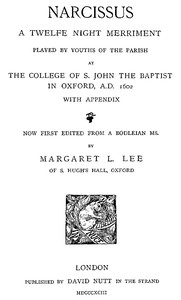
Narcissus, a Twelfe Night Merriment
Language: en414 downloads on Project Gutenberg
Subjects
In: Plays/Films/Dramas·Mythology, Legends & Folklore·British Literature
Public-domain ebook sourced from Project Gutenberg #41726.
Public-domain ebook
Language: en414 downloads on Project Gutenberg
Subjects
In: Plays/Films/Dramas·Mythology, Legends & Folklore·British Literature
Public-domain ebook sourced from Project Gutenberg #41726.
The opening · free to read
THIS play, which for want of a ready-made title I have called Narcissus, dates from a period of peculiar interest in the history of that class of dramatic composition to which it belongs.
So vast a phenomenon as the rise and fall of the complete English drama could not but be attended by widely-spread symptoms of the popular love for stage representation; a tendency which, though it would never have produced a Shaksperian tragedy, yet alone rendered possible the work of a Shakspere. These lesser manifestations of the feeling that pervaded Elizabethan England may be compared to the small fissures on the side of a volcano, through which the same lava as fills the molten crater emanates in slender and perhaps hardly perceptible channels. It may chance that the activity of these side-streams presages the final eruption at the summit; yet afterwards they are scarcely noticed, and their effects are too puny to attract attention. So it is with the abortive forms of drama, heralding, accompanying, and in some cases outliving, the culmination of English dramatic art under Shakspere. They are not, as a rule, the product of those great intellects which helped in the rearing of the main structure; but rather of such lesser writers as were either possessed by the dramatic spirit while ignorant of the formative and restraining rules of art, or else imbued with a desire to follow those rules, as they had been drawn up by Aristotle and Horace and exemplified in French and Italian literature, whilst themselves wanting in originality, and oblivious of the superiority of a native growth over the best of importations. The latter class of would-be English dramatists, in especial, found a natural field for action amongst the scholarly societies which constituted a mediæval university. Though as early as 1584 and 1593 statutes are found enacting that no players shall perform within five miles of Oxford, it must be remembered that these refer to professional, not to academical actors, and that the regulations controlling the former were of much greater stringency than those which concerned the latter.
Nor were plays imitated from Greek and Latin writers the only ones to be performed by undergraduates and others before select audiences in the college halls. Youthful players would probably demand the introduction of something more or less witty; and the fact that theatrical representations generally took place on the occasion of a royal visit, or at times of special rejoicing, accounts in some degree for the casting aside of the strictly classical models, and the employment of masques, or of such looser forms of comedy as were the outcome of Heywood's Interludes, into either of which contemporary allusions and jests could be readily introduced. Nevertheless, the majority of such pieces continued to deal with subjects taken from Roman and Greek mythology, the various anachronisms and absurdities which arose from this method of treatment only contributing to heighten the amusement of the spectators.
I have already implied that Narcissus belongs to the class of University plays, inasmuch as it was acted at S. John's College, Oxford, on Twelfth Night, 1602. It does not, however, approximate in any way to the classical form of comedy; it is rather to be regarded as a Christmas piece, an imitation of the Yule-tide mummeries acted by disguised villagers or townsfolk at the houses of such wealthier persons as would afford them hospitality.
The following list of Oxford plays--compiled, with additions, from W. L. Courtney's article in Notes and Queries for December 11th, 1886, and W. Carew Hazlitt's _Manual of English Plays_--may be of interest, as showing the frequency of dramatic entertainments at the various colleges between 1547 and the Restoration. The dates appended are in most cases those of presentation; but when these are either unknown, or impossible to distinguish from dates of entry at Stationers' Hall, I have substituted the latter.
1547. Archipropheta, sive Joannes Baptista, by Nicholas Grimald, in Ch. Ch. Hall.
1566. Marcus Geminus, by (?) in Ch. Ch. Hall.
1566. Palæmon and Arcyte, by Richard Edwards, in Ch. Ch. Hall.
1566. Ariosto, by Geo. Gascoigne, at Trin. Coll.
1566. Progne, by Dr. James Calfhill, in Ch. Ch. Hall.
? 1580. Ulysses Redux, by William Gager, in Ch. Ch. Hall.
1581. Meleager, by William Gager, in Ch. Ch. Hall.
1582. Supposes, translated from Ariosto, by Geo. Gascoigne, at Trin. Coll.
1582. Julius Cæsar, by Dr. Geddes, in Ch. Ch. Hall.
1583. Rivales, by William Gager, in Ch. Ch. Hall.
1583. Dido, by William Gager, in Ch. Ch. Hall.
? Tancred, by H. Wotton, at Queen's Coll.
? Kermophus, by George Wild (?) at (?)
1591. Kynes Redux, by William Gager, in Ch. Ch. Hall.
1592. Bellum Grammaticale, sive Nominum Verborumque Discordia Civilis, by (?) at Ch. Ch.
? 1602. Hamlet, by W. Shakspere, at (?).
1602. Narcissus, by (?) at S. John's College.
1605. Ajax Flagellifer, by (?) at (?).
1605. Alba, by (?) in Ch. Ch. Hall.
1605. Vertumnus, sive, Annus Recurrens Oxonii, by Dr. Matthew Gwinne, in Ch. Ch. Hall.
1606. The Queen's Arcadia, by Samuel Daniel, in Ch. Ch. Hall.
1607. Cæsar and Pompey, by (?) at Trin. Coll.
1607. The Christmas Prince, by divers hands, at S. John's Coll.
1608. Yule-tide, by (?) at Ch. Ch.
1614. Spurius, by Peter Heylin, at Hart Hall.
1617. Technogamia, by Barten Holiday, at Ch. Ch.
1617-8. Philosophaster, by R. Burton, at Ch. Ch.
1631. The Raging Turk, by Thomas Goffe, at Ch. Ch.
1632. The Courageous Turk, by Thomas Goffe, at Ch. Ch.
1633. Fuimus Troes, by Dr. Jasper Fisher, at Magd. Coll.
1633. Orestes, by Thomas Goffe, at Ch. Ch.
? 1634. The Sophister, by R. Zouch, at (?).
1634-5. Euphormus, sive, Cupido Adultus, by Geo. Wilde, at S. John's Coll.
1636. Stonehenge, by John Speed, at S. John's Coll.
1636. The floating Island, by William Strode, at Ch. Ch.
The book keeps going
Reading is free forever. Sign up and watch scenes appear while you read.



Scenes Storieta drew for other classics.
New illustrated classics
Once or twice a month: the latest books to get full character casts, scene art, and free comic editions. No account needed.
![Cover of The Works of William Shakespeare [Cambridge Edition] [Vol. 3 of 9]](/covers/50559.jpg)
![Cover of The Works of William Shakespeare [Cambridge Edition] [Vol. 7 of 9]](/covers/47715.jpg)
![Cover of The Works of William Shakespeare [Cambridge Edition] [Vol. 8 of 9]](/covers/49008.jpg)
![Cover of The Works of William Shakespeare [Cambridge Edition] [Vol. 4 of 9]](/covers/50095.jpg)