Public-domain ebook
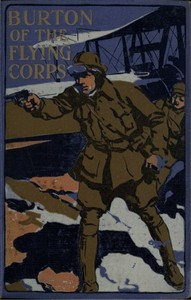
Burton of the Flying Corps
Language: en582 downloads on Project Gutenberg
Subjects
In: World War I·Crime, Thrillers and Mystery·Adventure
Public-domain ebook sourced from Project Gutenberg #41737.
Public-domain ebook
Language: en582 downloads on Project Gutenberg
Subjects
In: World War I·Crime, Thrillers and Mystery·Adventure
Public-domain ebook sourced from Project Gutenberg #41737.
The opening · free to read
About one o'clock one Saturday afternoon in summer, a hydro-aeroplane--or, as its owner preferred to call it, a flying-boat--dropped lightly on to the surface of one of the many creeks that intersect the marshes bordering on the river Swale. The pilot, a youth of perhaps twenty years, having moored his vessel to a stake in the bank, leapt ashore with a light suit-case, and walked rapidly along a cinder path towards the low wooden shed, painted black, that broke the level a few hundred yards away.
It was a lonely spot--the very image of dreariness. All around extended the "glooming flats"; between the shed and Luddenham Church, a mile or so distant, nothing varied the grey monotony except an occasional tree, and a small red-brick, red-tiled cottage, which, with its flower-filled windows, seemed oddly out of place amid its surroundings--an oasis in a desert.
The youth, clad in khaki-coloured overalls and a pilot's cap, made straight for the open door of the shed. There he set his suit-case on the ground, and stepping in, recoiled before the acrid smell that saluted his nostrils. He gave a little cough, but the man stooping over a bench that ran along one of the walls neither looked up, nor in any way signified that he was aware of a visitor. He was a tall, fair man, spectacled, slightly bald, clean shaven, dressed in garments apparently of india-rubber. The bench was covered with crucibles, retorts, blow-pipes, test tubes, Bunsen burners, and sundry other pieces of scientific apparatus, and on the shelf above it stood an array of glass bottles and porcelain jars. It was into such a jar that the man was now gazing.
"Hullo, Pickles!" said the newcomer, coughing again. "What a frightful stink!"
The man lifted his head, looked vacantly through his spectacles for a moment, then bent again over the jar, from which he took a small portion of a yellowish substance on the end of a scalpel. Placing this in a glass bowl, he poured on it a little liquid from one of the glass bottles, stirred it with a glass rod, and watched. A smell of ammonia combined with decayed fish mingled with the other odours in the air, causing the visitor to choke again.
"Beautiful!" murmured the experimenter. He then poured some of the solution into another vessel and gazed at it with the rapt vision of an enthusiast.
Ted Burton leant against the doorpost. He knew that it was useless to interrupt his friend until the experiment was concluded. But becoming impatient as the minutes passed, he took out a cigarette, and was about to strike a match. Then, however, at a sudden recollection of his surroundings, he slipped out into the open air, taking great gulps as if to clear his throat of the sickening fumes, and proceeded to light his cigarette in ease of mind.
By and by a cheery voice hailed him from the interior.
"That you, Teddy?"
"If you've quite finished," said Burton, putting his head in at the door, after he had first flung away his half-smoked cigarette.
"Glad to see you, my dear fellow. I say, will you do something for me? You came in your machine, of course."
"Of course. What is it? It's about lunch-time, you know."
"Is it? But it won't take you long. I've run out of picric acid, and can't get on. Just fly over to Chatham, will you, and bring some back with you. You'll get it at Wells's in the High Street: you'll be there and back in half an hour or so."
"Can't you wait till after lunch?"
"Well, I can, but it will be a nuisance. You see, the whole experiment is hung up for want of the stuff."
"Oh, very well. By the way, you've done it at last, I see."
"Done what?"
"Pulled off the phenosulphonitro-something-or-other that you've been working at I don't know how long."
"How on earth did you know?" inquired his friend with an air of surprise and chagrin.
Burton pulled out a newspaper, unfolded it, and handed it over, pointing to a short paragraph.
We understand that a new high explosive of immense power, the invention of Dr. Bertram Micklewright, is about to be adopted for the British Navy. Dr. Micklewright has been for some years engaged in perfecting his discovery, and after prolonged experimentation has succeeded in rendering his explosive stable.
"Well, I'm hanged!" cried Micklewright, frowning with annoyance. "The Admiralty swore me to secrecy, and now they've let the cat out of the bag. Some confounded whipper-snapper of a clerk, I suppose, who's got a journalist brother."
"It's true, then?"
"Yes, by Jove, it's true! Look, here's the stuff; licks lyddite hollow."
He took some yellowish crystals from a porcelain bath and displayed them with the pride of an inventor.
"I say, Pickles, is it safe?" said Burton, backing as the chemist held the stuff up for his inspection.
"Perfectly," said Micklewright with a smile. "It's more difficult even than lyddite to detonate, and it'll burn without exploding. Look here!"
He put a small quantity into a zinc pan, lit a match, and applied it. A column of suffocating smoke rose swiftly to the roof. Burton spluttered.
"Beautiful!" he gasped ironically. "I'm glad, old man; your fortune's made now, I suppose. But I can't say I like the stink. Takes your appetite away, don't it?"
"Ah! You mentioned lunch. Just get me that stuff like a good fellow; then I'll prepare my solution; and then we'll have lunch and you can dispose of me as you please."
Burton returned to the creek, boarded his flying-boat, and was soon skimming across country on the fifteen-mile flight to Chatham.
He had been Micklewright's fag at school, and the two had remained close friends ever since. Micklewright, after carrying all before him at Cambridge, devoted himself to research, and particularly to the study of explosives. To avoid the risk of shattering a neighbourhood, he had built his laboratory on the Luddenham Marshes, putting up the picturesque little cottage close at hand for his residence. There he lived attended only by an old woman, who often assured him that no one else would be content to stay in so dreary a spot. He had wished Burton, when he left school, to join him as assistant: but the younger fellow had no love for "stinks," and threw in his lot with a firm of aeroplane builders. Their factory being on the Isle of Sheppey, within a few miles of Micklewright's laboratory, the two friends saw each other pretty frequently; and when Burton started a flying-boat of his own, he often invited himself to spend a week-end with Micklewright, and took him for long flights for the good of his health, as he said: "an antidote to your poisonous stenches, old man."
Burton was so much accustomed to voyage in the air that he had ceased to pay much attention to the ordinary scenes on the earth beneath him. But he had completed nearly a third of his course when his eye was momentarily arrested by the sight of two motor-cycles, rapidly crossing the railway bridge at Snipeshill. To one of them was attached a side car, apparently occupied. Motor-cycles were frequently to be seen along the Canterbury road, but Burton was struck with a passing wonder that these cyclists had quitted the highway, and were careering along a road that led to no place of either interest or importance. If they were exploring they would soon realise that they had wasted their time, for the by-road rejoined the main road a few miles further east.
On arriving at Chatham, Burton did not descend near the cemetery, as he might have done with his landing chassis, but passed over the town and alighted in the Medway opposite the "Sun" pier. Thence he made his way to the address in the High Street given him by Micklewright. He was annoyed when he found the place closed.
"Just like old Pickles!" he thought. "He forgot it's Saturday." But, loth to have made his journey for nothing, he inquired for the private residence of the proprietor of the store, and luckily finding him at home, made known the object of his visit.
"I'm sorry I shall have to ask you to wait, sir," said the man. "The place is locked up, as you saw; my men have gone home, and I've an engagement that will keep me for an hour or so; perhaps I could send it over--some time this evening?"
"No, I'd better wait. Dr. Micklewright wants the stuff as soon as possible. When will it be ready?"
"If you'll be at the store at three o'clock I will have it ready packed."
It was now nearly two.
"No time to fly back to lunch and come again," thought Burton, as he departed. "I'll get something to eat at the 'Sun,' and ring old Pickles up and explain."
The book keeps going
Reading is free forever. Sign up and watch scenes appear while you read.



Scenes Storieta drew for other classics.
New illustrated classics
Once or twice a month: the latest books to get full character casts, scene art, and free comic editions. No account needed.