Public-domain ebook
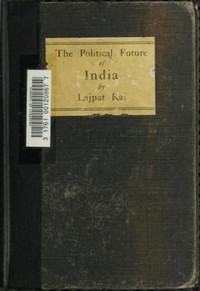
The Political Future of India
Language: en612 downloads on Project Gutenberg
Subjects
In: History - British·History - Modern (1750+)·Politics
Public-domain ebook sourced from Project Gutenberg #41819.
Public-domain ebook
Language: en612 downloads on Project Gutenberg
Subjects
In: History - British·History - Modern (1750+)·Politics
Public-domain ebook sourced from Project Gutenberg #41819.
The opening · free to read
"So much for the general situation. In Northern India the outbreaks were nakedly revolutionary. They are unconnected with the Rowlatt Act or with passive resistance, which probably precipitated a movement long concerted. There is abundant evidence of the organized revolutionary character of the disturbances in the systematic attacks on railways, telegraphs, and all means of communication, and its definitely anti-British character is apparent from the efforts to plunge the railways into a general strike.
"There are signs of the inter-connection of the Punjab revolutionaries with the Bombay revolutionaries who organized attacks on communications at Ahmedabad and Viramgam, derailed trains, cut telegraphs, and sent rowdies from Kaira to take part in the work of destruction. There is evidence also of some outside inspiration, but whether Bolshevist or otherwise is obscure.
"Whilst in the Punjab the soil was fruitful, owing to economic conditions, the ravages of influenza, and the pressure of last year's recruiting campaign, the revolutionary origin of the disturbances is unquestioned...."
As usual the message is a mixture of truth and imagination. At most it is a partisan view. Be the causes what they may, the events in our judgment amply justify the following conclusions:
(a) That India is politically united in demanding a far reaching measure of self-determination.
(b) That she will not be satisfied with paltry measures of political reform which do not give her power to shape her fiscal policy in her own interests, independent of control from London.
(c) That it is useless to further harp on the "cleavages" of race, religion and language, in dealing with the problem of India.
(d) That the country is no longer prepared to let measures of coercion pass and take effect without making their protest and dislike known to the authorities in a manner, the significance of which may not be open to misunderstanding.
The Indian members of the Legislative Council while opposing the Rowlatt Bills spoke in sufficiently clear and strong language of the grave situation the Government was creating by its ill-considered policy. They knew their people. The bureaucracy evidently dismissed it as bluff or, if it knew what was likely to happen, encouraged it in the hope that the outbreak might justify their opposition to, and dislike of, the Montagu-Chelmsford scheme. In doing that they have had to hatch the eggs they themselves laid. These events have, besides, proved (a) that the lead of the country has passed from the hands of the so called "natural leaders," the aristocracy of land, money and birth; (b) that even the moderate leaders have considerably lost in prestige and influence; (c) that the lead has definitely passed into hands that openly and frankly stand for self-determination and self-government within the Empire and are prepared for any sacrifice to achieve that end; (d) that the old methods of governing India must now be discarded once for all and the charge of provinces taken away from sun-dried bureaucrats of the type of Sir Michael O'Dwyer and Sir Reginald Craddock.
The bloodshed in the Punjab, which outdid all other Provinces in sending help during the war both in men and money, pointed to the administration or mal-administration of Sir Michael O'Dwyer as responsible for the nature and intensity of the outbreak. If ever there was a British ruler of India who deserved impeachment it is Sir Michael O'Dwyer. He was not only a tyrant and a snob of the worst order but he was incompetent also. One of the two things must have happened: Either he was out of touch with public feeling in the province or he deliberately provoked this disaster by a policy of strength. In either case he deserves to be publicly impeached and condemned for incompetence or brutality or possibly for both.
The following Summary of the orders passed by the officer commanding shows the nature of the martial law administered in the "most loyal" province in India, a province which has so far been considered to be the right arm of British Ráj in India.
I have italicised some words and sentences for special attention. The reader I hope will note the exceptions in favor of the Europeans and the Indian servants in the employ of the Europeans and also the reasonableness of the other orders, threatening punishment upon the owners of certain properties and requiring "all students," and all male persons belonging to private Colleges in Lahore to attend four times a day at a particular place for roll call. Order No. 14 is a gem of great brilliance.
I have omitted order No. 6 as unimportant. Orders from 8 to 12 inclusive are not available. What has been given above, however, is quite sufficient to show the nature of the martial law that has been applied to the Punjab, after five years of unquestioned and unrivalled loyalty to the British Empire, in the period of greatest danger that had overtaken it. Such is the reward of "loyalty."
1. At 20·00 hours (8 o'clock) each evening a gun will be fired from the Fort, and from that signal till 05·00 hours (5 o'clock) on the following morning no person other than a European or a person in possession of a military permit signed by me or on my behalf will be permitted to leave his or her house or compound or the building in which he or she may be at 20 hours. During these prohibited hours no person other than those excepted above will be permitted to use the streets or roads, and any person found disobeying this order will be arrested, and if any attempt is made to evade or resist that person will be liable to be shot.
This and all other orders which from time to time I may deem necessary to make will be issued on my behalf from the water-works station in the city, whither every ward will keep at least four representatives from 6 A.M., till 17·00 hours (5 P.M.) daily to learn what orders, if any, are issued and to convey such orders to the inhabitants of their respective wards. The onus of ascertaining the orders issued by me will rest on the people through their representatives.
2. Loyal and law-abiding persons have nothing to fear from the exercise of Martial Law.
3. In order to protect the lives of his Majesty's soldiers and police under my command, I make known that if any firearm is discharged or bombs thrown at them the most drastic reprisals will instantly be made against property surrounding the scene of the outrage. Therefore it behooves all loyal inhabitants to see to it that no evil-disposed agitator is allowed on his premises.
4. During the period of Martial Law I prohibit all processions, meetings or other gatherings of more than 10 persons without my written authority, and any such meetings, gatherings or processions held in disobedience of this order will be broken up by force without warning.
5. I forbid any person to offer violence or cause obstruction to any person desirous of opening his shop or conducting his business or proceeding to his work or business. Any person contravening this order will be arrested, tried by a summary court and be liable to be shot.
6. At present the city of Lahore enjoys the advantage of electric lights and a water-supply; but the continuance of these supplies will depend on the good behaviour of the inhabitants and their prompt obedience to my orders.
All tongas and tum-tums, (horse carriages) whether licensed for hire or otherwise, will be delivered up to the Military Officer appointed for that purpose at the Punjab Light Horse ground by 17·00 (5 P.M.) to-day--Tuesday, 15th April. Drivers will receive pay and horses be rationed.
All motor-cars or vehicles of any descriptions will be delivered to the Military Officer appointed for that purpose at the Punjab club by 17·00 (5 P.M.) this day.
By virtue of the powers vested in me I have prohibited the issue of third or intermediate class tickets at all railway stations in the Lahore Civil Command, except only in the case of servants travelling with their European masters or servants or others in the employ of the Government.
Whereas, from information received by me, it would appear that shops, generally known as Langars, for the sale of cooked food, are used for the purpose of illegal meetings, and for the dissemination of seditious propaganda, and whereas I notice that all other shops (particularly in Lahore city) have been closed as part of an organized demonstration against his Majesty's Government, now, therefore, by virtue of the powers vested in me under Martial Law, I order that all such Langars or shops for the sale of cooked food in the Lahore civil area, except such as may be granted an exemption in writing by me shall close and cease to trade by 10·00 hours (10 A.M.) tomorrow, Wednesday, the 16th April, 1919.
Disobedience to this order will result in the confiscation of the contents of such shop and the arrest and trial by summary procedure of the owner or owners.
All students of the said college now in this Command area will report themselves to the Officer Commanding Troops at the Bradlaugh Hall daily at the hours specified below and remain there until the roll of such students has been called by the principal or some other officer approved by me acting on his behalf, and until they have been dismissed by the Officer Commanding Troops at Bradlaugh Hall.
07·00 hours. (7 A.M.) 11·00 hours. (11 A.M.) 15·00 hours. (3 P.M.) 19·30 hours. (7.30 P.M.)
Whereas some evilly-disposed persons have torn down or defaced notices and orders which I have caused to be exhibited for information and good government of the people in the Lahore (Civil) Command.
In future all orders that I have to issue under Martial Law will be handed to such owners of property as I may select and it will be the duty of such owners of property to exhibit and keep exhibited and undamaged in the position on their property selected by me all such orders.
The duty of protecting such orders will therefore devolve on the owners of property and failure to ensure the proper protection and continued exhibition of my orders will result in severe punishment.
Similarly, I hold responsible the owner of any property on which seditious or any other notices, proclamations or writing not authorized by me are exhibited.
Whereas information laid before me shows that a martial law notice issued by me and posted by my orders on a property known as the Sanatan Dharam College Hostel on Bahawalpur road, has been torn or otherwise defaced, in contravention of my Martial Law Notice No. 8.
Now, therefore, by virtue of the powers vested in me under martial law, I order the immediate arrest of all male persons domiciled in the said hostel and their internment in the Lahore Fort pending my further orders as to their trial or other disposal.
Whereas practically every shop and business establishment in the area under my command has been closed in accordance with the hartal or organized closure of business directed against his Majesty's Government.
And whereas the continuance or resumption of such hartal is detrimental to the good order and governance of the said area.
The book keeps going
Reading is free forever. Sign up and watch scenes appear while you read.



Scenes Storieta drew for other classics.
New illustrated classics
Once or twice a month: the latest books to get full character casts, scene art, and free comic editions. No account needed.