About this book
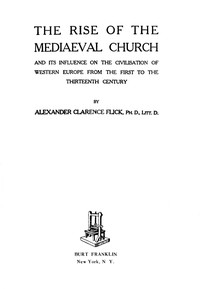
Alexander C. Flick’s work is a scholarly survey of the medieval Church’s development from its apostolic beginnings through the thirteenth century, presented as a single‑volume textbook rather than a theological treatise. The opening pages explain the author’s motivation: to fill a gap in college curricula where church history is often relegated to seminaries, and to provide a “simple account of the evolution of the old Church minus all theological and dogmatic discussions.” Flick outlines his method, emphasizing principal lines of development while minimizing subordinate influences, and lists the extensive research he conducted in European libraries, especially in Berlin, Rome, Paris, and London. The book is organized into clearly marked chapters, each with an outline that guides the reader through topics such as the rise of the papacy, monasticism, the Crusades, and the formation of the Holy Roman Empire, all supported by bibliographies and source notes.
The tone is that of an early‑20th‑century academic lecturer, formal yet accessible, with a focus on factual narrative over polemic. Its style reflects the era’s emphasis on systematic organization and exhaustive citation, making it a useful reference for students of medieval history, religious studies, or anyone interested in how ecclesiastical structures shaped Western civilization. Readers who appreciate a disciplined, source‑rich approach, particularly undergraduates, graduate students, and informed lay readers, will find Flick’s balanced, non‑doctrinal perspective both informative and engaging.