Public-domain ebook
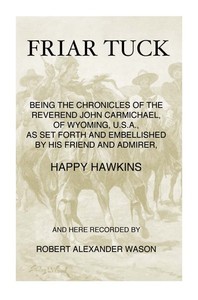
Friar Tuck Being the Chronicles of the Reverend John Carmichael, of Wyoming, U. S. A.
Language: en601 downloads on Project Gutenberg
Subjects
Public-domain ebook sourced from Project Gutenberg #41926.
Public-domain ebook
Language: en601 downloads on Project Gutenberg
Subjects
Public-domain ebook sourced from Project Gutenberg #41926.
The opening · free to read
Reviews are not infrequently colored by a temporary elevation of the critic’s mind (or a temporary depression of the critic’s liver), advertisements are not invariably free from bias; so, perhaps, a few words of friendly warning will not be considered impertinent.
Whosoever is squeamishly sensitive as to the formal technique of literary construction will save himself positive irritation by avoiding this book. It is a told, rather than a written story; and this is a compromise which defies Art and frankly turns to the more elastic methods of Nature.
It is supposed to be told by an outdoor man in those delightful moments of relaxation when the restraint of self-consciousness is dropped, and the spirit flows forth with a freedom difficult to find, outside the egoism of childhood. This general suggestion is easily tossed out; but the reader must supply the details—the night camps with the pipes sending up incense about the tiny fires, the winter evenings when the still cold lurks at the threshold or the blizzard howls around the log corners; or those still more elusive moments when the riding man shifts his weight to a single thigh, and tells the inner story which has been rising from his open heart to his closed lips for many a long mile.
Nor will these details suffice to complete the atmosphere in which, bit by bit, the story is told. The greatest charm in the told story comes direct from the teller; and, toil as we will over printed pages, they obstinately refuse to reproduce the twinkle of bright, deep-set eyes, the whimsical twist which gives character to a commonplace word, the subtile modulations of a mellow voice, the discriminating accent which makes a sentence fire when spoken, and only ashes when written; or, hardest of all, those eloquent pauses and illuminating gestures which convey a climax neither tongue nor pen dare attempt.
Happy Hawkins is complex, but the basic foundation of his character is simplicity. His audience is usually a mixed one, men of the range and an Easterner or two, fortunate enough to find the way into his confidence. Occasionally he amuses himself by talking to the one group over the heads of the other; but even then, his own simplicity is but thinly veiled. The phases of life which he holds lightly are exploited with riotous recklessness; but whoever would visit his private shrines must tread with reverent step.
His exaggerations are not to deceive, but to magnify—an adjunct to expression invariably found among primitive people. A brass monkey is really not sensitive to variations of temperature; and yet, even among the civilized, a peculiarly vivid impression is conveyed by stating that a particular cold snap has had a disintegrating effect upon the integrity of a brass monkey. There is a philosophy of exaggeration which is no kin to falsehood.
Happy has an eager, hungry, active mind, a mind worthy of careful cultivation; but forced by circumstances to gather its nourishment along lines similar to those adopted by the meek and lowly sponge. A sponge is earnest, patient, and industrious; but, fixed to a submerged stone as it is, it is hampered by limitations which no amount of personal ambition is quite able to overcome. As Happy himself was fond of saying: “The thing ’at sets most strangers again each other, is the fact that each insists on judgin’ everything from his own standpoint. A cow-puncher gets the idee that because an Eastener can’t sit comfortable on a bronco when it’s sunfishin’ or twistin’ ends, he jes nachely ain’t fit to clutter up the surface o’ the earth; while the Eastener is inclined to estimate the puncher an’ his pony as bein’ on the same intellectual level. If they’d just open up an’ examine each other impartial, they’d mighty soon see ’at the difference in ’em came from what they did, instead o’ the choice o’ their lines o’ business dependin’ on their natural make-up. I once had a no-account pinto which refused to squat back on the rope, and I rejoiced exceeding when I got seventy-five bucks for him; but the feller I took advantage of clipped his mane, docked his tail, introduced him into swell-society, and got three hundred for him as a polo pony; which all goes to show—” (The finish of this is an expansive wave of the hand, a tilt of the head to the right, and an indescribably droll expression.)
The above is a fair sample of the leisurely way in which Happy Hawkins tells a story. This is not the proper way to tell a story. A story should travel an air-line and not stop at the smaller stations, while Happy prefers to take his bed along on a spare horse and camp out wherever the mood strikes him. The reader who delights in a story which speeds along like a limited, will probably be disappointed in this book; while, on the other hand, the reader who enjoys the intimate association which is lighted with the evening camp fire, runs a risk of finding some relaxation in taking another little trip with Happy Hawkins.
R. A. W.
CONTENTS CHAPTER ONE—THE MEETING CHAPTER TWO—THE BETTIN’ BARBER O’ BOGGS CHAPTER THREE—ABOVE THE DUST CHAPTER FOUR—TY JONES CHAPTER FIVE—THE HOLD-UP CHAPTER SIX—A REMINISCENCE CHAPTER SEVEN—HORACE WALPOLE BRADFORD CHAPTER EIGHT—A CASE OF NERVES CHAPTER NINE—TREATING THE CASE CHAPTER TEN—INJUNS! CHAPTER ELEVEN—BENEFITS OF FASTING CHAPTER TWELVE—A COMPLETE CURE CHAPTER THIRTEEN—AN UNEXPECTED CACHE CHAPTER FOURTEEN—HAPPY’S NEW AMBITION CHAPTER FIFTEEN—TENDER FEELINGS CHAPTER SIXTEEN—THEMIS IN THE ROCKIES CHAPTER SEVENTEEN—KIT MURRAY CHAPTER EIGHTEEN—TESTING THE FRIAR’S NERVE CHAPTER NINETEEN—OTHER PEOPLE’S BUSINESS CHAPTER TWENTY—QUARRELING FOR PEACE CHAPTER TWENTY-ONE—PEACE TO START A QUARREL CHAPTER TWENTY-TWO—A PROGRESSIVE HUNT CHAPTER TWENTY-THREE—A LITTLE GUN-PLAY CHAPTER TWENTY-FOUR—NIGHT-PROWLERS CHAPTER TWENTY-FIVE—THE TRADE-RAT’S CHRISTMAS-GIFT CHAPTER TWENTY-SIX—A CONTESTED LIFE-TITLE CHAPTER TWENTY-SEVEN—A STRANGE ALLIANCE CHAPTER TWENTY-EIGHT—THE HEART OF HAPPY HAWKINS CHAPTER TWENTY-NINE—THE LITTLE TOWN OF BOSCO CHAPTER THIRTY—TY JONES GETS A WOMAN CHAPTER THIRTY-ONE—JUSTICE UNDELAYED CHAPTER THIRTY-TWO—THE FRIAR GOES ALONE CHAPTER THIRTY-THREE—THE FRIAR GIVEN TWO WEEKS CHAPTER THIRTY-FOUR—A CROSS FOR EVERY MAN CHAPTER THIRTY-FIVE—THE FRIAR A COMPLICATION CHAPTER THIRTY-SIX—A SIDE-TRIP TO SKELTY’S CHAPTER THIRTY-SEVEN—PROMOTHEUS IN THE TOILS CHAPTER THIRTY-EIGHT—OLAF RUNS THE BLOCKADE CHAPTER THIRTY-NINE—SKIRMISHES CHAPTER FORTY—AN IRRITATING GRIN CHAPTER FORTY-ONE—THE NIGHT-ATTACK CHAPTER FORTY-TWO—HAND TO HAND CHAPTER FORTY-THREE—THE GIFT OF THE DAWN CHAPTER FORTY-FOUR—TY JONES NODS HIS HEAD CHAPTER FORTY-FIVE—THE LITTLE GUST O’ WIND CHAPTER FORTY-SIX—THE FINAL MOVES
It’s a curious thing—life. Ya might just as well ask a kitten to chase her own tail or a dog to bay at the evenin’ star, or a periodical spring to run constant, as to ask a feller right out to tell a story. Some things can only be done spontaneous.
Friar Tuck used to say ’at whenever he could cut it, he allus got on the lee side o’ human nature and let it blow down on him natural; and my way o’ gettin’ to the lee side o’ human nature in story-tellin’ is not to ask for a story, but to start tellin’ one myself. And it’s a good plan not to put over too good a one either; ’cause if it seems as though a feller is short run on stories, some listener is likely to take pity on him and fit him out with a new assortment so as he won’t be such bad company for himself when he’s alone again. This is the way I’ve picked up most o’ my stories.
Then again, it’s allus hard for me to tell what is the true beginnin’ of a story. It’s easy enough to tell cream from milk—after the milk has stood long enough for the cream to rise to the top; but the great trouble is, that a man’s own recollections haven’t stood long enough for him to skim out just what part he might be in need of.
Without meanin’ the least mite o’ disrespect to any one, it does seem to me that if I was able to plan out any sort of a memory at all, I could have made a few improvements on the ones we now have.
My own memory is as stubborn as a mule and as grippy as a bulldog. What it does remember, it calls up in the shape o’ pictures; and I see old things just as plain as livin’, breathin’ beings; but try as I would, I never could keep my memory from loadin’ herself down with so many trifles that sometimes I’ve had to spade it over as many as six times to turn up some important item which I was actually in need of. When my memory’s in a good humor, I like to start a pipe and lean back and just watch old scenes over again, the same as if I was in a the-ater; and I can see every twinkle in a pair o’ well-known eyes, which have been lookin’ up through six feet of earth for this many a long year, and I can hear—actually hear—the half tones ripplin’ through voices which have no more part in my to-day than the perfume o’ last year’s flowers; and then, like as not, my memory’ll lay her ears back and refuse to confide what I did with my shavin’ soap.
When I look back at my own life and compare it with others, it seems like a curious, patch-worky sort of affair, and not much more my own than the lives o’ those others with which I compare it. I allus liked my work, and yet it never attracted my attention much. Side-trips and such-like stand out plain as figures in a hand-painted picture, such as I’ve seen in hotels down at Frisco; but the work part is just a blotchy, colorless sort of smudge, the same as the background o’ one o’ these pictures.
When I first took on with Jabez—every one called him ol’ Cast Steel Judson at this time—they wanted to know if I could ride. I was nothin’ but a regular kid then, so I handed in a purty high average as to my ridin’ ability; though, truth to tell, I wasn’t no bronco buster those days. They gave me a genuwine mean one as a starter, and told me to ride him clean or step off and walk.
At that time I didn’t even know how to discard a hoss when I couldn’t stand the poundin’ any longer; so when I felt my backbone gettin’ wedged too far into my skull, I made a grab for the horn. My luck was on the job that day and I got the quirt, instead. At his next pitch, my hand went up as natural as ever, and I slammed down the quirt as hard as I could. It landed on a ticklish spot and before he had time to make up his mind, the cayuse had started to run, me whalin’ him at every jump and givin’ thanks between ’em. I rode him good and out as soon as he started to stampede, and they all thought I was a real rider. Well, this gave me a lot o’ trouble—tryin’ to live up to my reputation—but that’s a good sort o’ trouble for a kid to have.
Now I can feel all the sensations o’ this ride as plain as though it was this mornin’; but the’s a thousand rides since then which have all melted an’ run together. The same with most o’ the rest o’ my work: I allus aimed to do my bit a little quicker and cleaner ’n the rest; but as soon as I learned all the tricks of it, it fell into a rut, like breathin’ and seein’. Easteners seem to have an idee that our life must be as carefree and joyous as goin’ to a different circus every day in the year; but it ain’t: it’s work, just like all other work. We’re a good bit like our ridin’ ponies: when we’re in the thick of it we’re too busy to take notice; and when we’re through, we’re hungry—and that’s about the whole story.
The book keeps going
Reading is free forever. Sign up and watch scenes appear while you read.



Scenes Storieta drew for other classics.
New illustrated classics
Once or twice a month: the latest books to get full character casts, scene art, and free comic editions. No account needed.