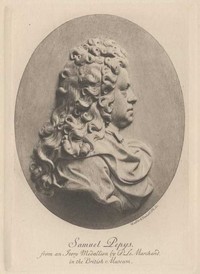
January 1st. Up, and all the morning in my chamber making up some accounts against this beginning of the new year, and so about noon abroad with my wife, who was to dine with W. Hewer and Willet at Mrs. Pierces, but I had no mind to be with them, for I do clearly find that my wife is troubled at my friendship with her and Knepp, and so dined with my Lord Crew, with whom was Mr. Browne, Clerk of the House of Lords, and Mr. John Crew. Here was mighty good discourse, as there is always: and among other things my Lord Crew did turn to a place in the Life of Sir Philip Sidney, wrote by Sir Fulke Greville, which do foretell the present condition of this nation, in relation to the Dutch, to the very degree of a prophecy; and is so remarkable that I am resolved to buy one of them, it being, quite throughout, a good discourse. Here they did talk much of the present cheapness of corne, even to a miracle; so as their farmers can pay no rent, but do fling up their lands; and would pay in corne: but, which I did observe to my Lord, and he liked well of it, our gentry are grown so ignorant in every thing of good husbandry, that they know not how to bestow this corne: which, did they understand but a little trade, they would be able to joyne together, and know what markets there are abroad, and send it thither, and thereby ease their tenants and be able to pay themselves. They did talk much of the disgrace the Archbishop is fallen under with the King, and the rest of the Bishops also. Thence I after dinner to the Duke of York's playhouse, and there saw "Sir Martin Mar-all;" which I have seen so often, and yet am mightily pleased with it, and think it mighty witty, and the fullest of proper matter for mirth that ever was writ; and I do clearly see that they do improve in their acting of it. Here a mighty company of citizens, 'prentices, and others; and it makes me observe, that when I begun first to be able to bestow a play on myself, I do not remember that I saw so many by half of the ordinary 'prentices and mean people in the pit at 2s. 6d. a-piece as now; I going for several years no higher than the 12d. and then the 18d. places, though, I strained hard to go in then when I did: so much the vanity and prodigality of the age is to be observed in this particular. Thence I to White Hall, and there walked up and down the house a while, and do hear nothing of anything done further in this business of the change of Privy-counsellors: only I hear that Sir G. Savile, one of the Parliament Committee of nine, for examining the Accounts, is by the King made a Lord, the Lord Halifax; which, I believe, will displease the Parliament. By and by I met with Mr. Brisband; and having it in my mind this Christmas to (do what I never can remember that I did) go to see the manner of the gaming at the Groome-Porter's, I having in my coming from the playhouse stepped into the two Temple-halls, and there saw the dirty 'prentices and idle people playing; wherein I was mistaken, in thinking to have seen gentlemen of quality playing there, as I think it was when I was a little child, that one of my father's servants, John Bassum, I think, carried me in his arms thither. I did tell Brisband of it, and he did lead me thither, where, after staying an hour, they begun to play at about eight at night, where to see how differently one man took his losing from another, one cursing and swearing, and another only muttering and grumbling to himself, a third without any apparent discontent at all: to see how the dice will run good luck in one hand, for half an hour together, and another have no good luck at all: to see how easily here, where they play nothing but guinnys, a L100 is won or lost: to see two or three gentlemen come in there drunk, and putting their stock of gold together, one 22 pieces, the second 4, and the third 5 pieces; and these to play one with another, and forget how much each of them brought, but he that brought the 22 thinks that he brought no more than the rest: to see the different humours of gamesters to change their luck, when it is bad, how ceremonious they are as to call for new dice, to shift their places, to alter their manner of throwing, and that with great industry, as if there was anything in it: to see how some old gamesters, that have no money now to spend as formerly, do come and sit and look on, as among others, Sir Lewis Dives, who was here, and hath been a great gamester in his time: to hear their cursing and damning to no purpose, as one man being to throw a seven if he could, and, failing to do it after a great many throws, cried he would be damned if ever he flung seven more while he lived, his despair of throwing it being so great, while others did it as their luck served almost every throw: to see how persons of the best quality do here sit down, and play with people of any, though meaner; and to see how people in ordinary clothes shall come hither, and play away 100, or 2 or 300 guinnys, without any kind of difficulty: and lastly, to see the formality of the groome-porter, who is their judge of all disputes in play and all quarrels that may arise therein, and how his under-officers are there to observe true play at each table, and to give new dice, is a consideration I never could have thought had been in the world, had I not now seen it. And mighty glad I am that I did see it, and it may be will find another evening, before Christmas be over, to see it again, when I may stay later, for their heat of play begins not till about eleven or twelve o'clock; which did give me another pretty observation of a man, that did win mighty fast when I was there. I think he won L100 at single pieces in a little time. While all the rest envied him his good fortune, he cursed it, saying, "A pox on it, that it should come so early upon me, for this fortune two hours hence would be worth something to me, but then, God damn me, I shall have no such luck." This kind of prophane, mad entertainment they give themselves. And so I, having enough for once, refusing to venture, though Brisband pressed me hard, and tempted me with saying that no man was ever known to lose the first time, the devil being too cunning to discourage a gamester; and he offered me also to lend me ten pieces to venture; but I did refuse, and so went away, and took coach and home about 9 or to at night, where not finding my wife come home, I took the same coach again, and leaving my watch behind me for fear of robbing, I did go back and to Mrs. Pierces, thinking they might not have broken up yet, but there I find my wife newly gone, and not going out of my coach spoke only to Mr. Pierce in his nightgown in the street, and so away back again home, and there to supper with my wife and to talk about their dancing and doings at Mrs. Pierces to-day, and so to bed.
2nd. Up, and with Sir J. Minnes by coach to White Hall, and there attended the King and the Duke of York in the Duke of York's lodgings, with the rest of the Officers and many of the Commanders of the fleete, and some of our master shipwrights, to discourse the business of having the topmasts of ships made to lower abaft of the mainmast; a business I understand not, and so can give no good account; but I do see that by how much greater the Council, and the number of Counsellors is, the more confused the issue is of their councils; so that little was said to the purpose regularly, and but little use was made of it, they coming to a very broken conclusion upon it, to make trial in a ship or two. From this they fell to other talk about the fleete's fighting this late war, and how the King's ships have been shattered; though the King said that the world would not have it that about ten or twenty ships in any fight did do any service, and that this hath been told so to him himself, by ignorant people. The Prince, who was there, was mightily surprised at it, and seemed troubled: but the King told him that it was only discourse of the world. But Mr. Wren whispered me in the eare, and said that the Duke of Albemarle had put it into his Narrative for the House, that not above twenty-five ships fought in the engagement wherein he was, but that he was advised to leave it out; but this he did write from sea, I am sure, or words to that effect: and did displease many commanders, among others, Captain Batts, who the Duke of York said was a very stout man, all the world knew; and that another was brought into his ship that had been turned out of his place when he was a boatswain, not long before, for being a drunkard. This the Prince took notice of, and would have been angry, I think, but they let their discourse fall: but the Duke of York was earnest in it. And the Prince said to me, standing by me, "God damn me, if they will turn out every man that will be drunk, they must turn out all the commanders in the fleete. What is the matter if he be drunk, so when he comes to fight he do his work? At least, let him be punished for his drunkenness, and not put out of his command presently." This he spoke, very much concerned for this idle fellow, one Greene. After this the King began to tell stories of the cowardice of the Spaniards in Flanders, when he was there, at the siege of Mardike and Dunkirke; which was very pretty, though he tells them but meanly. This being done I to Westminster Hall, and there staid a little: and then home, and by the way did find with difficulty the Life of Sir Philip Sidney (the book I mentioned yesterday). And the bookseller told me that he had sold four, within this week or two, which is more than ever he sold in all his life of them; and he could not imagine what should be the reason of it: but I suppose it is from the same reason of people's observing of this part therein, touching his prophesying our present condition here in England in relation to the Dutch, which is very remarkable. So home to dinner, where Balty's wife is come to town; she come last night and lay at my house, but being weary was gone to bed before I come home, and so I saw her not before. After dinner I took my wife and her girl out to the New Exchange, and there my wife bought herself a lace for a handkercher, which I do give her, of about L3, for a new year's gift, and I did buy also a lace for a band for myself, and so home, and there to the office busy late, and so home to my chamber, where busy on some accounts, and then to supper and to bed. This day my wife shows me a locket of dyamonds worth about L40, which W. Hewer do press her to accept, and hath done for a good while, out of his gratitude for my kindness and hers to him. But I do not like that she should receive it, it not being honourable for me to do it; and so do desire her to force him to take it back again, he leaving it against her will yesterday with her. And she did this evening force him to take it back, at which she says he is troubled; but, however, it becomes me more to refuse it, than to let her accept of it. And so I am well pleased with her returning it him. It is generally believed that France is endeavouring a firmer league with us than the former, in order to his going on with his business against Spayne the next year; which I am, and so everybody else is, I think, very glad of, for all our fear is, of his invading us. This day, at White Hall, I overheard Sir W. Coventry propose to the King his ordering of some particular thing in the Wardrobe, which was of no great value; but yet, as much as it was, it was of profit to the King and saving to his purse. The King answered to it with great indifferency, as a thing that it was no great matter whether it was done or no. Sir W. Coventry answered: "I see your Majesty do not remember the old English proverb, 'He that will not stoop for a pin, will never be worth a pound.'" And so they parted, the King bidding him do as he would; which, methought, was an answer not like a King that did intend ever to do well.