Public-domain ebook
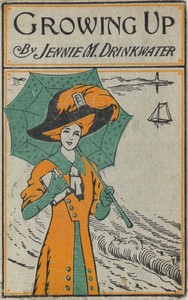
Growing Up: A Story of the Girlhood of Judith Mackenzie
Language: en523 downloads on Project Gutenberg
Subjects
Public-domain ebook sourced from Project Gutenberg #42408.
Public-domain ebook
Language: en523 downloads on Project Gutenberg
Subjects
Public-domain ebook sourced from Project Gutenberg #42408.
The opening · free to read
“I remember the lessons of childhood, you see, And the horn book I learned on my poor mother’s knee. In truth, I suspect little else do we learn From this great book of life, which so shrewdly we turn, Saving how to apply, with a good or bad grace, What we learned in the horn book of childhood.”
—Owen Meredith.
Judith’s mother sat in her invalid chair before the grate; she looked very pretty to Judith with her hair curling back from her face, and the color of her eyes and cheeks brought out by the becoming wrapper; the firelight shone upon the mother; the fading light in the west shone upon the girl in the bay-window, the yellow head, the blue shoulders bent over the letter she was writing.
“Judith, come and tell me pictures.”
About five o’clock in the afternoon, her mother’s weariest-time, Judith often told her mother pictures.
The picture-telling began when Judith was a little girl; one afternoon she said: “Mother, I’ll tell you a picture; shut your eyes.”
It was in this very room; her mother leaned back in her wheel-chair, lifted her feet to the fender, shut her eyes, and a small seven-year-old “told” her “picture.”
Telling pictures had been the amusement of the one, and the rest of the other, many, many weary times since.
As the child grew, her pictures grew.
“Yes, mother,” said the girl in the bay window, “I’ve just finished my letter; I’ve written Aunt Affy the longest letter and told her all you said.”
“Read it to me, please?”
Standing near the window to catch the light, Judith read aloud the letter.
At times it was quaint and unchildish; then, forgetting herself, Judith had run on with her ready pen, and, with pretty phrases, told Aunt Affy the exciting events in her own life, and the quiet story of her mother’s days.
“We are coming as soon as spring comes,” she ended, “mother is coming to get strong, and I am coming to help you and learn about your village. Beautiful Bensalem. Mother says I am learning the lessons taught out of school; but how I would like to go to school with Jean Draper in your big, queer school-room.” As she turned towards her mother, the firelight and the light in her face were all the lights in the room.
The home of these two people was in two rooms; one was the kitchen, the other was bed-room, school-room, parlor. It was a month since her mother had walked through the two rooms; several times a day Judith pushed the wheel-chair through the rooms. She called these times her mother’s excursions. Last winter her mother wiped dishes, sewed a little, and once she made cake; this winter she had done little besides teach Judith. The child was such an apt scholar that her mother said she needed no teacher—she always taught herself.
Judith loved housekeeping; she loved everything she had to do, she loved everything she was growing up to do; her mother she loved best of all.
She lived all day long in a very busy world; the pictures helped fill it.
“Now, mother, shut your eyes,” she began, gleefully.
The eyes shut themselves, the restless hands held themselves still; there would not be many more weary days, but Judith did not know that.
Judith waited a moment until she could think.
“Mother, how do pictures come?”
“Bring me that paper Don brought last night; I saw something to show you, then forgot it.”
Her mother turned the leaves of the paper and indicated the paragraph with her finger. Judith read it aloud:—
“Some years ago I chanced to meet Sir Noël Paton on the shores of a beautiful Scottish loch, all alone, with an open Bible in his hand. He put his finger between his pages, as he rose to greet me, and still kept it there as we talked. Supposing he might be devoting a quiet hour to devotional reading in the secluded spot, I made no remark on the nature of his studies; but after a few minutes he observed, with a glance downwards, ‘You see, I am getting a new picture.’ He then proceeded to explain that it was his habit, before settling down to his winter’s work, to walk about in the neighborhood of his summer residence, wherever that might be, with his Bible in his hand, seeking for an inspiration. Sometimes the inspiration came almost immediately; at others, he was weeks before he could please himself. The following spring appeared ‘The Good Shepherd,’ one of the finest of his works.”
Her mother made no remark; she often waited for Judith’s thought.
“I think Aunt Affy sees things through the Bible, mother,” said Judith, speaking her first thought.
“I know she does.”
“I see a face,” began the picture-teller, dropping down on the rug, and resting her head against the padded arm of the chair.
“You love faces,” was the quick response.
“And voices, and hands, and hair. This face I see is a good face—but, then, I do not often see ugly faces—the eyes tell the truth, the lips tell the truth; perhaps it isn’t a handsome face; the forehead is low, rather square, the eye-brows dark and heavy; the eyes underneath are a kind of grayish blue, not blue blue, like mine, and they are looking at me very seriously; the nose is quite a large nose, and the mouth large, too, with such splendid teeth; the upper lip is smooth, and the cheeks and chin all shaven; the hair is blackest black; now the eyes smile, and it looks like another face; I do not know which face I like better. What is the name of my picture?”
“Strong and true.”
“That is a good name,” said the picture-teller, satisfied, “and who is it?”
“Our dear Cousin Don,” was the reply with loving intonation.
“You always guess.”
“Because your pictures are so true. I like to look at people and places through your eyes.”
Judith smiled, and looking a moment into the fire, began again: “A fence, an old fence, and a terrace, not green, but rather dried up, then a lawn, with a horse-chestnut, a big, big horse-chestnut tree on each side the brick path, and then up three steps to a long piazza: the house is painted white, with white shutters instead of blinds, and there are three dormer windows in the roof; these windows make the third story. I wish I could see inside, but I never did. Perhaps I shall some day. ‘Some day’ is my fairyland, and may you be there to see. That day Cousin Don came to take me walking he took me past the place; he said some day when you could spare me longer he would take me in, he wanted me to see the brown girl who lives there; but there she stood on the piazza, the door was open and she was going in; she was a brown girl, all in brown with a brown hat and brown feather; a brown face too—I love browns; she happened to turn and she tossed a laugh down to Cousin Don. It was a pretty laugh, with something in it I didn’t understand; it was a laugh—that—didn’t—tell—everything. I told Don so. He said: ‘Nonsense!’ I don’t know what he meant.”
“That was Marion Kenney, and the old house on Summer Avenue,” guessed Judith’s mother, who knew the story of the brown girl from Don’s enthusiastic recitals.
Her mother’s voice was more rested; Judith pondered again.
“That was a city picture; this is a country picture. It is the beautiful, beautiful country, even if the grass is dead, and the trees bare; it is the February country in New Jersey; there are clouds, and clouds, and clouds overhead; and a brook with the sun shining on it, and a bridge with a stone wall on each side, a little bit of a stone wall, and stone arches where the water flows through; perhaps it rushes because the snow is melting so fast; there’s a garden with no flowers in it yet, but there are flower stalks, and bushes, and bushes; and a path up to the kitchen door, for the garden is down in a hollow; the kitchen shines, it is so clean, and smells, oh, how it does smell of graham bread, and hot molasses cake, and cup custards, and apple pie—but we can’t smell in a picture,” she laughed.
“I can—in your pictures,” said her mother, echoing the laugh very softly.
The book keeps going
Reading is free forever. Sign up and watch scenes appear while you read.



Scenes Storieta drew for other classics.
New illustrated classics
Once or twice a month: the latest books to get full character casts, scene art, and free comic editions. No account needed.