Public-domain ebook
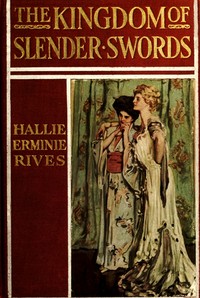
The Kingdom of Slender Swords
Language: en1,234 downloads on Project Gutenberg
Subjects
In: Bestsellers, American, 1895-1923·Novels
Public-domain ebook sourced from Project Gutenberg #42427.
Public-domain ebook
Language: en1,234 downloads on Project Gutenberg
Subjects
In: Bestsellers, American, 1895-1923·Novels
Public-domain ebook sourced from Project Gutenberg #42427.
The Kingdom of Slender Swords is a historical fiction set in Meiji‑era Japan, written by Hallie Erminie Rives. The opening chapter introduces Barbara, a twenty‑three‑year‑old American heiress, as she watches her ship approach the Japanese coast. Rives blends vivid travel description, the glittering sunrise over Mount Fuji, the bustling harbor, and the scent of camellias, with personal backstory about Barbara’s orphaned parents, her uncle the Episcopal bishop of Tokyo, and a hinted romantic entanglement with the enigmatic Austen Ware. The narrative promises a series of episodes, as indicated by the extensive chapter list, that will weave together personal drama, cultural observation, and the political atmosphere of early twentieth‑century Japan.
Rives writes in a richly descriptive, almost lyrical prose that reflects the turn‑of‑the‑century American literary taste for exotic settings and moral reflection. Her style is earnest and occasionally didactic, echoing contemporary travelogues that aimed to educate Western readers about the “Japanese spirit.” Readers who enjoy immersive period pieces, detailed cultural sketches, and stories that balance romance with historical insight will find this novel rewarding. It especially appeals to those fascinated by the interplay of East‑West relations during the Meiji period and the romanticized vision of Japan that captivated Western audiences at the time.
The opening · free to read
It has been my happy fortune to have made the acquaintance of the gifted author of this book. From time to time she was kind enough to confide to me its progress. When the manuscript was completed I was privileged to go over it, and the hours so spent were of unbroken interest and pleasure.
What especially touched and concerned me was, of course, the Japanese characters depicted, the motives of these actors in their respective roles, and other Japanese incidents connected with the story. I am most agreeably impressed with the remarkable insight into, and the just appreciation of, the Japanese spirit displayed by the author.
While the story itself is her creation, the local coloring, the moral atmosphere called in to weave the thread of the tale, are matters belonging to the domain of facts, and constitute an amount of useful and authentic information. Indeed, she has taken unusual pains to be correctly informed about the people of the country and their customs, and in this she has succeeded to a very eminent degree.
I may mention one or two of the striking characteristics of the work. The sacrifice of the girl Haru may seem unreal, but such is the dominant idea of duty and sacrifice with the Japanese, that in certain emergencies it is not at all unlikely that we should behold her real prototype in life. The description of the Imperial Review at Tokyo and its patriotic significance vividly recalls my own impression of this spectacle.
It gives me great satisfaction to know that by perusing these pages, the vast reading public, who, after all, have the decisive voice in the national government of the greatest republic of the world, and whose good will and friendship we Japanese prize in no uncommon degree, should be correctly informed about ourselves, as far as the scope of this book goes. We attach great importance to a thorough mutual understanding of two foremost peoples on the Pacific, in whose direction and coöperation the future of the East must largely depend. It is, therefore, incumbent upon us all to do our utmost to cultivate such good understanding, not only for those immediately concerned, but for the welfare of the whole human race.
In the chapters of this novel the author seems always to have had such high ideals before her, and the result is that, besides being an exciting and agreeable reading, the book contains elements of serious and instructive consideration, which can not but contribute toward establishing better and healthier knowledge between the East and West of the Pacific.
N. MAKINO.
Sendagaya, Tokyo, 9th of August, 1909.
The book keeps going
Reading is free forever. Sign up and watch scenes appear while you read.



Scenes Storieta drew for other classics.
New illustrated classics
Once or twice a month: the latest books to get full character casts, scene art, and free comic editions. No account needed.