Public-domain ebook
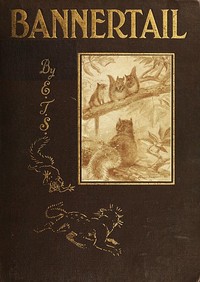
Bannertail: The Story of a Graysquirrel
Language: en402 downloads on Project Gutenberg
Subjects
In: Children & Young Adult Reading·Adventure·Novels
Public-domain ebook sourced from Project Gutenberg #42827.
Public-domain ebook
Language: en402 downloads on Project Gutenberg
Subjects
In: Children & Young Adult Reading·Adventure·Novels
Public-domain ebook sourced from Project Gutenberg #42827.
The opening · free to read
IT was a rugged old tree standing sturdy and big among the slender second-growth. The woodmen had spared it because it was too gnarled and too difficult for them to handle. But the Woodpecker, and a host of wood-folk that look to the Woodpecker for lodgings, had marked and used it for many years. Its every cranny and borehole was inhabited by some quaint elfin of the woods; the biggest hollow of all, just below the first limb, had done duty for two families of the Flickers who first made it, and now was the homing hole of a mother Graysquirrel.
She appeared to have no mate; at least none was seen. No doubt the outlaw gunners could have told a tale, had they cared to admit that they went gunning in springtime; and now the widow was doing the best she could by her family in the big gnarled tree. All went well for a while, then one day, in haste maybe, she broke an old rule in Squirreldom; she climbed her nesting tree openly, instead of going up its neighbor, and then crossing to the den by way of the overhead branches. The farm boy who saw it, gave a little yelp of savage triumph; his caveman nature broke out. Clubs and stones were lying near, the whirling end of a stick picked off the mother Squirrel as she tried to escape with a little one in her mouth. Had he killed two dangerous enemies the boy could not have yelled louder. Then up the tree he climbed and found in the nest two living young ones. With these in his pocket he descended. When on the ground he found that one was dead, crushed in climbing down. Thus only one little Squirrel was left alive, only one of the family that he had seen, the harmless mother and two helpless, harmless little ones dead in his hands.
Why? What good did it do him to destroy all this beautiful wild life? He did not know. He did not think of it at all. He had yielded only to the wild ancestral instinct to kill, when came a chance to kill, for we must remember that when that instinct was implanted, wild animals were either terrible enemies or food that must be got at any price.
The excitement over, the boy looked at the helpless squirming thing in his hand, and a surge of remorse came on him. He could not feed it; it must die of hunger. He wished that he knew of some other nest into which he might put it. He drifted back to the barn. The mew of a young Kitten caught his ear. He went to the manger. Here was the old Cat with the one Kitten that had been left her of her brood born two days back. Remembrance of many Field-mice, Chipmunks and some Squirrels killed by that old green-eyed huntress, struck a painful note. Yes! No matter what he did, the old Cat would surely get, kill, and eat the orphan Squirrel.
Then he yielded to a sudden impulse and said: "Here it is, eat it now." He dropped the little stranger into the nest beside the Kitten. The Cat turned toward it, smelled it suspiciously once or twice, then licked its back, picked it up in her mouth, and tucked it under her arm, where half an hour later the boy found it taking dinner alongside its new-found foster-brother, while the motherly old Cat leaned back with chin in air, half-closed eyes and purring the happy, contented purr of mother pride. Now, indeed, the future of the Foundling was assured.
LITTLE Graycoat developed much faster than his Kitten foster-brother. The spirit of play was rampant in him, he would scramble up his mother's leg a score of times a day, clinging on with teeth, arms and claws, then mount her back and frisk along to climb her upright tail; and when his weight was too much, down the tail would droop, and he would go merrily sliding off the tip to rush to her legs and climb and toboggan off again. The Kitten never learned the trick. But it seemed to amuse the Cat almost as much as it did the Squirrelet, and she showed an amazing partiality for the lively, long-tailed Foundling. So did others of importance, men and women folk of the farmhouse, and neighbors too. The frisky Graycoat grew up amid experiences foreign to his tastes, and of a kind unknown to his race.
The Kitten too grew up, and in midsummer was carried off to a distant farmhouse to be "their cat."
Now the Squirrel was over half-grown, and his tail was broadening out into a great banner of buff with silver tips. His life was with the old Cat; his food was partly from her dish. But many things there were to eat that delighted him, and that pleased her not. There was corn in the barn, and chicken-feed in the yard, and fruit in the garden. Well-fed and protected, he grew big and handsome, bigger and handsomer than his wild brothers, so the house-folk said. But of that he knew nothing; he had never seen his own people. The memory of his mother had faded out. So far as he knew, he was only a bushy-tailed Cat. But inside was an inheritance of instincts, as well as of blood and bone, that would surely take control and send him herding, if they happened near, with those and those alone of the blowsy silver tails.
IN the Hunting-moon it came, just when the corn begins to turn, and in the dawn, when Bannertail Graycoat was yielding to the thrill that comes with action, youth and life, in dew-time.
There was a growing, murmuring sound, then smoke from the barn, like that he had seen coming from the red mystery in the cook-house. But this grew very fast and huge; men came running, horses frantically plunging hurried out, and other living things and doings that he did not understand. Then when the sun was high a blackened smoking pile there was where once had stood the dear old barn; and a new strange feeling over all. The old Cat disappeared. A few days more and the house-folk, too, were gone. The place was deserted, himself a wildwood roving Squirrel, quite alone, without a trace of Squirrel training, such as example of the old ones gives, unequipped, unaccompanied, unprepared for the life-fight, except that he had a perfect body, and in his soul enthroned, the many deep and dominating instincts of his race.
THE break was made complete by the Red Horror, and the going of the man-people. Fences and buildings are good for some things, but the tall timber of the distant wooded hill was calling to him and though he came back many a time to the garden while there yet was fruit, and to the field while the corn was standing, he was ever more in the timber and less in the open.
Food there was in abundance now, for it was early autumn; and who was to be his guide in this: "What to eat, what to let alone?" These two guides he had, and they proved enough: instinct, the wisdom inherited from his forebears, and his keen, discriminating nose.
Scrambling up a rotten stub one day, a flake of bark fell off, and here a-row were three white grubs; fat, rounded, juicy. It was instinct bade him seize them, and it was smell that justified the order; then which, it is hard to say, told him to reject the strong brown nippers at one end of each prize. That day he learned to pry off flakes of bark for the rich foodstuffs lodged behind.
At another time, when he worked off a slab of bark in hopes of a meal, he found only a long brown millipede. Its smell was earthy but strange, its many legs and its warning feelers, uncanny. The smell-guide seemed in doubt, but the inborn warden said: "Beware, touch it not." He hung back watching askance, as the evil thing, distilling its strange pestilent gas, wormed Snake-like out of sight, and Bannertail in a moment had formed a habit that was of his race, and that lasted all his life. Yea, longer, for he passed it on--this: Let the hundred-leggers alone. Are they not of a fearsome poison race?
Thus he grew daily in the ways of woodlore. He learned that the gum-drops on the wounded bark of the black birch are good to eat, and the little faded brown umbrella in the woods is the sign that it has a white cucumber in its underground cellar; that the wild bees' nests have honey in them, and grubs as good as honey; but beware, for the bee has a sting! He learned that the little rag-bundle babies hanging from vine and twig, contain some sort of a mushy shell-covered creature that is amazingly good to eat; that the little green apples that grow on the oaks are not acorns, and are yet toothsome morsels of the lighter sort, while nearly every bush in the woods at autumn now had strings of berries whose pulp was good to eat and whose single inside seed was as sweet as any nut. Thus he was learning woodcraft, and grew and prospered, for outside of sundry Redsquirrels and Chipmunks there were few competitors for this generous giving of the Woods.
THERE are certain stages of growth that are marked by changes which, if not sudden, are for a time very quick, and the big change in Bannertail, which took place just as he gave up the tricks and habits learned from his Cat-folk, and began to be truly a Squirrel, was marked by the fluffing of his tail. Always long and long-haired, it was a poor wisp of a thing until the coming of the Hunting-moon. Then the hairs grew out longer and became plumy, then the tail muscles swelled and worked with power. Then, too, he began a habit of fluffing out that full and flaunting plume every few minutes. Once or twice a day he combed it, and ever he was most careful to keep it out of wet or dirt. His coat might be stained with juice of fruit or gum of pine, and little he cared; but the moment a pine drop or a bit of stick, moss, or mud clung to his tail he stopped all other work to lick, clean, comb, shake, fluff and double-fluff that precious, beautiful member to its perfect fulness, lightness, and plumy breadth.
Why? What the trunk is to the elephant and the paw to the monkey, the tail is to the Graysquirrel. It is his special gift, a vital part of his outfit, the secret of his life. The 'possum's tail is to swing by, the fox's tail for a blanket wrap, but the Squirrel's tail is a parachute, a "land-easy"; with that in perfect trim he can fall from any height in any tree and be sure of this, that he will land with ease and lightness, and on his feet.
This thing Bannertail knew without learning it. It was implanted, not by what he saw in Kitten days, or in the woods about, but by the great All-Mother, who had builded up his athlete form and blessed him with an inner Guide.
THAT year the nut crop was a failure. This was the off-year for the red oaks; they bear only every other season. The white oaks had been nipped by a late frost. The beech-trees were very scarce, and the chestnuts were gone--the blight had taken them all. Pignut hickories were not plentiful, and the very best of all, the sweet shag-hickory, had suffered like the white oaks.
October, the time of the nut harvest, came. Dry leaves were drifting to the ground, and occasional "thumps" told of big fat nuts that also were falling, sometimes of themselves and sometimes cut by harvesters; for, although no other Graysquirrel was to be seen, Bannertail was not alone. A pair of Redsquirrels was there and half a dozen Chipmunks searching about for the scattering precious nuts.
The book keeps going
Reading is free forever. Sign up and watch scenes appear while you read.



Scenes Storieta drew for other classics.
New illustrated classics
Once or twice a month: the latest books to get full character casts, scene art, and free comic editions. No account needed.