Public-domain ebook
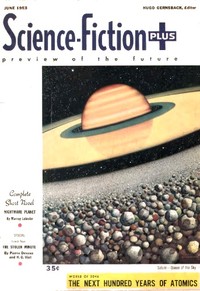
Nightmare Planet
Language: en346 downloads on Project Gutenberg
Subjects
In: Science Fiction·Science-Fiction & Fantasy·Adventure
Public-domain ebook sourced from Project Gutenberg #42987.
Public-domain ebook
Language: en346 downloads on Project Gutenberg
Subjects
In: Science Fiction·Science-Fiction & Fantasy·Adventure
Public-domain ebook sourced from Project Gutenberg #42987.
The opening · free to read
The Directory-ship Tethys made the first landing on the planet, L216^{12}. It was a goodly world, with an ample atmosphere and many seas, which the nearby sun warmed so lavishly that a perpetual cloud-bank hid them and all the solid ground from view. It had mountains and islands and high plateaus. It had day and night and rain. It had an equable climate, rather on the tropical side. But it possessed no life.
No animals roamed its solid surface. No vegetation grew from its rocks. Not even bacteria struggled with the stones to turn them into soil. No living thing, however small, swam in its oceans. It was one of that disappointing vast majority of otherwise admirable worlds which was unsuited for colonization solely because it had not been colonized before. It could be used for biological experiments in a completely germ-free environment, or ships could land upon it for water and supplies of air. The water was pure and the air breathable, but it had no other present utility. Such was the case with an overwhelming number of Earth-type planets when first discovered in the exploration of the galaxy. Life simply hadn't started there.
So the ship which first landed upon it made due note for the Galactic Directory and went away, and no other ship came near the planet for eight hundred years.
But nearly a millennium later, the Seed-Ship Orana arrived. It landed and carefully seeded the useless world. It circled endlessly above the clouds, dribbling out a fine dust comprised of the spores of every conceivable microorganism that could break down rock to powder and turn the powder to organic matter. It also seeded with moulds and fungi and lichens, and everything that could turn powdery primitive soil into stuff on which higher forms of life could grow. The Orana seeded the seas with plankton. Then it, too, went away.
Centuries passed. Then the Ecological Preparation Ship Ludred swam to the planet from space. It was a gigantic ship of highly improbable construction and purpose. It found the previous seeding successful. Now there was soil which swarmed with minute living things. There were fungi which throve monstrously. The seas stank of teeming minuscule life-forms. There were even some novelties on land, developed by strictly local conditions. There were, for example, paramecium as big as grapes, and yeasts had increased in size so that they bore flowers visible to the naked eye. The life on the planet was not aboriginal, though. It had all been planted by the seed-ship of centuries before.
The Ludred released insects, it dumped fish into the seas. It scattered plant-seeds over the continents. It treated the planet to a sort of Russell's Mixture of living things. The real Russell's Mixture is that blend of simple elements in the proportions found in suns. This was a blend of living creatures, of whom some should certainly survive by consuming the now habituated flora, and others which should survive by preying on the first. The planet was stocked, in effect, with everything it could be hoped might live there.
But at the time of the Ludred's visit of course no creature needing parental care had any chance of survival. Everything had to be able to care for itself the instant it burst its egg. So there were no birds or mammals. Trees and plants of divers sorts, and fish and crustaceans and insects could be planted. Nothing else.
The Ludred swam away through emptiness.
There should have been another planting, centuries later still, but it was never made. When the Ecological Preparation Service was moved to Algol IV, a file was upset. The cards in it were picked up and replaced, but one was missed. So that planet was forgotten. It circled its sun in emptiness. Cloud-banks covered it from pole to pole. There were hazy markings in certain places, where high plateaus penetrated the clouds. But from space the planet was featureless. Seen from afar, it was merely a round white ball--white from its cloud-banks and nothing else.
But on its surface, in its lowlands it was nightmare.
Especially was it nightmare--after some centuries--for the descendants of the human beings from the space-liner Icarus, wrecked there some forty-odd generations ago. Naturally, nobody anywhere else thought of the Icarus any more. It was not even remembered by the descendants of its human cargo, who now inhabited the planet. The wreckage of the ship was long since hidden under the seething, furiously striving fungi of the boil. The human beings on the planet had forgotten not only the ship but very nearly everything--how they came to this world, the use of metals, the existence of fire, and even the fact that there was such a thing as sunlight. They lived in the lowlands, deep under the cloud-bank, amid surroundings which were riotous, swarming, frenzied horror. They had become savages. They were less than savages. They had forgotten their high destiny as men.
Dawn came. Grayness appeared overhead and increased. That was all. The sky was a blank, colorless pall, merely mottled where the clouds clustered a little thicker or a little thinner, as clouds do. But the landscape was variegated enough! Where the little group of people huddled together, there was a wide valley. Its walls rose up and up into the very clouds. The people had never climbed those hillsides.
They had not even traditions of what might lie above them, and their lives had been much too occupied to allow of speculations on cosmology. By day they were utterly absorbed in two problems which filled every waking minute. One was the securing of food to eat, under the conditions of the second problem, which was that of merely staying alive.
There was only one of their number who sometimes thought of other matters, and he did so because he had become lost from his group of humans once, and had found his way back to it. His name was Burl, and his becoming lost was pure fantastic accident, and his utilization of a fully inherited power to think was the result of extraordinary events. But he still had not the actual habit of thinking. This morning he was like his fellows.
All of them were soaked with wetness. During the night--every night--the sky dripped slow, spaced, solemn water-drops during the whole of the dark hours. This was customary. But normally the humans hid in the mushroom-forests, sheltered by the toadstools which now grew to three man-heights. They denned in small openings in the tangled mass of parasitic growths which flourished in such thickets. But this last night they had camped in the open. They had no proper habitations of their own. Caves would have been desirable, but insects made use of caves, and the descendants of insects introduced untold centuries before had shared in the size-increase of paramecium and yeasts and the few true plants which had been able to hold their own. Mining-wasps were two yards long, and bumble-bees were nearly as huge, and there were other armored monstrosities which also preferred caves for their own purposes. And of course the humans could not build habitations, because anything men built to serve the purpose of a cave would instantly be preempted by creatures who would automatically destroy any previous occupants.
The humans had no fixed dens at any time. Now they had not even shelter. They lacked other things, also. They had no tools save salvaged scraps of insect-armor--great sawtoothed mandibles or razor-pointed leg-shells--which they used to pry apart the edible fungi on which they lived, or to get at the morsels of meat left behind when the brainless lords of this planet devoured each other. They had not even any useful knowledge, except desperately accurate special knowledge of the manners and customs of the insects they could not defy. And on this special morning they concluded that they were doomed. They were going to be killed. They stood shivering in the open, waiting for it to happen.
It was not exactly news. They had had warning days ago, but they could do nothing about it. Their home valley, to be sure, would have made any civilized human being shudder merely to look at it, but they had considered it almost paradise. It was many miles long, and a fair number wide, and a stream ran down its middle. At the lower end of the valley there was a vast swamp, from which at nightfall the thunderously deep-bass croaking of giant frogs could be heard. But that swamp had kept out the more terrifying creatures of that world. The thirty-foot centipedes could not cross it or did not choose to. The mastodon-sized tarantulas which ravaged so much of the planet would not cross it save in pursuit of prey. So the valley was nearly a haven of safety.
True, there was one clotho spider in its ogre's castle nearby, and there was a labyrinth spider in a minor valley which nobody had ever ventured into, and there were some--not many--praying-mantises as tall as giraffes. They wandered terribly here and there. But most members of insect life here were absorbed in their own affairs and ignored the humans. There was an ant-city, whose foot-long warriors competed with the humans as scavengers. There were the bees, trying to eke out a livelihood from the great, cruciform flowers of the giant cabbage-plants and the milkweeds when water-lilies in the swamps did not bear their four-foot blooms. Wasps sought their own prey. Flies were consumers of corruption, but even the flies two feet in length would shy away from a man who waved his arms at it. So this valley had seemed to these people to be a truly admirable place.
But a fiend had entered it. As the gray light grew stronger the shivering folk looked terrifiedly about them. There were only twenty of the people now. Two weeks before there had been thirty. In a matter of days or less, there would be none. Because the valley had been invaded by a great gray furry spider!
There was a stirring, not far from where the man-folk trembled. Small, inquisitive antennae popped into view among a mass of large-sized pebbles. There was a violent stirring, and gravel disappeared. Small black things thrust upward into view and scurried anxiously about. They returned to the spot from which they had emerged. They were ants, opening the shaft of their city after scouting for danger outside. They scratched and pulled and tugged at the plug of stones. They opened the ant-city's artery of commerce. Strings of small black things came pouring out. They averaged a foot in length, and they marched off in groups upon their divers errands. Presently a group of huge-jawed soldier-ants appeared, picking their way stolidly out of the opening. They waited stupidly for the workers they were to guard. The workers came, each carrying a faintly greenish blob of living matter. The caravan moved off. The humans knew exactly what it was. The green blobs were aphids--plant lice: ant-cows--small creatures sheltered and guarded by the ants and daily carried to nearby vegetation to feed upon its sap and yield inestimable honeydew.
Something reared up two hundred yards away, where the thin mist that lay everywhere just barely began to fade all colorings before it dimmed all outlines. The object was slender. It had a curiously humanlike head. It held out horrible sawtoothed arms in a gesture as of benediction--which was purest mockery. Something smaller was drawing near to it. The colossal praying mantis held its pose, immovable. Presently it struck downward with lightning speed. There was a cry. The mantis rose erect again, its great arms holding something that stirred and struggled helplessly, and repented its unconsonanted outcry. The mantis ate it daintily as it struggled and screamed.
The book keeps going
Reading is free forever. Sign up and watch scenes appear while you read.



Scenes Storieta drew for other classics.
New illustrated classics
Once or twice a month: the latest books to get full character casts, scene art, and free comic editions. No account needed.