Public-domain ebook
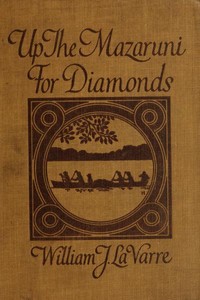
Up the Mazaruni for Diamonds
Language: en415 downloads on Project Gutenberg
Subjects
Public-domain ebook sourced from Project Gutenberg #43051.
Public-domain ebook
Language: en415 downloads on Project Gutenberg
Subjects
Public-domain ebook sourced from Project Gutenberg #43051.
The opening · free to read
"_ARE YOU GAME TO TRY IT?_"
"Here's a queer looking letter," I said to myself one day early in the spring of 1917. I could hardly make out the postmark. It was something of a surprise to receive a letter from British Guiana, as I finally deciphered it, but the contents were even more surprising.
The letter was from my friend Dudley P. Lewis.
"I need a partner in a diamond mining venture," he wrote. "Are you game to try it out with me? It will be a long trip full of adventures and dangers, but there are diamonds here to be had for the digging."
He wrote much more. I became enthusiastic on the moment and was determined to go if possible. I had little trouble in arranging this and wrote him that I would come.
On the tenth of May I sailed from New York on the steamship Saga to Barbados, where Lewis met me. He was delighted and quite as enthusiastic as I. He had been in Georgetown, British Guiana, for a while on other business and had learned about the diamond fields away up the famous, and treacherous, Mazaruni River.
From Barbados we sailed away to South America on the steamer Parima. I was surprised to find Georgetown such a large city, 60,000 inhabitants, and, as the buildings were all one and two stories, one can imagine how it spread out.
"Can we start to-morrow?" I asked, after we had reached our hotel. Lewis laughed.
"Hardly," he said. "This isn't like a trip back home where you can toss some clothes and clean collars in a bag, buy your ticket, catch your train and be off."
I had not given much thought to exactly how we were to travel. But I soon learned that to journey up a great river for hundreds of miles with a score of natives, taking all the food for a six months' stay, was a matter that could not be arranged in a moment.
The starting out place for the trip was twenty miles from Georgetown at a town upriver called Bartica. But as Bartica has only twenty inhabitants we bought everything in Georgetown. There we busied ourselves with the preparations. It seemed as though there were a million details to look after, and I got an idea of what an explorer is up against, as we had to outfit ourselves about the same as an exploring party would.
"We must get lead guns, beads, mirrors and other trinkets," said Lewis.
"What's the big idea?" I asked. "Are we to open a five and ten cent store for the native Indians up there?"
"Not exactly," laughed Lewis, "but we must have something to trade with. What use is a silver or gold coin to a native back hundreds of miles in the jungle? He'd rather have a twenty-five cent kitchen knife than a fifty dollar gold piece."
The "lead guns" are not lead, as I learned, but the very cheapest sort of cheap guns, manufactured in England solely for trading with semi-civilized and uncivilized people. No live American boy would take one as a gift, but I found that the natives treasured them above everything else they possessed.
We were fortunate in finding a Dutch captain, a man who has navigated the turbulent waters of the Mazaruni for twenty years. And he picked out a skilled "bowman," a native who stands at the bow of your boat, with an immense paddle, and fends it off rocks, gives steering directions and acts generally as a sort of life preserver for the boat.
Then there was "Jimmy." He was a negro, rather undersized and as black as the inside of a lump of coal. He appointed himself our special guardian, a sort of valet, overseer and servant. He looked after our personal belongings, cooked our food, made our tea and devoted himself exclusively to us.
Twenty paddlemen were also engaged. Sixteen of them were quite as black as our Jimmy, and four of them were in varying shades from tobacco brown to light molasses candy tint. These latter were of mixed Dutch and Negro blood.
"They are 'Bovianders,'" said the captain.
"Queer tribal name," I commented.
The captain laughed. "Not exactly a tribal name," he explained. "They live up the river quite a distance and so it is said that they come from 'above yonder.' They have twisted that into 'Boviander,' so that the word always means people who live up the river."
While we were engaging our staff the captain was getting boats for us. He selected a great fifty-foot boat seemingly as heavy as a locomotive. It looked like a crude craft, made of great thick planks. I soon learned the necessity of such a heavy boat. We also had a small boat for emergency and for little side trips here and there.
Next came the "eats." We had to take enough food for ourselves, our twenty-two helpers and partly enough for the native Indians that we were to employ later. When the big boat was finally loaded properly under the skillful direction of the captain, we had five tons of food aboard and this included no meat at all except salt fish. There was no need to take meat, for game and fresh fish were so plentiful that we were never without them.
There was a queer, tent-shaped rig amidships of our big craft. Beneath this was room enough for us to stay sheltered during the heat of the day. White men can seldom stand the midday heat in British Guiana.
Packed all about us was the food. Jimmy climbed to the top of the pile. The captain took his position aft. The sturdy Boviander bowman took his place at the bow with his immense paddle, the twenty paddle men took their places in four groups of five, one group on each side, forward and aft of the cargo.
Then they shoved off and began their peculiar, noisy paddling.
The little town of Bartica fell away behind us as we slid out into the broad expanse of the old Mazaruni.
We were off at last, on our great diamond mining adventure!
Eagerly I scanned the waters and either shore, determined that nothing should escape me, that I should see everything and enjoy all that there was to be enjoyed.
The captain sat, complacently smoking, at the stern of the boat, the great steering paddle, tied to the stern with thongs, in his hands. He looked as bored as if crossing the street to buy an evening paper. How could he, when there was such glorious adventure, I wondered. But afterwards I realized that twenty years of navigating the river had somewhat dulled the novelty of it for him. With him it was work, and nothing more.
To a boy used to paddling our own style of light canoes, the paddling methods of those black men seemed the most awkward in the world. Yet they "got there," and I doubt if any crew of white men, without years of practice, could have propelled the heavy craft as easily as they. Their method was to bend forward, holding the paddle horizontally and sliding it along the gunwale with a loud scraping noise, then suddenly lean over sidewise and dig the paddle viciously into the water, giving a sturdy backward tug with it, still scraping the paddle against the gunwales. At the end of this stroke they returned the paddle to the horizontal position with a loud thumping noise, sat up straight, then leaned forward and repeated the stroke.
They kept perfect time. No varsity crew boys ever worked in unison at the oars any better, and they were forever singing. It didn't matter whether they were paddling twenty feet across a narrow inlet or making an all day pull upstream, they always had music with their paddling.
They were crude songs, partly English that was scarcely understandable, partly native dialect and partly something else that may have been handed down to them from their ancestors who were captured in Africa so many generations ago and brought over by the early Dutch and English slave traders.
If the water was smooth and open, with no current, our twenty paddle men would sing as softly as the whispering of a summer breeze. But if there was a current they would sing louder. And the more difficult the paddling, the louder they would sing. In boiling rapids where it took every ounce of their strength and they had to take quick, short strokes to keep going, their voices arose to an almost howling crescendo.
Soon Bartica was lost to view around a point of land. For nearly six months we were to see no more civilization than Indian villages here and there, hidden far back from the river bank. As we swung up into the broad river where the current became strong enough to cause the paddlers to use a little extra "elbow grease" they broke into a queer song which I heard so many times after that, that it still rings in my ears. I cannot translate it. I do not know what it means, but imagine that it is some sort of love song to some dusky "Lena." This is the way it sounds:
"_San, Lena, chile, I do love yo'; Me know so, hear so, yes! Le, le, le, le, le, le, Blow, ma booly boy, blow! Califo 'ge 'ole! Splenty o'gol's for A've been tol' I' th' lan' o' Mazaruni!_"
We came in sight of another boat. On the Mazaruni every boat one sees that is going in the same direction is an "adversary" and every paddler believes that it is his duty to pass it. Then you see some fancy paddle strokes, so weird and unusual and grotesque that they are difficult to describe. One would think that they were trying more to awe each other with their paddle gesticulations than with speed. How they race upstream, each determined to get and keep the lead! The captain told me that many lives were lost at rapids because the racing paddlers would give thought only to getting into the narrow passes first and were frequently crashed upon the rocks and overturned.
Not far from the little town is Kalacoon, the biological station where at various times Professor Beebe and the other scientists take up their intimate studies of tropical life. This station is on a high hill where the Mazaruni and Essequibo Rivers join. It was at this place that Colonel Roosevelt stopped when he visited the colony.
From this point the vegetation on both sides of the river became so dense that it seemed almost like greenish-black solid walls. No huts or signs of human life were visible at first. But finally, with sharp eyes, we got so we could detect a slight opening, a log landing at the water's edge or a faint suggestion of a thatched hut in back of the shore row of trees.
It would have been fearfully monotonous but for the fact that Lewis and I devised a new sort of game--to see which one could detect the greater number of signs of human habitation. Our natives, with sharper eyes, would verify our discoveries. All this was in the Boviander section, where the natives come down from "'Bove yonder." Just before nightfall we reached the foot of the first falls and landed to make camp for the night.
The book keeps going
Reading is free forever. Sign up and watch scenes appear while you read.



Scenes Storieta drew for other classics.
New illustrated classics
Once or twice a month: the latest books to get full character casts, scene art, and free comic editions. No account needed.