Public-domain ebook
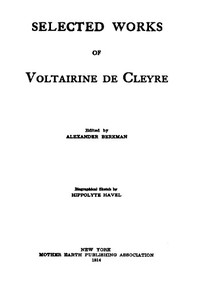
Selected Works of Voltairine de Cleyre
Language: en13,430 downloads on Project Gutenberg
Subjects
In: Biographies·Essays, Letters & Speeches·Philosophy & Ethics
Public-domain ebook sourced from Project Gutenberg #43098.
Public-domain ebook
Language: en13,430 downloads on Project Gutenberg
Subjects
In: Biographies·Essays, Letters & Speeches·Philosophy & Ethics
Public-domain ebook sourced from Project Gutenberg #43098.
Selected Works of Voltairine de Cleyre gathers the writings of one of America’s most outspoken anarchist feminists, presenting a portrait of a life forged in the crucible of post‑Civil War upheaval. The volume opens with a fervent tribute that frames de Cleyre as a “being devoid of sham, uncompromising, and to whom the truth is sacred,” before moving into a concise biography that traces her birth in 1866, a harsh convent education, and the pivotal moments that turned a gifted poet into a tireless activist. The editor explains that while the full correspondence of this prolific letter‑writer cannot be included, the selected essays, poems, and speeches that follow illustrate her evolving struggle for liberty, labor rights, and gender equality.
De Cleyre’s voice is unmistakably that of a late‑nineteenth‑century polemicist: sharp, impassioned, and unafraid to blend personal narrative with political theory. Her prose oscillates between lyrical poetry and incisive essays, reflecting both the Romantic influences of her youth and the gritty realism of her anarchist convictions. Readers interested in the history of American radical thought, early feminist advocacy, or the raw energy of turn‑of‑the‑century social movements will find her work both intellectually stimulating and emotionally resonant.
The opening · free to read
What could be added to this splendid tribute by Jay Fox to the memory of =Voltairine de Cleyre=? These admirable words express the sentiments of all the friends and comrades of that remarkable woman whose whole life was dedicated to a dominant idea.
Like many other women in public life, =Voltairine de Cleyre= was a voluminous letter writer. Those letters addressed to her comrades, friends, and admirers would form her real biography; in them we trace her heroic struggles, her activity, her beliefs, her doubts, her mental changes--in short, her whole life, mirrored in a manner no biographer will ever be able to equal. To collect and publish this correspondence as a part of =Voltairine de Cleyre's= works is impossible; the task is too big for the present undertaking. But let us hope that we will find time and means to publish at least a part of this correspondence in the near future.
The average American still holds to the belief that Anarchism is a foreign poison imported into the States from decadent Europe by criminal paranoiacs. Hence the ridiculous attempt of our lawmakers to stamp out Anarchy, by passing a statute which forbids Anarchists from other lands to enter the country. Those wise Solons are ignorant of the fact that Anarchist theories and ideas were propounded in our Commonwealth ere Proudhon or Bakunin entered the arena of intellectual struggle and formulated their thesis of perfect freedom and economic independence in Anarchy. Neither are they acquainted with the writings of Lysander Spooner, Josiah Warren, Stephen Pearl Andrews, William B. Greene, or Benjamin Tucker, nor familiar with the propagandistic work of Albert R. Parsons, Dyer D. Lum, C. L. James, Moses Harman, Ross Winn, and a host of other Anarchists who sprang from the native stock and soil. To call their attention to these facts is quite as futile as to point out that the tocsin of revolt resounds in the writings of Emerson, Thoreau, Hawthorne, Whitman, Garrison, Wendell Phillips, and other seers of America; just as futile as to prove to them that the pioneers in the movement for woman's emancipation in America were permeated with Anarchist thoughts and feelings. Hardened by a fierce struggle and strengthened by a vicious persecution, those brave champions of sex-freedom defied the respectable mob by proclaiming their independence from prevailing cant and hypocrisy. They inaugurated the tremendous sex revolt among the American women--a purely native movement which has yet to find its historian.
=Voltairine de Cleyre= belongs to this gallant array of rebels who swore allegiance to the cause of universal liberty, thus forfeiting the respect of all "honorable citizens," and bringing upon their heads the persecution of the ruling class. In the real history of the struggle for human emancipation, her name will be found among the foremost of her time. Born shortly after the close of the Civil War, she witnessed during her life the most momentous transformation of the nation; she saw the change from an agricultural community into an industrial empire; the tremendous development of capital in this country, with the accompanying misery and degradation of labor. Her life path was sketched ere she reached the age of womanhood: she had to become a rebel! To stand outside of the struggle would have meant intellectual death. She chose the only way.
=Voltairine de Cleyre= was born on November 17, 1866, in the town of Leslie, Michigan. She died on June 6, 1912, in Chicago. She came from French-American stock, on her mother's side of Puritan descent. Her father, Auguste de Cleyre, was a native of western Flanders, but his family was of French origin. He emigrated to America in 1854. Being a freethinker and a great admirer of Voltaire, he insisted on the birthday of the child that the new member of the family should be called Voltairine. Though born in Leslie, the earliest recollections of Voltairine were of the small town of St. John's, in Clinton County, her parents having removed to that place a year after her birth. Voltairine did not have a happy childhood; her earliest life was embittered by want of the common necessities, which her parents, hard as they tried, could not provide. A vein of sadness can be traced in her earliest poems--the songs of a child of talent and great fantasy. A deep sorrow fell into her heart at the age of four, when the teacher of the primary school refused to admit her because she was too young. But she soon succeeded in forcing her entrance into the temple of knowledge. An earnest student, she was graduated from the grammar school at the age of twelve.
Strength of mind does not seem to have been a characteristic of Auguste de Cleyre, for he recanted his libertarian ideas, returned to the fold of the church, and became obsessed with the idea that the highest vocation for a woman was the life of a nun. He determined to put the child into a convent. Thus began the great tragedy of =Voltairine's= early life. Her beloved mother, a member of the Presbyterian Church, opposed this idea with all her strength, but in vain: the will of the lord of the household prevailed, and the child was sent to the Convent of Our Lady of Lake Huron, at Sarnia, in the Province of Ontario, Canada. Here she experienced four years of terrible ordeal; only after much repression, insubordination, and atonement, she forced her way back into the living world. In the sketch, "The Making of an Anarchist," she tells us of the strain she underwent in that living tomb:
"How I pity myself now, when I remember it, poor lonesome little soul, battling solitary in the murk of religious superstition, unable to believe and yet in hourly fear of damnation, hot, savage, and eternal, if I do not instantly confess and profess! How well I recall the bitter energy with which I repelled my teacher's enjoinder, when I told her I did not wish to apologize for an adjudged fault as I could not see that I had been wrong and would not feel my words. 'It is not necessary,' said she, 'that we should feel what we say, but it is always necessary that we obey our superiors.' 'I will not lie,' I answered hotly, and at the same time trembled lest my disobedience had finally consigned me to torment! I struggled my way out at last, and was a freethinker when I left the institution, three years later, though I had never seen a book or heard a word to help me in my loneliness. It had been like the Valley of the Shadow of Death, and there are white scars on my soul yet, where Ignorance and Superstition burnt me with their hell-fire in those stifling days. Am I blasphemous? It is their word, not mine. Beside that battle of my young days all others have been easy, for whatever was without, within my own Will was supreme. It has owed no allegiance, and never shall; it has moved steadily in one direction, the knowledge and assertion of its own liberty, with all the responsibility falling thereon."
During her stay at the convent there was little communication between her and her parents. In a letter from Mrs. Eliza de Cleyre, the mother of =Voltairine=, we are informed that she decided to run away from the convent after she had been there a few weeks. She escaped before breakfast, and crossed the river to Port Huron; but, as she had no money, she started to walk home. After covering seventeen miles, she realized that she never could do it; so she turned around and walked back, and entering the house of an acquaintance in Port Huron asked for something to eat. They sent for her father, who afterwards took her back to the convent. What penance they inflicted she never told, but at sixteen her health was so bad that the convent authorities let her come home for a vacation, telling her, however, that she would find her every movement watched, and that everything she said would be reported to them. The result was that she started at every sound, her hands shaking and her face as pale as death. She was about five weeks from graduating at that time. When her vacation was over, she went back and finished her studies. And then she started for home again, but this time she had money enough for her fare, and she got home to stay, never to go back to the place that had been a prison to her. She had seen enough of the convent to decide for herself that she could not be a nun.
"There's a love supreme in the Great Hereafter, The buds of Earth are bloom in Heaven, The smiles of the world are ripples of laughter When back to its Aidenn the soul is given, And the tears of the world, though long in flowing, Water the fields of the bye-and-bye; They fall as dews on the sweet grass growing, When the fountains of sorrow and grief run dry. Though clouds hang over the furrows now sowing There's a harvest sun-wreath in the After-sky.
"No love is wasted, no heart beats vainly, There's a vast perfection beyond the grave; Up the bays of heaven the stars shine plainly-- The stars lying dim on the brow of the wave. And the lights of our loves, though they flicker and wane, they Shall shine all undimmed in the ether nave. For the altars of God are lit with souls Fanned to flaming with love where the star-wind rolls."
returned from the convent a strong-minded freethinker. She was received with open arms by her mother, almost as one returned from the grave. With the exception of the education derived from books, she knew no more than a child, having almost no knowledge of practical things.
Already in the convent she had succeeded in impressing her strong personality upon her surroundings. Her teachers could not break her; they were therefore forced to respect her. In a polemic with the editor of the Catholic Buffalo Union and Times, a few years ago, =Voltairine= wrote: "If you think that I, as your opponent, deserve the benefit of truth, but as a stranger you doubt my veracity, I respectfully request you to submit this letter to Sister Mary Medard, my former teacher, now Superioress at Windsor, or to my revered friend, Father Siegfried, Overbrook Seminary, Overbrook, Pa., who will tell you whether, in their opinion, my disposition to tell the truth may be trusted."
Reaction from the repression and the cruel discipline of the Catholic Church helped to develop =Voltairine's= inherent tendency toward free-thought; the five-fold murder of the labor leaders in Chicago, in 1887, shocked her mind so deeply that from that moment dates her development toward Anarchism. When in 1886 the bomb fell on the Haymarket Square, and the Anarchists were arrested, =Voltairine de Cleyre=, who at that time was a free-thought lecturer, shouted: "They ought to be hanged!" They were hanged, and now her body rests in Waldheim Cemetery, near the grave of those martyrs. Speaking at a memorial meeting in honor of those comrades, in 1901, she said: "For that ignorant, outrageous, bloodthirsty sentence I shall never forgive myself, though I know the dead men would have forgiven me, though I know those who loved them forgive me. But my own voice, as it sounded that night, will sound so in my ears till I die--a bitter reproach and a shame. I have only one word of extenuation for myself and the millions of others who did as I did that night--ignorance."
The book keeps going
Reading is free forever. Sign up and watch scenes appear while you read.



Scenes Storieta drew for other classics.
New illustrated classics
Once or twice a month: the latest books to get full character casts, scene art, and free comic editions. No account needed.