Public-domain ebook
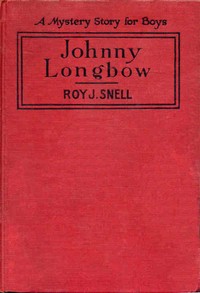
Johnny Longbow
by Roy J. Snell
Language: en389 downloads on Project Gutenberg
Subjects
Public-domain ebook sourced from Project Gutenberg #43230.
Public-domain ebook
by Roy J. Snell
Language: en389 downloads on Project Gutenberg
Subjects
Public-domain ebook sourced from Project Gutenberg #43230.
The opening · free to read
Johnny Thompson caught his breath as his feet shot from beneath him and he plunged into a rushing torrent of icy water. Thoughts flashed across his mind, mental pictures of homes and firesides. Echoes of laughter sounded in his ears.
Yet in this wilderness there was no laughter save the boisterous roar of an Arctic stream. There were no homes save those of the muskrat, the beaver and the white owl. The nearest cabin was fifty miles or more back. An all but impassable forest of scrub spruce, fir and pine lay between. There was time for but a flash back before Johnny found himself fighting for his life against the torrent that was dragging him over rocks and sunken logs, splashing, ducking, pulling at him and threatening every moment to make an end of him.
But Johnny Thompson was not one to be beaten at once by this rushing torrent of northern Canada. Swimming strongly, warding off overhanging branches here, dodging great protruding boulders there, he still watched for a gently shelving bank that might offer him so much as a moment’s rest. Since no such haven offered itself at once, he shot the rapids like a salmon.
A long, slender oiled canvas sack hung at his back. Twice this threatened to prove his undoing. It caught upon a tough willow branch and dragged him beneath the surface. Hardly had he freed himself than this same sack that apparently contained some stiff and stubborn affair of wood or steel caught in a rocky crevice to throw him high and wide. This involuntary pole vault left him with breath quite crushed out, but still struggling.
Suddenly, straight ahead, he caught sight of that which must prove his salvation or his undoing. Undermined by the torrent a green spruce tree lay squarely across his path.
Ten seconds to wonder. Would he be caught in the branches and drowned, or would he mount those same branches to freedom?
Sixty seconds of terrific battle and the splendid muscles of the boy won against relentless nature. Panting, triumphant, he sat astride the branches.
He was saved. There remained but to climb back to land. He was cold and wet. A roaring fire would remedy that. His blanket roll lay where he had tossed it on this side of the stream before he attempted to ford the treacherous tumult of water. The way back to his blankets would be rough going. He’d manage that.
But suddenly the smile on his face faded. His eyes had fallen upon the long sack that had hung at his back.
“Gone,” he muttered, “torn open by the same branch. And they’re gone, all gone but one.”
After adjusting the torn fastenings as best he could, he worked his way over the swaying tree trunk to solid earth. Then with sober face, he began making his way back over the rocks to the spot where his blanket roll lay. The situation was a serious one.
An hour later he sat before a roaring campfire of fir and balsam boughs. Dressed in a change of clothing and wrapped in a blanket, with his costume of an hour before sending clouds of steam toward the sky, he might have seemed the picture of contentment. He was far from contented. Presently he removed a small coffee pot from the fire and poured a cup of dark brown liquid. The aroma of coffee seemed good. He smiled. Then, without sugar or cream, he gulped it down black and hot. Nor did he eat after that. There was nothing to eat.
Had you chanced to look into his pack you would have found there neither firearms nor ammunition. The nearest cabin that he knew of in all that vast northern wilderness was fifty miles back over an ill-defined trail. That cabin was deserted. He had slept there four nights back.
So Johnny sat by the fire meditating, thinking on matters of greater or less importance. And as he meditated, at a point somewhat more than a mile downstream, as the crow flies, a figure appeared among the rocks that kept the rushing stream in tumult.
A girl in her late teens, she moved out from among dark pines into a patch of light. The touches of sunset, lighting up her dark brown hair and adding a touch of gold to her ruddy freckled cheeks, transformed her for the moment into a goddess of the forest.
Sensing the change, she stood motionless as a statue for a full moment. Then, into that glory of the sunset she smiled, and the smile made her seem more alive than any wild thing that had ever ventured to the brink of that tumultuous stream.
In her hand she held a rustic bucket. Its handle, a thong of caribou sinew, its bottom a circle of wood cut from some fallen spruce tree, its sides white birchbark, this bucket seemed a part of the wilderness.
As she stooped to fill the rustic bucket, her eyes caught sight of some unusual object bobbing up and down in the water.
One moment, a flash of red and gold, she saw it. The next it was lost in a rush of foam. In a twinkling the bucket was dropped among the rocks and she went racing downstream in hot pursuit.
A hundred yards, leaping from boulder to boulder, she plunged onward until, red-cheeked, panting, she came upon an eddy, a still dark pool, twenty feet across, and at its very center, moving serenely about, was the coveted prize.
With the aid of the slow current and a long dry pole, she succeeded at last in coaxing the thing ashore.
As she grasped it, a trio of bright feathers bound to a slender shaft came to view. She caught her breath again. And as she pricked her hand on the broad head sharp as a razor at the other end of the shaft, her face lost some of its heightened color.
Turning, she raced back to the spot where the crude bucket still rested. There, without pausing to complete her errand, she dashed up the slope to a spot where a tumbled-down cabin rested among the trees.
A man, very tall, very straight and quite old, a bearded patriarch, rose at her approach.
“Grandfather!” she exclaimed, almost in a whisper. “We must leave this cabin at once.”
The old man threw her a questioning look. For answer she held up the arrow she had found floating feather up in the stream.
Taking it from her, he examined it closely in the waning light.
“White man,” he pronounced at last, as if reading from a book. “Somewhat new at the game, but possessed of a considerable knowledge of the art. A very good arrow.
“We must go up,” he said after a moment of silence. “We will go up at once.”
They entered the cabin together. Some twenty minutes later, with well arranged packs on their backs, they emerged from the shadowy interior to go marching briskly down toward the banks of the rushing stream. There they began leaping from rock to rock. In this manner they traveled a considerable distance without leaving a single tell-tale footprint behind.
So they moved on into the twilight, a powerful old man and a short, sturdy girl, marched on into a wilderness that is acquainted only with the voice of the wolf, the caribou and the white owl.
Once as they paused for a moment’s rest beside a great flat rock, the girl removed some object from her pack and held it up to the uncertain light.
“It’s strange,” the old man rumbled. “An arrow, a well-shaped, well-constructed arrow with a death-dealing steel point! Had it been a shot gun shell, that would not have seemed strange. But an arrow!”
“But Grandfather, we——” The girl stroked a strong longbow that hung at her side.
“Yes, I know.” The old man’s smile was good to see. “But we are of a bygone race, at least I am. This is 1928. Except for such as we are, the bow and arrow are of the past. But see!” He started up. “It is getting dark.”
A few yards farther down the strange pair left the stream’s bank to go clambering up a rocky run. Even here they avoided snow. And so, marching sturdily forward, they faded into the gathering darkness and deep shadows of pines.
You have perhaps guessed that the arrow found bobbing its way downstream came from Johnny Thompson’s quiver. In fact at the very moment when the old man and the girl left the cabin, he was engaged in the task of oiling two stout bows and waxing their strings. Having done this, he looked sorrowfully at the single broadhead arrow that remained in his quiver, took one more long gulp of hot black coffee, then set to wondering what lay before him.
To be facing a wilderness alone with bows and arrows as one’s sole means of securing food might seem bad enough. To have but one arrow; what could be worse? A missed shot, a shattering rattle against the rocks, and this arrow might be gone forever.
And then? Blunt arrows, sent crashing into the side of resting rabbit or sleeping ptarmigan would be as deadly as spear point when fired from Johnny’s sixty-pound bow. There was wood all about for shafts. But what of feathers and weights for the tips? One might come upon a sleeping owl. Here would be feathers.
“And yet,” he told himself, “I have not seen a living thing for three days. The country is deserted. But no, not quite. There was the caribou track.”
The book keeps going
Reading is free forever. Sign up and watch scenes appear while you read.



Scenes Storieta drew for other classics.
New illustrated classics
Once or twice a month: the latest books to get full character casts, scene art, and free comic editions. No account needed.