Public-domain ebook
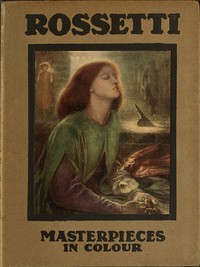
Rossetti
Language: en498 downloads on Project Gutenberg
Subjects
In: Masterpieces in Colour·Biographies·British Literature
Public-domain ebook sourced from Project Gutenberg #43347.
Public-domain ebook
Language: en498 downloads on Project Gutenberg
Subjects
In: Masterpieces in Colour·Biographies·British Literature
Public-domain ebook sourced from Project Gutenberg #43347.
The opening · free to read
About the middle of the nineteenth century Europe woke to the fact that Art, despite its pretention, had lost all touch with tradition and, like a blind man deprived of his staff, stood fumbling for direction. The necessary "point d'appui" took shape in a return to nature. This return was effected by very different means according to the country and artistic milieu in which it occurred. In England it was really a revival of the schools of painting that preceded Raphael and resulted in grafting the complicated passions of our century upon the naïve outlook of the early Italians. The more logical mind of the Frenchman saw that it was not enough to look at nature through the eyes of the Primitives. The point of view had perforce changed and all that it was necessary to borrow from the early schools was the sincerity they brought to the interpretation of phenomena.
We have been told that, in contrast to the continental movement, the realism of the Pre-Raphaelites was applied only to noble subjects. But what is a noble subject? The distinction is a purely literary one. There are no noble subjects in art; there are only harmonies of line and colour. For example this school would prefer the rose to the cabbage as a subject, on account of the symbols attached to it. It is the Queen of Flowers, the Mystic Rose, &c., &c. But is the rose greater than the cabbage from a purely pictorial point of view? It depends entirely upon how far the painter is able to reveal the beauty, the harmony of form and colour of either. The symbolistic appanage of the rose will not suffice of itself to make a picture, nor for the lack of these symbols may we condemn the cabbage.
The realism of the Pre-Raphaelites developed an absorption in detail, a "bit by bit" painting that was too often detrimental to the whole. In the best works of the early Italians the unity is, in spite of that attention to detail, admirably maintained--in other words the values are preserved. It was not long, however, before Rossetti quitted the path of the Pre-Raphaelites for a broader one. His paintings are entirely symbolistic, therefore literary. Given the personality of an artist equally gifted as painter and poet, this need not surprise us. Indeed, seeing that Rossetti's pictorial conceptions are exclusively literary, he might be considered as more dominantly a writer than a painter; and this is the light in which he saw himself. We might say he painted "sentiments" and add that sentiment is the property of literature, but in Rossetti's case they have at least the advantage of intensity. They come straight from life, for all his art is more or less connected with the tragedy of his own existence. Herein lies the value of Rossetti's works as artistic creations.
Rossetti's family, as his name indicates, was of Italian origin. His ancestors on his father's side belong to Vasto d'Ammone, a small city of the Abruzzi. The original name of the family was Della Guardia. Probably the diminutive Rossetti was given to some red-haired ancestor and retained in spite of the disappearance of that peculiarity. The grandfather of the poet, Dominico Rossetti, was in the iron trade, his son Gabriel Rossetti, born at Vasto, became a custodian of the Bourbon Museum at Naples. He was an ardent patriot and one of the group of reformers who obtained a constitution from Ferdinand, King of the Two Sicilies, in 1820. The return of the King with the Austrian army obliged Gabriel Rossetti, who was compromised by his actions as well as by his patriotic songs, to make his escape from Italy. He did this by the help of the English admiral, commanding the fleet in the bay. Indeed he left Italy disguised in an English uniform.
From the oil painting (28½ in. by 17 in.) painted in 1850 and is now in the Tate Gallery
This picture was first exhibited in 1850 at the "Free Exhibition" in Portland Place. It was very slightly retouched in 1873 for the then owner, Mr. Graham. It is rightly considered the most typical of Rossetti's "Pre-Raphaelite" period.]
After passing three years in Malta (1822-1825), he came to England bearing introductions from John Hookham Frere, then Governor of Malta. A year after his arrival he married Frances Mary Livinia Polidori, whose mother was an English lady of the name of Pierce, while her father was Gaetano Polidori, the translator of Milton. Gabriel Rossetti was appointed Professor of Italian literature at King's College in 1831; but owing to the failure of his eyesight he had to resign that position in 1845. He died nine years after, on April 26th, 1854. He is the author of several works, the best known in England are: Comento analitico sulla Divina Commedia (1826-1827); Sullo Spirito Anti-Papale (1832); and Il Mistero dell' Amor Platonic (1840). In Italy, particularly in his own province, his name is held in veneration for services in the cause of liberty. He had four children, the eldest, Maria Francesca, the author of "A Shadow of Dante," died in 1876. Dante Gabriel was the second and was born the 12th of May 1828 at 38 Charlotte Street, Great Portland Place, London. William Michael was the third, and Christina was the youngest.
Very little is known of the early life of Rossetti. He received some instruction at a private school in Foley Street, Portland Place, studying there from the autumn of 1836 to the summer of 1837. He was afterwards sent to King's College School. There he learned Latin, French, and a little Greek. Naturally enough he knew Italian very well from home and also a little German. In his home surroundings the young child's taste for literature was developed very early; at five years old he wrote a drama called "The Slave." Towards his thirteenth year he began a romantic tale in prose, "Roderick and Rosalba." Somewhere about 1843 he wrote a legendary tale entitled "Sir Hugh Le Heron," founded on a tale by Allan Cunningham. His grandfather Gaetano Polidori printed it himself for private circulation, but the work contains no sign of his ultimate development and has been justly omitted from his collected works. Soon the wish to be a painter took possession of Dante Gabriel and, on leaving school, he began his technical education in art at Cary's Academy in Bloomsbury. In 1846 he joined the classes of the Antique School of the Royal Academy. It is worth pointing out that he never followed the Life School of that institution. Conventional methods of study were distasteful to him. He decided to throw up the Academy training and wrote to a painter, not very well known at that date but whose work he admired, asking to be admitted to his studio as a pupil. The painter was Madox Brown, and young Rossetti, given his needs and mode of thought, could not have chosen a more suitable master. Madox Brown was only seven years older than Rossetti, but he had studied at Ghent, Antwerp, Paris, and Rome. He had exhibited some fine cartoons during the early forties for the decoration of the House of Lords. Among these was one that Rossetti had greatly admired at the exhibition of the competitive cartoons in Westminster Hall. It was "Harold's body brought before William the Conqueror." In March 1848 Rossetti entered upon his new experience and Madox Brown agreed to teach him painting, not for a fee but for the mere pleasure of meeting and training a sympathetic spirit. Rossetti did not long remain a regular attendant in the studio. He left after a few months.
On the opening day of the exhibition (May 1848), "Rossetti," says Mr. Hunt, "came up boisterously and in loud tongue made me feel very confused by declaring that mine was the best picture of the year. The fact that it was from Keats ('The Eve of St. Agnes') made him extra enthusiastic, for, I think, no painter had ever before painted from that wonderful poet, who then, it may scarcely be credited, was little known." Rossetti wished so earnestly to become more intimate with Hunt that he agreed to work with him, sharing a studio that the latter had just taken in Cleveland Street, Fitzroy Square. Here he began to paint his first composition, having hitherto done no more than studies, sketches, a number of portraits, some of which reveal excellent work. At this time his literary development was somewhat ahead of his artistic growth. He had already translated the Vita Nuova which is alone a monumental achievement, introducing wonderfully into the English the warmth of the southern language; and he had written some of his best known poems, including "The Blessed Damozel," "My Sister's Sleep," "The Portrait," a considerable portion of "Ave," "A last Confession," and the "Bride's Prelude."
Millais and Holman Hunt, whose friendship dated from the Academy Schools, found ground for sympathetic union with Rossetti in their common distaste for contemporary art. They were convinced it was necessary to abandon the conventional style of the day and return to a severe and conscientious study of nature. They were for a while uncertain as to the path to pursue. Where should they turn for precept and guidance on the line of their new-found principles? Looking through a book of engravings from the Campo Santo of Pisa one day at Millais' house, they thought they had found there the direction they sought. Mr. Holman Hunt tells us that the foundation of the Pre-Raphaelite Brotherhood was the immediate result of coming across the book at that particular time.
While Holman Hunt was painting "Rienzi swearing revenge over his brother's corpse," and Millais, "Lorenzo and Isabella," Rossetti began his "Girlhood of Mary Virgin." As can well be imagined that first composition gave him endless trouble and was the cause of the most violent fits of alternate depression and energy. But the following spring (1849), the three pictures were ready for exhibition. Millais and Hunt were hung in the Royal Academy Exhibition and Rossetti's in the so-called Free Exhibition, which was held in a gallery at Hyde Park Corner. In the "Girlhood of Mary Virgin," he represents a room in the Virgin's home with a balcony on which her father, St. Joachim, is seen tending a vine which grows up towards the top of the picture. On the right, against a dark green curtain, are the figures of St. Anna and the Virgin sitting at an embroidery frame. The mother, in dark green and brown garments with a dull red head-dress, is watching with clasped hands the work in front of her. The young girl, a quite unconventional Madonna dressed in grey, pauses with a needle in her hand gazing in front of her at a child angel holding a white lily. Underneath the pot in which the white lily grows are six big books bearing the names of the six cardinal virtues. The figures, as well as the dove which is perched on the trellis, bear halos, their names being inscribed within. Rossetti painted his mother for St. Anna and his sister Christina for the Virgin. Changing her dark brown hair to golden, he broke a rule of the Brotherhood, which decrees that the artist shall copy his model most scrupulously. The picture was signed with his name, followed by the three letters P.R.B. Rossetti having revealed the meaning of these three letters to a friend it was soon generally known and no peace was given to those who dared to stand up against traditional authority. It is necessary to explain that, at that time, Raphael was considered the greatest of all painters. All who came before him were ignored and a set of fixed rules supposed to have been deduced from his work was taught in all the schools. The revolt of the "Brethren" was directed much more against those rules than against Raphael's work which, in all probability, they hardly knew.
The book keeps going
Reading is free forever. Sign up and watch scenes appear while you read.



Scenes Storieta drew for other classics.
New illustrated classics
Once or twice a month: the latest books to get full character casts, scene art, and free comic editions. No account needed.