It was shortly after his reaching Philadelphia that Lafayette met Washington for the first time. "Though surrounded by officers and citizens," writes the young Frenchman, "his majestic face and form could not be mistaken, while his kind and noble manners were not less unmistakable." The veteran commander and the boyish lover of liberty and adventure were instantly drawn to each other. Washington invited Lafayette to join him at a review of the American army--"eleven thousand men, only fairly armed, and worse clothed, their best clothing the gray hunting shirts of the Carolinas." "We can not but feel a little abashed," remarked Washington, "in the presence of an officer who comes to us from the army of France."
"It is to learn, not to teach, that I am here," was the modest reply. "This way of talking," adds Lafayette, "made a good impression, for it was not common among the Europeans."
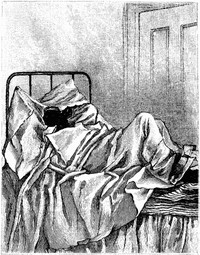
On the 11th of September, 1777, Lafayette saw his first battle. The English had landed at the Capes of the Delaware, and marched on Philadelphia. Washington was deceived by bad scouts, and before he knew it the British had got past his army; and though the Americans fought bravely, they were obliged to give way. In trying to rally them, Lafayette was badly wounded by a musket-ball in the leg. For some time, in his zeal, he did not notice the wound, until an aide-de-camp saw the blood, which had filled his boot, and was running over the top. Hastily dismounting to have the wound bandaged, Lafayette instantly took to his saddle again; and it was only at midnight, a dozen miles from the battle-field, and when a stand had at last been made, that he consented to give up and be properly cared for. For six weeks he was kept in bed; and it was not until the latter part of November that he again entered active service, which he did before his wound was fully healed. On the 25th of that month, at the head of three hundred and fifty men, he was making a "reconnoissance," i. e., trying to find where the enemy were, and how many there were of them, when he suddenly came upon the British advance guard, strongly placed, with cannon. With a daring joined with prudence which was very rare in one so young, he attacked the enemy with such spirit that they thought he must have a large force with him, and retreated. Lafayette, who knew he might soon be surrounded with his little band, withdrew rapidly to a place of safety. "My experiment would have cost me dear," he writes, "if those who might have destroyed me had not counted too much on those who ought to have captured me." The British General was Lord Cornwallis, who then took the first of many lessons which Lafayette, "the boy," as he called him, was to teach him in the art of war.
This little fight had quite important results. It gave Washington time to get his army safely back into the country, and to take up quarters for the winter at Valley Forge. Congress was greatly pleased, and passed a vote asking Washington to give Lafayette command of a division, which was done. Scarcely turned twenty, the young soldier found himself at the head of a body of picked men, mostly Virginians, whom he tried hard to make the flower of the army in activity, discipline, and courage. He shared all the hardships and miseries of the terrible winter at Valley Forge, where the army underwent untold sufferings. From 18,000 men it was reduced to 5000.
The British lay well housed and idle in Philadelphia. There was no fighting going on, and the country simply forgot and neglected its gallant soldiers. These were camped in a wooded hollow among the hills, and during that winter deeper snow than had been seen for many years buried the country.
Lafayette writes that "in his night visits about the camp" he found the sentinels with bare feet frozen at their posts, and men without coats, often without shirts, huddled on beds of branches about the camp fires, unable, from hunger and cold, to sleep. For days together one scant meal a man was all that could be had. In the midst of such suffering the noble boy lived as his men did, fasting as they fasted, and denying himself everything. "Ill at ease" as he had been "among the pleasures of a Paris festival," he was at home on that cold hill-side, and attracted universal admiration by his simple self-denial, his cheerful and constant devotion.
Meanwhile Congress was divided into two quarrelsome parties; and while it had not time to attend to Washington's earnest prayers for relief for his starving army, it found plenty of time to plan to put another General over his head, and to try to carry on the war without him. To aid in this mad scheme they sought to win Lafayette by offering him a separate command of an army that was to march into Canada.
Faithful in his duty to his commander and his friends, Lafayette refused to take the place unless he could receive all his orders direct from Washington. This could not be refused, but it cooled the zeal of Congress, and when Lafayette arrived at Albany, where he was to have found men and means for the invasion of Canada, he found neither one nor the other. Seeing that it was too late to wait long for them, he promptly gave up the plan. He took a long journey northward to try to make friends with the Indians, whom he managed with great skill, and then came back to camp with Washington. He was very glad to rejoin his beloved General, who immediately gave him command of his old division, and sent him out, as he had done in the fall, to get news of the enemy.
Clinton, the English commander, learned of the movement, and resolved to capture the daring "youngster." Lafayette had only 2000 men and no cannon; Clinton sent out 7000 with fourteen cannon after him. Some militia placed to guard a road that led around Lafayette's little army fled when the enemy came up, and before he knew it Lafayette was surrounded. Clinton, delighted with the prospect, sent an invitation to his lady friends in Philadelphia to meet Lafayette at supper that evening, so sure was he of capturing him; and the Admiral of the fleet was directed to set apart a vessel to take the prisoner to England. But they were reckoning without their host. Lafayette never lost his cool head for a moment. Arranging his men in the woods so as to make them seem many more than they were, he marched with such order that the English were deceived, and feared to attack him, and while they hesitated he got his men out of the trap into which they had fallen, and returned to the main camp.
Before the winter-quarters were broken up, and the fighting for the summer of 1778 began, Lafayette had the great joy of announcing to the American army that the King of France was going to send a fleet and an army to aid the United States. Then, for the first time, he felt sure of final victory. He was immensely pleased to think that he was going to be able to fight side by side with his own countrymen on American soil for American liberty. It was largely his own wisdom and zeal that had brought about this result, for young as he was, he already showed himself a far-sighted statesman, as well as a brave, skillful, and prudent soldier.
Although he had been less than a year in the country, he had endeared himself to all hearts, and had especially won the entire confidence of General Washington.
[TO BE CONTINUED.]
STAMP COLLECTING.
BY J. J. CASEY.
I have no doubt that many of the readers of YOUNG PEOPLE are stamp collectors, and that many more are ready to become stamp collectors if they are started properly. Little difficulty is experienced at the present day in getting a good assortment of stamps, because the great spread of the postal system, and the resulting increase of correspondence, bring the stamps of every foreign country into the business houses of New York. But the main difficulty is so to manage with the stamps as to make them more than a plaything for a few weeks--to make them really instructive, and their possessors real Philatelists.
The materials requisite for the beginner are very few--a blank book, some sheets of very thin writing-paper, and a small bottle of pure gum-arabic dissolved in water and made thin. Of course, when the collection increases and begins to assume form, this blank book must give way to a special album; but in the beginning a small book, worth, say, four or five cents, will suffice. Thus provided, you are ready to begin your collection.
Every reader of YOUNG PEOPLE has friends who have a correspondence more or less extensive, and whose desks are, therefore, store-houses of postage stamps. Requests for these stamps will seldom be denied, and in a very little while the beginner will have enough to make a start. Look over the specimens, pick out those that are the cleanest, and put aside as useless those that are torn or much defaced. Remove any superfluous paper from the back of the stamps selected for use by carefully touching the backs with warm water, when the adhering paper can easily be peeled off. Then cut the sheets of thin writing-paper into strips half an inch wide, gum along one edge of the strips, and lay the stamps on the gummed edge as in Fig. 1. Next cut the strips and trim the paper as in Fig. 2. Now fold this little strip of paper backward, so as to make a hinge, and fasten it to the blank page by a touch of gum. This is called mounting the stamp.
Now you may ask why all this labor, all this patience, with a lot of common stamps. Simply this: this system has been adopted by all Philatelists, but only after many trials, and the destruction of many fine specimens; and it is well, therefore, to be guided by the experience of others. Again, the collection will increase in interest, which could not be the case if no pains were taken in the mounting, and it will increase in size. You will, of course, desire to transfer the stamps to a more pretentious and permanent album. A little moisture will loosen the strip from the first book, when it can be placed in the new book without damage. Even when here you may wish to replace it by a better specimen without injury to the book. Another plan is to mount the stamps on thin card-board a trifle larger than the stamp, gum a square of paper to the back of the card, and a touch of gum to the centre will fasten it to the page.
But why hinge the stamp? Simply to enable you to write under it the date of issue, its cost, and certain other matters connected with the stamp itself, so that you may have at hand the few facts necessary to be known--all of which is necessary if you wish to be a true Philatelist.
Another point to which particular attention is directed: do not cut the stamps close up to the printed designs; if perforated, do not cut off the perforations. Aside from destroying the appearance of the stamps, you also destroy their value for collectors. Not long since a very large collection of stamps was sold by auction. Hundreds and hundreds of dollars must have been spent in purchasing the specimens, among which were numbers of all rarities. The owner had trimmed and trimmed his specimens, cutting away everything up to the printed design. The collection went for a mere song, in comparison to what it would have brought if the scissors had been left alone. No true collector fancies a mutilated specimen.